Category Archives: Botany

Cacti of the Bodie Hills

The cacti of the Bodie Hills are not difficult to master. There are only two of them: a Prickly-pear and a club-cholla. Opuntia polyacantha and Grusonia pulchella are both in subfamily Opuntioideae, and Grusonia was formerly included in the mega-genus Opuntia. That large and diverse genus is now treated in Flora North America and the Jepson eFlora as several separate genera. This isn’t just fine-grained splitting; Opuntia is still large, and the other smaller genera are easily distinguished in the field based on the shape of stem segments, overall growth form, and the presence or absence of spine sheaths. All Opuntioid cacti are armed with two kinds of spines: large, smooth, fixed spines and small, hairlike prickles called glochids, that will easily (and painfully) detach from the plant and penetrate your skin.

Key to Cactaceae in the Bodie Hills
1. Stem segments bilaterally flattened, circular, ovate, or obovate; flowers yellow to greenish-yellow;
throughout the Bodie Hills. . . .  Opuntia polyacantha
1’ Stem segments cylindric to ± spheric; flowers rose to purple;
north and east foothills of the Bodie Hills. . . .  Grusonia pulchella

Opuntia polyacantha

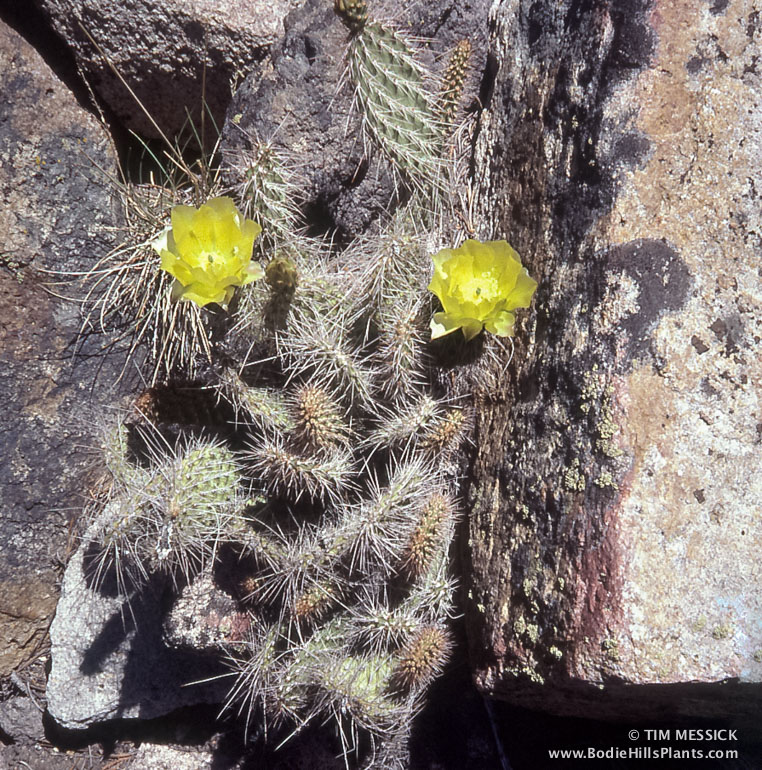
Opuntia polyacantha (above) is a prickly-pear cactus densely clothed in long spines. Common names include Grizzly bear prickly-pear, Mojave prickly-pear, and Plains prickly-pear, and (probably in Texas and Oklahoma) Panhandle prickly-pear. In the Bodie Hills, it’s fairly common on rocky outcrops, talus slopes, and occasionally among sagebrush. The plants are usually widely scattered, never numerous in one location.

This is a very widespread species (in virtually all of the western U.S. and Canada, plus scattered counties as far east as Missouri). There are several varieties. O. p. var. erinacea is the one commonly encountered throughout the Bodie Hills and across the Great Basin, Colorado Plateau, and Mojave Desert. One collection in 1945 (UC733179: Roxana S. Ferris and Laura Lorraine, 11027) from the New York Hill area—part of Masonic Mountain—was identified as O. p. var. hystricina. This could be accurate, but ought to be checked in the field. Var. hystricina (“Porcupine prickly-pear“) occurs mostly in southern Utah and nearby areas of adjoining states.

Grusonia pulchella

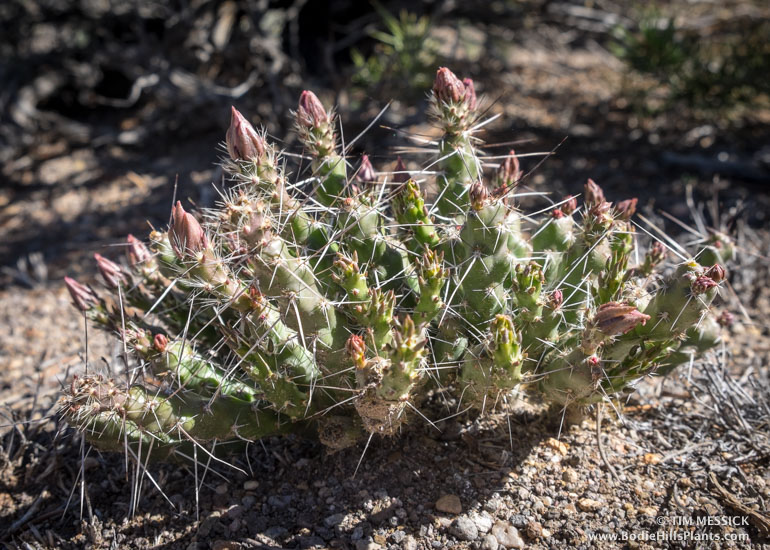
Grusonia pulchella (above) is a club-cholla that also has long spines, but generally less dense than in the Opuntia. Common names include Beautiful club-cholla and Sagebruch cholla. This plant “differs from other North American Opuntioid cacti in having a geophytic habit, where above-ground growth dies back to the crown in adverse conditions, and resprouts under more favorable conditions.” Here are some other photos of it, in flower.

Grusonia pulchella is found through much of the Great Basin, mostly in Nevada and Western Utah. In California it is recorded only from Deep Springs Valley in Inyo County. In the Bodie Hills, all occurrences are probably in Nevada.


Copyright © Tim Messick 2015. All rights reserved.
Lichens of the Bodie Hills (1)

You can’t wander far in the Bodie Hills without noticing some of the colorful lichens growing on rocks throughout the area. Look closer, and you will see a wide variety of shapes and colors, including some that are inconspicuous at first glance. Nearly all of the lichens in the Bodie Hills are saxicolous (they grow on rocks).

These are some of the lichens found in the Chemung Mine area on the north side of Masonic Mountain—a place where both the flowering and non-flowering floras seem particularly diverse and colorful.

TCM-23477-lichen

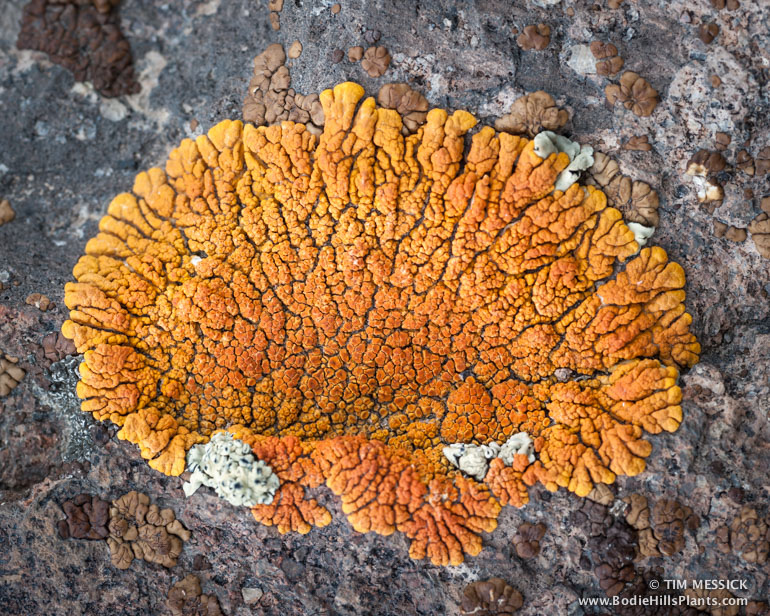
Gold cobblestone lichen, Pleopsidium flavum.

Acarospora rosulata

A brown cobblestone lichen, Acarospora (probably) rosulata.

TCM-23511-lichen

Desert firedot lichen, Caloplaca elegans

TCM-23514-lichen

Green rock-posy, Rhizoplaca melanophthalma, is one of the most abundant
and widespread lichens in the Bodie Hills.

Rhizoplaca spp.

Two kinds of “rock-posy”: Rhizoplaca melanophthalma (left)
and Rhizoplaca chrysoleuca (right).

Lecanora garovaglii

Sagebrush Rim-lichen, Lecanora garovaglii (I think).
TCM-23469-lichen

A rock tripe, Umbilicaria polaris.

Lichen identification gets fairly technical, involving color tests using various chemicals, and microscopic examination of the spores. But a couple of lavishly illustrated books are now available to help the non-specialist identify many lichens from photographs, macroscopic features, and descriptions:

Lichens of North America, by Irwin Brodo, Sylvia Sharnoff, and Stephen Sharnoff. Yale University Press, 2001. (links: Yale U. P. and Amazon)

A Field Guide to California Lichens, by Stephen Sharnoff. Yale University Press, 2014. (links: Yale U. P. and Amazon)

Other good visual resources include Stephen Sharnoff’s on-line lichen gallery and the lichen groups on Flickr, including Lichen Communities of North America, and Lichen.


© Tim Messick 2015. All rights reserved.
Pines of the Bodie Hills

Four pine species are found in the Bodie Hills, but only only one is abundant. The other three occur in small areas of locally favorable habitat, hangers-on from a time centuries ago when the climate was wetter and cooler than now.

Single-leaf pinyon pine

Single-leaf pinyon pine

Single leaf pinyon (or piñon) (Pinus monophylla) is the abundant one. It’s common at low to mid elevations in the range, mostly below 8,200–8,400 feet, and occasionally up to 9,000 feet. Pinyon-juniper woodlands, typically with varying amounts of pinyon and Utah juniper (Juniperus osteosperma) growing together, are common in a belt all the way around the range. Single leaf pinyon is common throughout much of the Great Basin, and it’s the tree for which the Pine Grove Hills (just north of the Bodie Hills) and the Pine Nut Mountains (east of Carson City) are named. The seeds of these beautiful trees were a staple food of indigenous peoples wherever pinyons grow, and are still harvested by today’s native Americans. Pinyon jays and other wildlife depend on these seeds for their survival.

From low elevations to high, the three less common pines are:

Pinus jeffreyi

Jeffrey pine

Jeffrey pine (Pinus jeffreyi) is abundant on the east side of the Sierra Nevada, especially between Mono Lake and Mammoth. In the Bodie Hills, it occurs in about two dozen very small stands in three areas: (1) the west-central Bodie Hills, mostly in and near Hot Springs Canyon, (2) the far north end of the Bodie Hills, with the largest stand in the Mineral County segment of lower Masonic Gulch, and (3) on the south side of east Brawley Peak. All of these stands are on or near soils derived from hydrothermally altered andesite (i.e., areas of ancient hot spring activity). These soils are lighter in color and more sparsely vegetated than adjacent soils, which are darker and often densely vegetated with sagebrush and pinyon pine.  The hydrothermally altered soils have lower pH, less calcium, and less phosphorus. This and the lack competing vegetation may enable Jeffrey pine to tolerate lower annual precipitation than where Jeffrey pines normally grow (Source: DeLucia et al. 1988. Water relations and the maintenance of Sierran conifers on hydrothermally altered rock. Ecology. 69(2): 303-311.)

Pinus contorta

Lodgepole pine

Lodgepole pine (Pinus contorta) is common throughout the Sierra Nevada and many other western mountain ranges. In the Bodie Hills it locally abundant at just one location: an unnamed canyon on the north side of East Brawley Peak than meets Bodie Creek (in Del Monte Canyon) about 1.7 driving miles northeast of the state line. (If you know a name for this canyon, please let me know!) The stand extends, almost continuously, from an elevation of 7,130 feet up to above 8,100 feet, almost to where the limber pines begin. A few other very small stands and even some isolated individuals can be found on north-facing slopes where snow melts late in the mid-portion of the range.

Pinus flexilis

Limber pine

Limber pine (Pinus flexilis) is common in the high Sierra Nevada on rocky ridges and scree slopes at treeline. In the Bodie Hills, however, limber pine is restricted to small populations on north-facing slopes on some of the highest summits in the range. The largest stand is on East Brawley Peak, extending from the summit, at 9,420 feet, down the north side to about 8,600 ft. Parts of this stand burned in the Spring Peak Fire of August, 2013. Two other stands are on Mt. Hicks and another summit just south of Mt. Hicks. A few scattered individuals survive on Bodie Mountain, at the edges of what in “normal” years should be a long-lasting snow bank on the north side of the summit. There may be another very small stand on a ridge north of Potato Peak—or they might be lodgepoles—either way, this site needs to be checked in the field.