Tag Archives: Maps

Mapping Monitor Pass

This is one of those posts about a place somewhat “beyond” the Bodie Hills. But there is a connection: when traveling to the Bodie Hills, I often travel across Monitor Pass, on State Route 89 in Alpine County, east of Markleeville. It’s a wonderfully scenic and botanically interesting area — one of my favorite places along the route to Mono County. Earlier this year I started making a map of the Monitor Pass area (during some spare hours at the office) as a way of getting to know the area better.

Monitor Pass and Vicinity, from Markleeville to Topaz (click to enlarge, back to return):

Monitor Pass and Vicinity

But then the Washington Fire happened. According to InciWeb, the fire incident information system, it was ignited by lightning sometime in early June, but remained small and undetected until June 19, 2015. Between then and the first week of July, nearly 17,800 acres of pine forest and sagebrush scrub burned in the East Fork Carson River watershed between Markleeville and Monitor Pass. Nearly 1200 personnel worked hard to bring the fire under control. They prevented damage to the small city of Markleeville and many nearby recreational sites. Remarkably, they got the  Monitor Pass and Ebbetts Pass roads open and safe to use in time for the annual “Death Ride” on July 11 — a grueling, high-profile, high-altitude cycling event with 5 mountain pass ascents over a course of 129 miles.

So my map of a favorite driving route turned into a fire history map of the Monitor Pass area. I downloaded the final perimeter of the Washington Fire (a KML file available from InciWeb). Then I found a statewide fire history geodatabase from the California Fire and Resource Assessment Program (FRAP) that maps incidents as far back as 1878, though the earliest fire mapped in the Monitor Pass area is 1941.

Fire history map of the Monitor Pass area (click to enlarge, back to return):

Monitor Pass Area Fire History

Fires have very long-lasting effects in this region of steep, arid topography. Pines, junipers, sagebrush and other large woody shrubs take many decades to recover even to a fraction of the cover that was present before a large fire. Areas that burned east of Monitor Pass in 2004 still have little woody vegetation. Areas that burned in the ’70s, ’80s, and ’90s are still clearly visible from the air, in Google Earth, or on the ground. Vegetative biomass and the wildlife habitat it provides takes a very long time to recover.
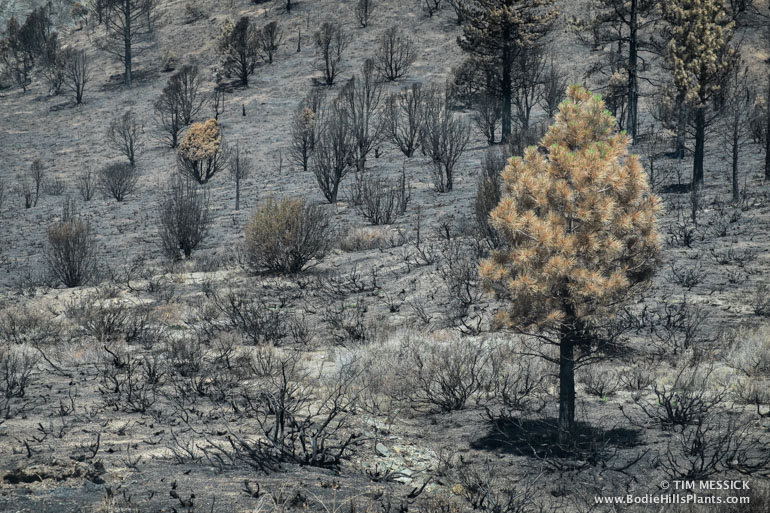
Washington Fire

Washington Fire burn area, near Heenan Lake, 7/12/2015
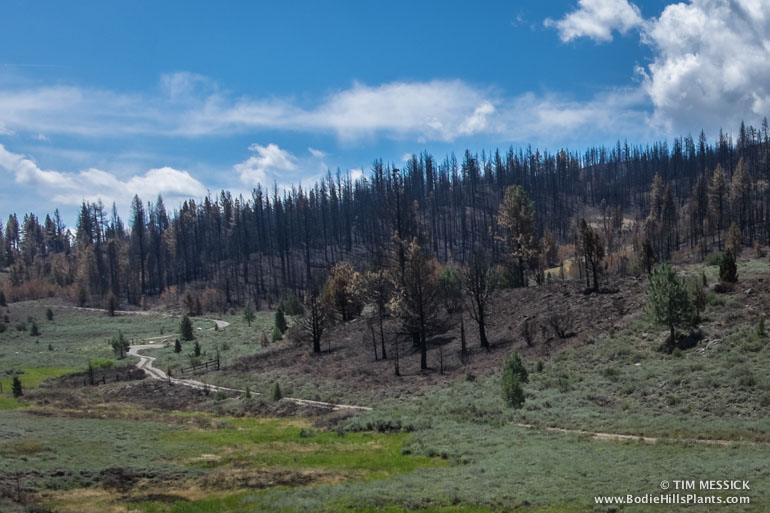
Washington Fire

Washington Fire perimeter, near Heenan Lake, 7/12/2015

The maps were compiled in Adobe Illustrator with the Avenza MAPublisher plug-in from GIS data available on the internet. The shaded relief background was created in Adobe Photoshop with the Avenza Geographic Imager plug-in and digital elevation data available from USGS.

MarkleevilleAfter the fire, in Markleeville


Copyright © Tim Messick 2015. All rights reserved.
How Straight was the Green Creek Power Line?

One of the popular myths about Bodie—because it makes a great story—is that the Green Creek power line, built in 1892 to run equipment in the Standard Mill, was an absolutely straight line. The reason, supposedly, was that its builders were concerned the electricity might jump off the wires and get lost if the line was not straight. Fun story, but it doesn’t hold up to close scrutiny. Yet the facts, if scrutinized, are still interesting.

The Map

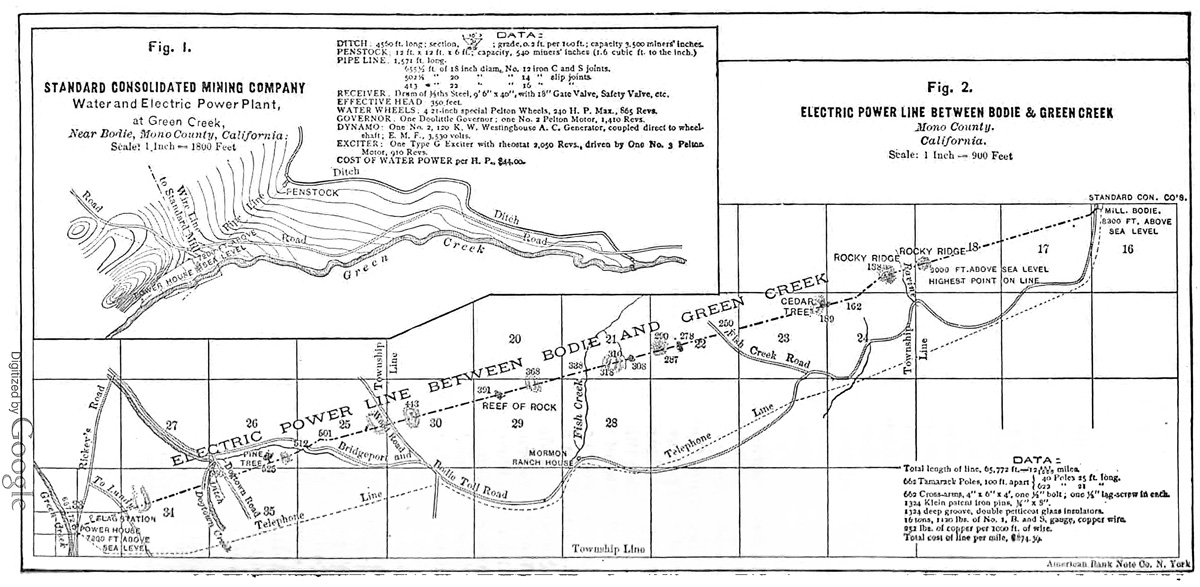
A map of the power line appears in an article titled “Electric Power Transmission Plants and the Use of Electricity in Mining Operations,” by “Thomas Haight Leggett, of Bodie, Mono County, California.” This article was published on pages 413—455 of the Twelfth Report of the State Mineralogist (Second Biennial,) Two Years Ending September 15, 1894, by the California State Mining Bureau, J. J. Crawford, State Mineralogist. [Google Books link]

The map is not very detailed—it shows the power line, selected pole numbers, section lines, roads, creeks, a few summits, and a telephone line to Bodie.

Green Creek Power Line map

The power line itself appears to have been mapped with some precision with respect to section boundaries. If you overlay the 1894 map on the 1909 US Geological Survey topographic map and register the two along the section boundaries (see below), the alignment and selected topographic features appear consistent with the 1909 topography. But the roads and creeks on the 1894 map are at best rough approximations of where topographic maps show them. The makers of the 1894 map were surveying the power line, not the roads or creeks, and had no aerial photographs for context.

1909 topo map with Green Creek Power Line

Was it straight? That depends on how you look at it. In plan view (map view), it was very nearly straight. This makes good sense, regardless of any concerns about losing power at bends or corners, because the straightest line is the shortest line, which is also probably the least expensive line to build and the quickest line to finish. According to the 1894 map, there were two or three slight bends where the line ran through the shallow canyon of lower Clearwater Creek. There were two more slight bends as it crossed a ridge and steep slopes north of Murphy Spring. Although not shown on the map, or maybe not visible at the scale of this map, I expect there was another bend or two as the line approached Bodie. If not, the line would have run directly through the IOOF Hall and Dechambeau Hotel—not likely, I think.

In profile view, the power line was much less straight. It crossed about a dozen substantial gullies or creeks, with about as many sizable hills and ridges in between. Some had steep slopes exceeding 40 percent. If you trace the approximate alignment from the 1894 map onto Google Earth, you can view its profile (below). The horizontal scale is greatly compressed, which accentuates the slopes and angles, but it’s hardly a straight line.

Green Creek Power Line profile

So were the builders of the Green Creek Power Line really concerned about losing  their electricity at bends in the wire? Electricity began lighting cities in the 1880s, but the distance of those electric transmissions was short. In the early 1890s, longer-distance transmission of power was new, and at first experimental. Leggett quotes a Mr. Chas. F. Scott from a letter, “The transmission of 100 horse-power a distance of 109 miles, from Frankfort to Lauffen, Germany, in 1891, showed conclusively that from an engineering standpoint, at least, the transmission of power over long distances by electricity was perfectly practicable…. Since then, however, plants have been installed both in Europe and in the United States, and are to-day successfully transmitting electricity for lighting and power purposes over distances ranging from 1 to 30 miles.”

When electricity came to Bodie in November 1892, long-distance transmission had been proven, but experience was limited. The project at Bodie had its skeptics and Leggett, who built the Green Creek Power Line, was of course a strong proponent. There was great excitement and relief when the first electricity arrived and set the motors spinning, but I doubt the engineers were too concerned that it wouldn’t work.

The Poles

Lodgepole pines

Lodgepole pines. a.k.a, formerly, “tamarack”

Leggett further describes the Green Creek Power Line as follows:

“The length of the line is 67,760 ft., or 12.46 miles. The poles are of round tamarack timber, 21 ft. long, 6 in. in diameter at the top, set 4 ft. in the ground; poles 25 ft. long being used through the town, and along the line wherever there is danger of deep snowdrifts. They are placed 100 ft. apart, and fitted each with a 4 by 6 in. cross-arm, boxed into the pole, and held by one bolt and one lag-screw.

“The line crosses extremely rough country, not 500 yds. of which is level beyond the town limits. Most of the ground is very rocky, over 500 lbs. of dynamite being used in blasting the pole-holes.”

“Tamarack” has been used over the years to refer to a few different kinds of trees. Among plant people, “tamarack,” or “tamarack larch,” now usually refers to Larix laricina, a deciduous conifer native from the northeastern United States across much of Canada to Alaska. The nearest native stand is over 800 miles from Bodie. In the past, the tree we now commonly call lodgepole pine (Pinus contorta) was sometimes called “tamarack pine,” or just “tamarack.” Lodgepole pine has a growth form well suited to electrical poles, and is abundant on the east side of the Sierra Nevada, not far from Bodie.


© Tim Messick 2015. All rights reserved.

Where is Millersville?

While researching old collections of plants in the Bodie Hills (using Calflora and the Jepson eFlora), I’ve run across two collections that were made “northeast of Millersville.” These include specimens of Salix geyeriana (Geyer’s willow) and Polygala intermontana (Great basin milkwort), collected by G. A. Graham in August–September, 1937. (See CalPhotos for pictures of the willow and the milkwort.)

Where’s Millersville?? I reviewed recent maps of the area (for the umpteenth time), did some searching in Google, and looked for place marks in the Google Earth Community. No luck. There’s a Millersville in Kern County, and a few Millersvilles in other states, but no Millersville in or near the Bodie Hills.

Then I happened to be browsing the 1909 Bridgeport 30-minute topographic quadrangle. And there it was, at the end of a dirt road, overlooking Bridgeport Valley, just north of Potato Peak.

Millersville on 1909 Bridgeport quadLooking at the area today, in Google Earth, I see the scars of old prospecting activity (cinnabar mining at the “Alta Plana prospect”, not sure when), some colorful geology, and not far away, some nice stands of trees—perhaps mountain mahogany (Cercocarpus ledifolius), and a small stand of something else—perhaps limber pine (Pinus flexilis).  Must go there.

Google Earth view of MillersvilleMillersville from the west, in Google Earth