Tag Archives: Keys

Mapping the Varieties of Eriogonum wrightii

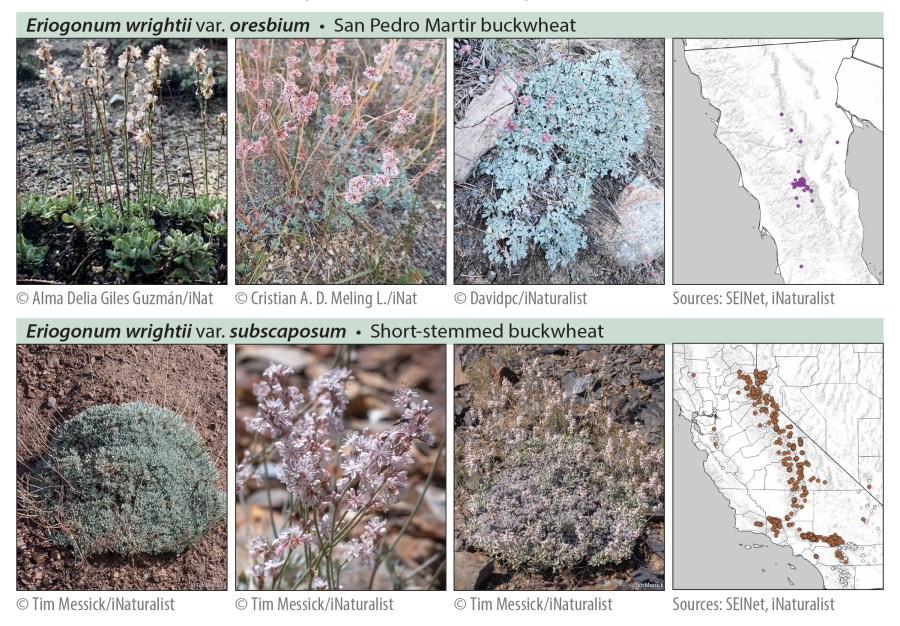
Anyone hiking in the Sierra Nevada eventually encounters Eriogonum wrightii (“Wright’s buckwheat” or, if you must, “Bastard sage”). The common form through most of the high Sierra is variety subscaposum—a short, more or less matted, perennial subshrub, with stems bearing white to pink flowers ascending either from throughout the plant, or often from just around its perimeter. It’s found in the Bodie Hills too, often on moderate to steep scree-like slopes.

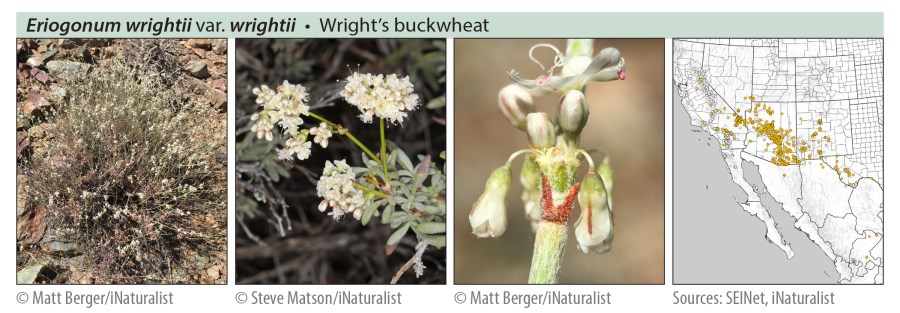
Eriogonum wrightii has 11 varieties in all: 5 occur only in Mexico (mostly in Baja California); the rest occur in the United States, but at least 3 of these extend across the southern border (and have certainly done so since long before there ever was a border). Most plants will run through the key without much difficulty, and some varieties are largely separate from the others geographically. Where taxon ranges may overlap, only 2 or 3 varieties will vie for your attention.

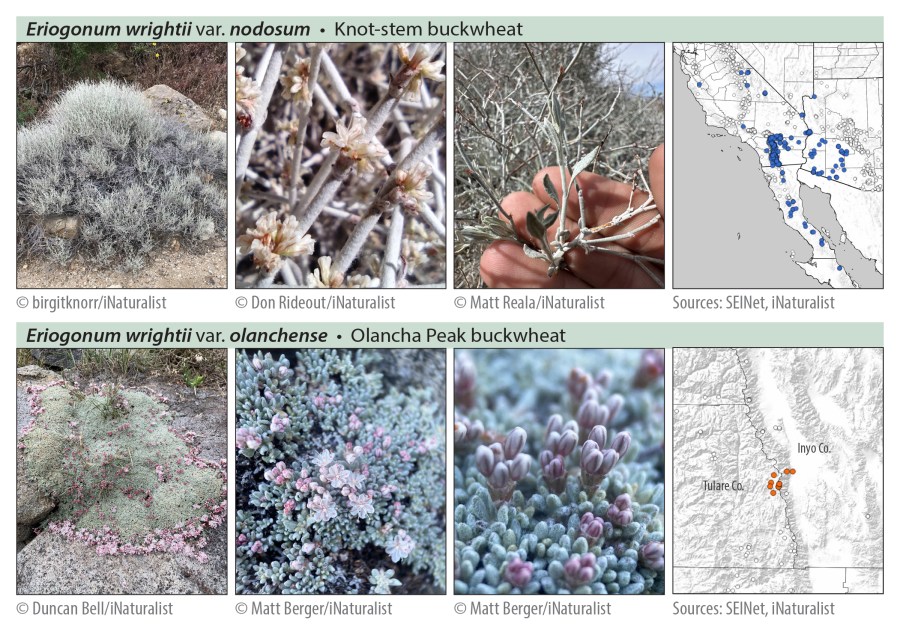
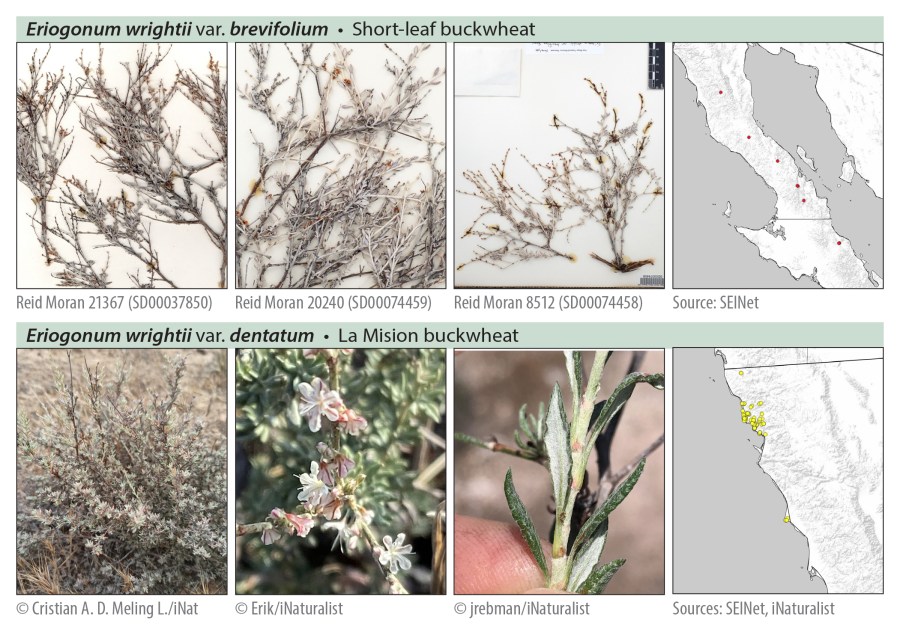
Curious to learn more about the other 10 varieties of E. wrightii and their distribution, I mapped all 11 using herbarium and iNaturalist data. The range maps were produced in QGIS, based on specimen location data in the SEINet Portal Network and iNaturalist observations (“Research Grade” only) as of December 11, 2023. NOTE: Some dots on the maps may be based on misidentifications or mismapped coordinates; most individual data points have not been reviewed to eliminate such errors, so taxon ranges indicated by these maps should be considered approximate.

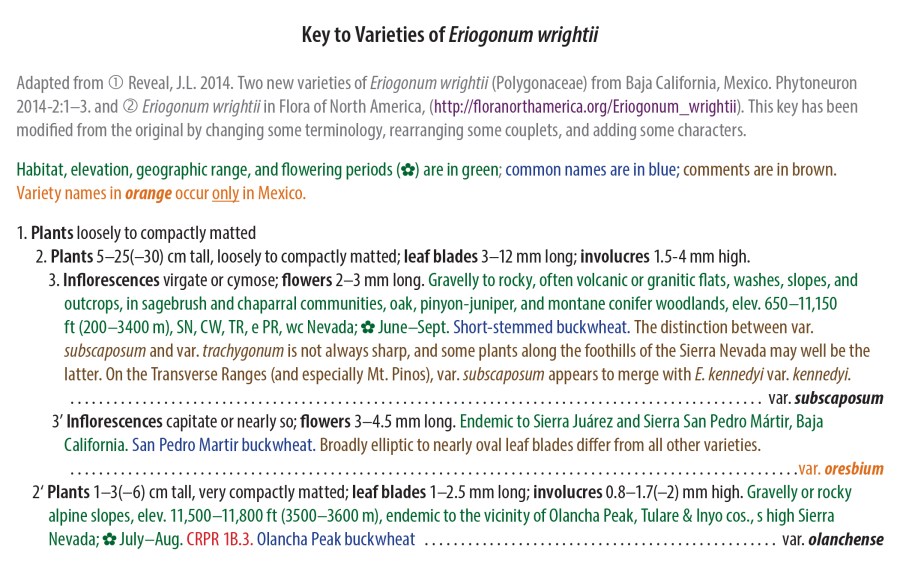
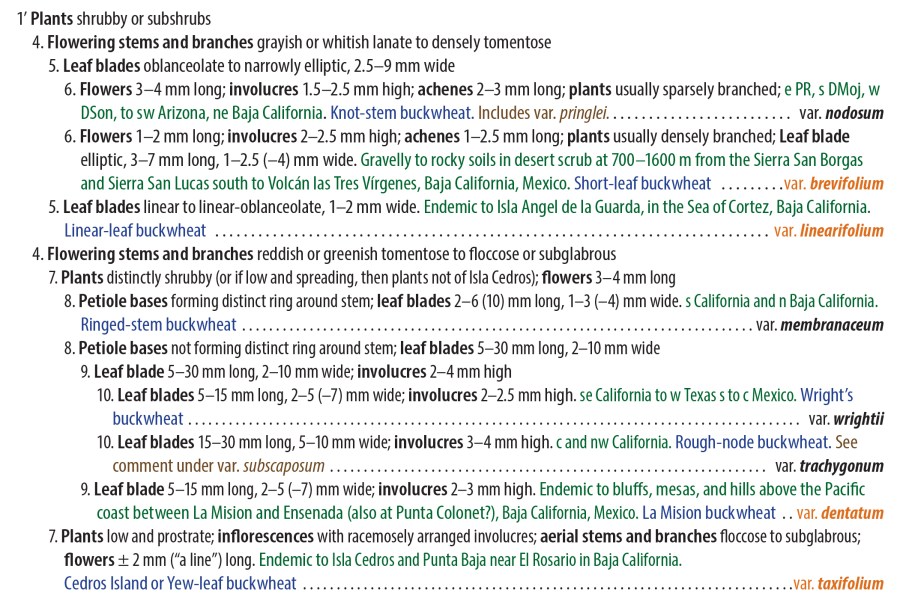
I also wrote a key, adapted from Reveal 2005 and Reveal 2014. This key has been modified from the originals by changing some of the terminology, rearranging some couplets, and adding some characters. I like my keys to include some of the information traditionally provided separately in descriptions, and I like to use text color to visually “layer” different categories of information. This is what you get when a botanist takes up information design and learns to love Adobe InDesign software.
The photos below are all from iNaturalist, except for a few from herbarium specimens of rarely observed taxa. All the photos are licensed for non-commercial use by the copyright holders under Creative Commons licenses CC BY 4.0, CC BY-NC 4.0, or CC BY-NCND 4.0. Thank you to all the photographers for allowing these images to be used!
References


Copyright © Tim Messick 2024. All rights reserved.

Mapping Mule’s Ears

One common factor contributing to mistakes when people are identifying plants is the scarcity of user-friendly visual documentation (i.e., maps) showing where different species occur in the world. Sure, more than one species of a genus will often co-occur in the same general area, but maps can help you quickly narrow down the number of possibilities in a given area.

Another aid that’s commonly missing is an explanation of how one species differs from a small set of related or similar species, where they may occur near each other. Keys can provide the technical details for distinguishing one plant from all others in a genus-wide or family-wide context, often over a wide area, but may obscure the simple details that can distinguish “Species A” from “Species D” where just those two happen to occur together.

How nice it would be to have more maps of species distributions based on current data for collections and observations. Such maps, together with keys and notes on how to distinguish one species from others in the same area, could facilitate more accurate identifications—especially in genera with little to moderate overlap of species ranges.

Wyethia mollis

This could be a fun project to help pass a pandemic winter, yes?

To explore the idea a bit further, I looked for a genus of modest size in western North America, with at least one species in Mono County. There are many genera to choose from. I selected Wyethia, commonly known as Mule’s Ears (or Mule Ears or Mules Ears), a genus with 14 distinct and well-documented species scattered across the mountains, hills, and deserts of western North America. Hikers in the upper elevations and east side of the Sierra Nevada will know Woolly Mule’s Ears (Wyethia mollis) as one of the brightest and showiest sunflowers of the region.

Here, then, is Mule’s Ears: an Atlas and Guide, a free PDF on my Downloads page. Look it over and let me know if you find this approach and format useful (corrections and suggestions are always welcome).

A Note on Taxonomy
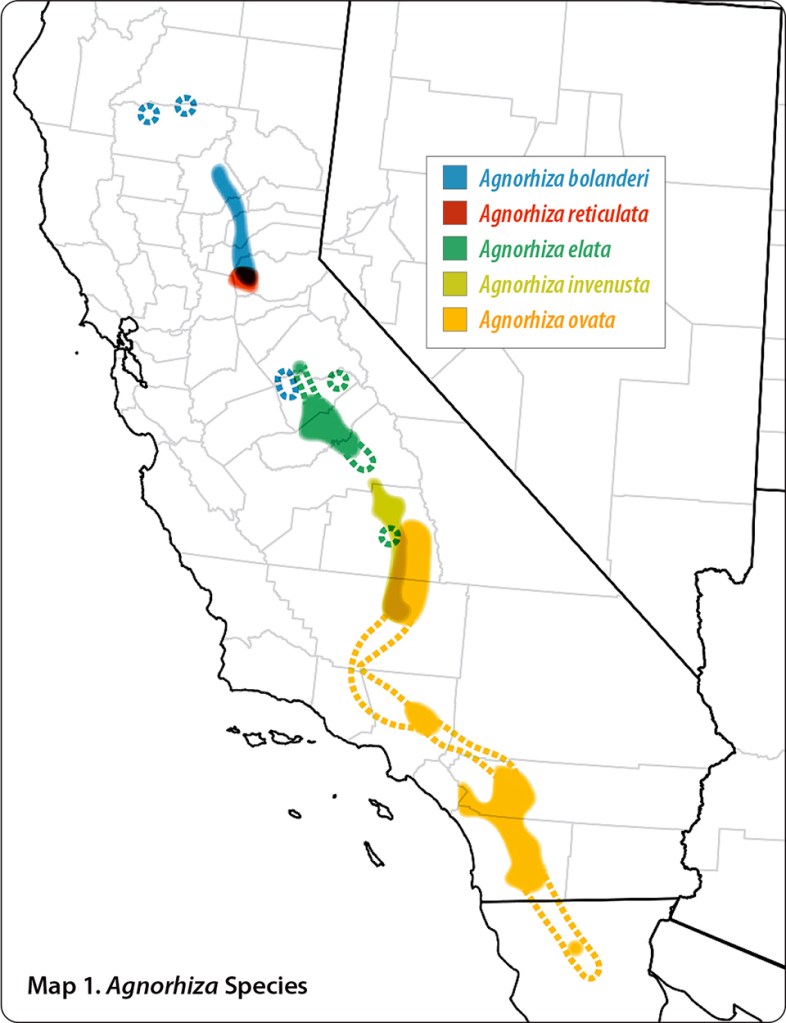
Traditionally, the 14 species of Mule’s Ears have been grouped all together in the genus Wyethia. (As of this date, the Jepson eFlora still treats all California species under Wyethia.) Currently, however, most sources recognize 3 separate genera in this group: Wyethia in a stricter sense (with 8 species), Agnorhiza (with 5 species), and Scabrethia (with 1 species). These are differentiated mostly by the shape, relative sizes, and distribution of leaves. Personally, I’m not always a fan of splitting genera by their sections, but in this case, I think it helps us recognize very visible differences within the group and makes the keys more manageable.

Methods
I downloaded location data (in CSV format) for herbarium collections of each species from the California Consortium of Herbaria (CCH), the Southwest Environmental Information Network (SEINet), the Intermountain Regional Herbarium Network, and the Consortium of Pacific Northwest Herbaria, along with crowd-sourced observation data from iNaturalist. These I imported to a base map of US states and counties, Canadian provinces, and Mexican states using QGIS (a free, open source GIS application).

For each species I exported a PDF dot map of collections and observations. These I placed into Adobe Illustrator, aligned with a clean base of only the state and county boundaries. I then traced the approximate boundaries of the occurrence clouds. In doing so, I did quick reality checks on occurrences that appeared inconsistent with overall distribution patterns or distributions reported in the literature. Many of these anomalies turned out to be obvious misidentifications or incorrect mapping of collection coordinates. Colors and patterns were used to differentiate species in the maps.

The final booklet, together with photographs licensed for non-commercial use by iNaturalist contributors (acknowledged in the booklet), was assembled in Adobe InDesign.

How to use this Booklet
1. Download the 16-page PDF from the DOWNLOADS PAGE. I suggest saving this into the library of the books app on your smart phone or tablet (e.g., Books on Apple devices) to keep it handy in the field. The pages are formatted as half-letter size (5.5 X 8.5 inches), so it’s fairly readable on your phone (if you’re near-sighted) or on your tablet.

2. You can also print this as a 16-page booklet from your computer using Adobe Acrobat or Adobe Reader (and probably other PDF apps). Tell the application to print all pages in Booklet format, both sides, left binding, and auto-rotate pages. Use letter-size (8.5 X 11) paper, and select your specific printer (not the generic “Any Printer”) and “US Letter” paper size in the printer dialog. This should result in the pages being filled and with centers properly aligned for folding. After printing, arrange as needed to make sure the page numbers are in proper sequence, fold the stack in the middle, and staple along the fold (a long-reach stapler works best for this).

3. Go forth and Botanize!


Copyright © Tim Messick 2023. All rights reserved.