Category Archives: Botany

Hops in the Bodie Hills

Bodie’s miners relaxed with a variety of beverages and there were (according to several sources) as many as 65 saloons in the business of satisfying their needs. Among the choices available to them were beers produced locally at several different breweries. In the 1880s there were (according to OldBreweries.com) at least 6 breweries operating in Bodie. Hops (Humulus lupulus) can be found growing today in sheltered locations outside several old houses in Bodie. Were these merely ornamental, or were some locally grown hops used to flavor locally produced beers? I’ve yet to find documentation that any locally grown hops were actually used by the breweries here, but the question is intriguing. It’s likely that hops for the breweries were of necessity imported from Carson Valley, Owens Valley, or even the Central Valley west of Sonora.

Humulus

Humulus lupulus growing in downtown Bodie

Hops are not native to the Bodie Hills, but there are varieties of hop that are apparently native to the American midwest and southwest. The kind cultivated here at Bodie and throughout much of the world for beer-making is the European or common hop, Humulus lupulus var. lupulus. Its relation to certain other intoxicating plants is indicated by its inclusion in the family Cannabaceae.

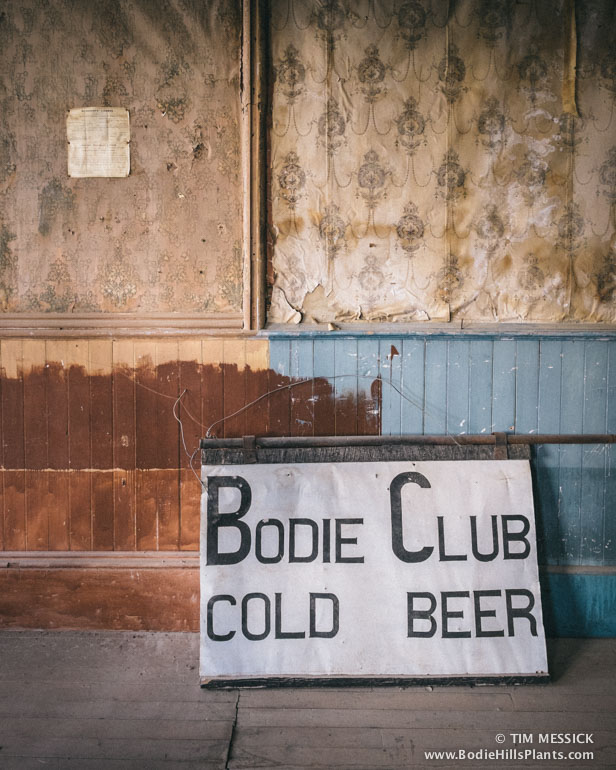
Bodie Club: Cold Beer

In the IOOF building

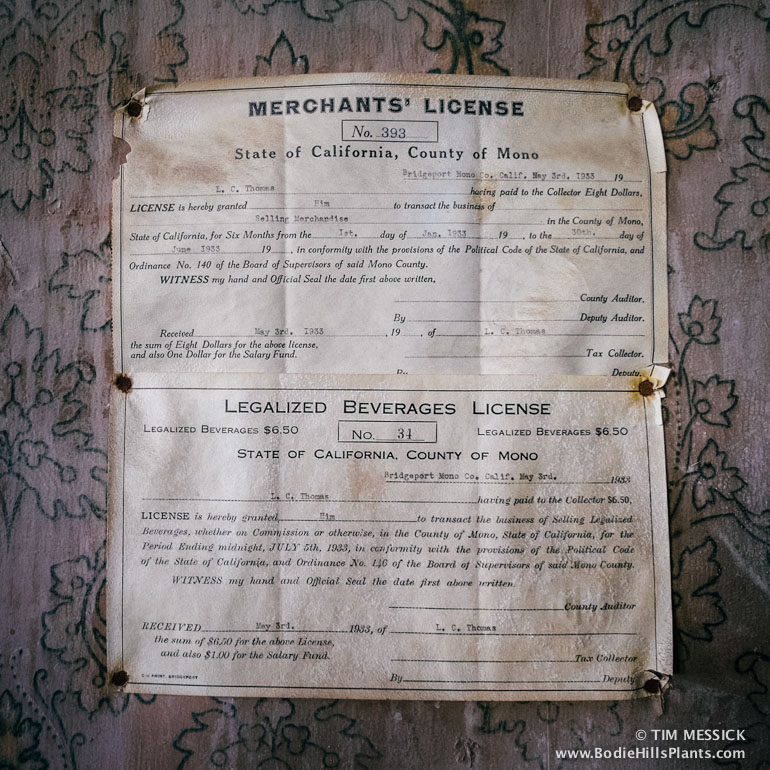
Licensed to sell Beer

A license to sell “legalized beverages”

Humulus

Another hops plant in Bodie (circa 1980)


Copyright © Tim Messick 2016. All rights reserved.
DOWNLOAD THE CHECKLIST

Floral Mimicry in the Bodie Hills

Soon it will be early spring in sagebrush country, and insects will be eager to find plants that provide nectar, pollen, or other yummy flower parts for food. Many early-spring flowers are in the mustard family (Brassicaceae) and buttercup family (Ranunculaceae). Many mustards and buttercups have bright yellow flowers. Bright yellow is a good color for attracting insects, because this color is also bright in ultraviolet, which many insects see well.

Puccinia monoica

But not all bright yellow plants are flowers. The yellow stuff above and below is a parasitic fungus—a type of rust (order Pucciniales)—growing on the leaves of a rock cress (Boechera sp.). The rock cress hasn’t flowered yet, and because of the fungal infection, this plant won’t produce real flowers at all this year. It will attract insects, though, because the fungus has produced zillions of little bright yellow spermatogonia on the leaves that cause the leaves to look superficially like flower petals. These spermatogonia exude spores (spermatia) that are carried by the visiting, feeding insects to other rock cress plants, just as they would normally carry pollen from flower to flower.

This particular rust is Puccinia monoica (no relation to Mono County, as far as I can determine, though I’m not sure what the name refers to). Puccinia was named after Tommaso Puccini (1749-1811), a professor of anatomy in Florence, Italy.

Floral mimicry is a deceitful, counterfeit way to make a living, but the rusts are obligate parasites and they have few options. Not all rusts are floral mimics, but those practicing this ruse are experts in their trade and are highly successful because if it. The rusts, like many parasites, have beautifully complex life cycles. Puccinia monoica infects additional hosts (the grasses, Koeleria, Trisetum, and Stipa, all of which live in this area), for another stage in its reproductive cycle. While on the grasses it does not engage in floral mimicry — that would be wasted effort indeed.
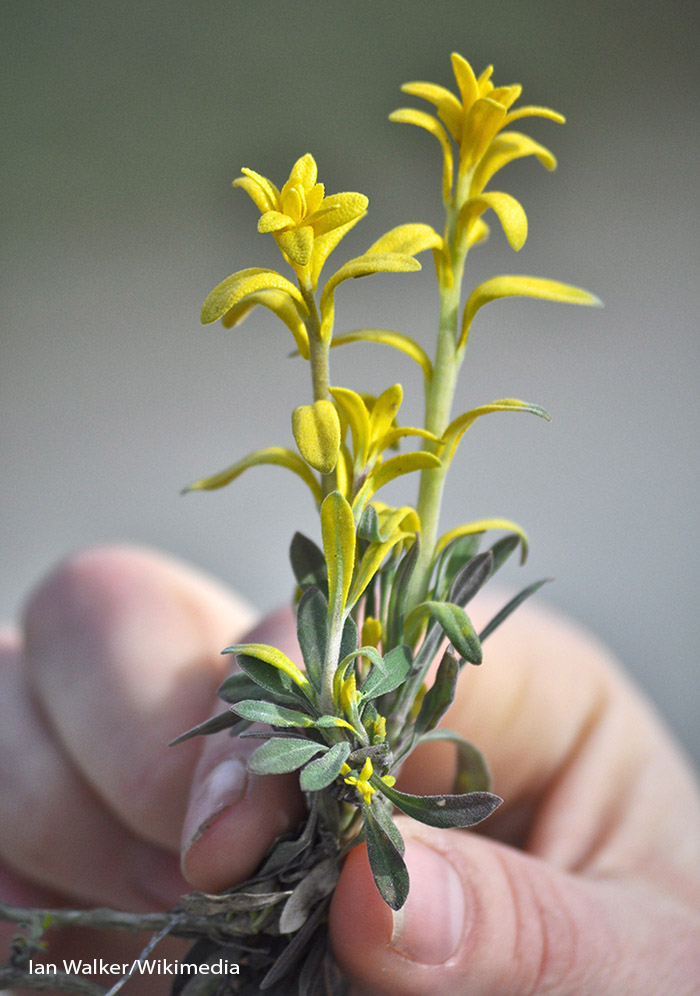
Puccinia monoica
Puccinia should not, however,  be confused with Puccinellia, which is not a fungus, but a grass, Alkali grass. Three species (P. distans, P. lemmonii, and P. nuttalliana) occur in the Bodie Hills — at Travertine Hot Springs and other moist alkaline places in the region and across much of western North America. Puccinellia was named after another Italian, botanist Benedetto Luigi Puccinelli (1808- 1850).

⋅   ⋅   ⋅   ⋅   ⋅

Phragmidium is another genus of rusts that infects leaves, stems, fruits, and flowers of roses, blackberries, and other members of the rose family (Rosaceae). Here’s one on Woods rose (Rosa woodsii) near the stream in the aspen grove in Masonic Gulch, near Lower Town Masonic.

Phragmidium

Phragmidium rusts are not floral mimics, and their spores may be largely wind-dispersed, but the bright orange of their spore-filled uredinia may attract some insect attention.

Phragmidium


Copyright © Tim Messick 2016. All rights reserved.
DOWNLOAD THE CHECKLIST

Available Now: Plants of the Bodie Hills, an Annotated Checklist

Lewisia rediviva var. minor

Lewisia rediviva var. minor

A year ago I decided to update the “Flora of the Bodie Hills” I had written 3.3 decades ago as my MA thesis at Humboldt State University. Why? There have been many nomenclatural and taxonomic changes in the flora, many more species have been found by subsequent collectors in the area, and there is now greatly simplified access to all this information through the internet. The Bodie Hills are rich in plants, wildlife, human history, geological interest, and recreational opportunities. More than ever, the natural resources of the Bodie Hills should be explored, documented, managed, and protected for all who enjoy the area.

Checklist Cover December 2015Plants of the Bodie Hills, an Annotated Checklist is a free, 47-page PDF document (5.1 MB), available for DOWNLOAD HERE. This first edition is dated January 3, 2016. Future editions will be released occasionally, as additions and corrections are made. This annotated checklist is an alphabetized list of plants by family and scientific name, with notes on distribution, habitat, and information gleaned from herbarium specimens. There are currently no keys, photographs, or illustrations, but I hope to add these in the future.  Meanwhile, selected keys, photos, and other natural history notes will be posted occasionally here at BodieHillsPlants.com.

Let me know what you think! And please tell me if you find additional plants in the Bodie Hills or errors that need correcting. Leave a comment below, go to the Contact Page, or email me at tmessick1[at]gmail.com. Thanks!

Masonic Upper Town

Masonic Upper Town (site) and the road south to Bodie


Copyright © Tim Messick 2016. All rights reserved.
DOWNLOAD THE CHECKLIST