Tag Archives: Bodie Hills

The View from Hilaria Hill

Last month during a quick trip down the northeast side of the Bodie Hills along NF-028 (a.k.a. Ninemile Ranch Road), I turned onto NF-128 and drove a short distance up the low northern slope of the Bodie Hills.

Red Wash Creek(See Flickr for a panoramic version of this photo)

There has been some prospecting in this area, but not much mining, so there are few roads through the relatively undisturbed pinyon-juniper woodland and few names on the features in this landscape. The drainage on the left side of this view is Red Wash Creek (which is usually dry), but none of these hills have names. Let’s call the place where I’m standing “Hilaria Hill,” because . . .

Hilaria jamesiiHilaria jamesii

Walking around on this low hill, I quickly encountered Galetta (Hilaria jamesii), a native grass that inhabits much of the arid southwest. Here, less than a mile from the southern boundary of Lyon County, Nevada, we are on the very westernmost edge of the species’ range.

Tetradimia spinosaTetradimia spinosa

Other plants here include the viciously armed Shortspine horsebrush (Tetradimia spinosa), the lovely Desert globemallow (Sphaeralcea ambigua) and the virtually leafless Nevada Mormon Tea (Ephedra nevadensis). There are lots more — I need to explore this place some more and go farther up the road. South of here there are some hydrothermally altered soils with Jeffrey pines that are disjunct from their primary range along the east side of the Sierra Nevada.
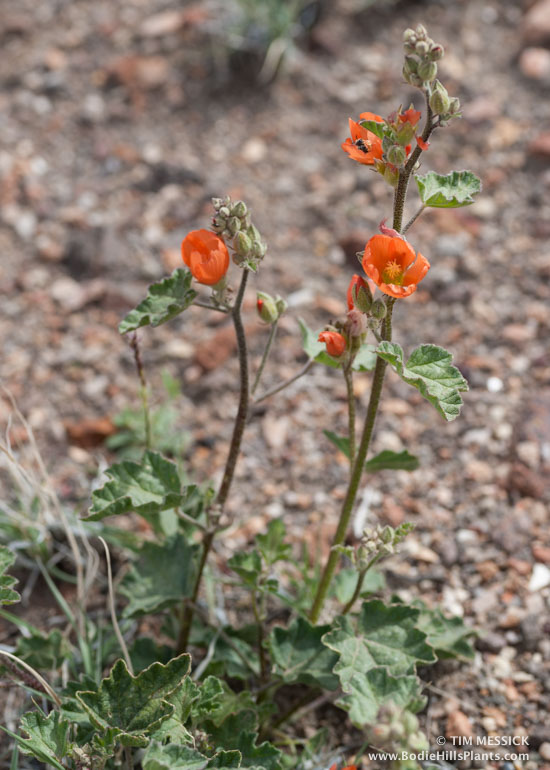
Sphaeralcea ambiguaSphaeralcea ambigua

Ephedra nevadensisEphedra nevadensis


Copyright © Tim Messick 2015. All rights reserved.
Cacti of the Bodie Hills

The cacti of the Bodie Hills are not difficult to master. There are only two of them: a Prickly-pear and a club-cholla. Opuntia polyacantha and Grusonia pulchella are both in subfamily Opuntioideae, and Grusonia was formerly included in the mega-genus Opuntia. That large and diverse genus is now treated in Flora North America and the Jepson eFlora as several separate genera. This isn’t just fine-grained splitting; Opuntia is still large, and the other smaller genera are easily distinguished in the field based on the shape of stem segments, overall growth form, and the presence or absence of spine sheaths. All Opuntioid cacti are armed with two kinds of spines: large, smooth, fixed spines and small, hairlike prickles called glochids, that will easily (and painfully) detach from the plant and penetrate your skin.

Key to Cactaceae in the Bodie Hills
1. Stem segments bilaterally flattened, circular, ovate, or obovate; flowers yellow to greenish-yellow;
throughout the Bodie Hills. . . .  Opuntia polyacantha
1’ Stem segments cylindric to ± spheric; flowers rose to purple;
north and east foothills of the Bodie Hills. . . .  Grusonia pulchella

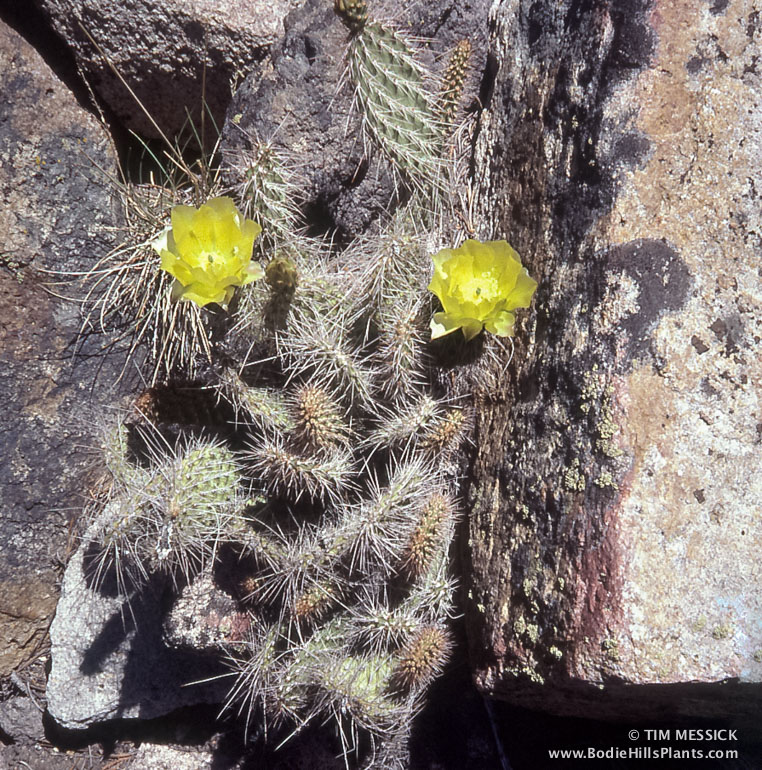
Opuntia polyacantha

Opuntia polyacantha (above) is a prickly-pear cactus densely clothed in long spines. Common names include Grizzly bear prickly-pear, Mojave prickly-pear, and Plains prickly-pear, and (probably in Texas and Oklahoma) Panhandle prickly-pear. In the Bodie Hills, it’s fairly common on rocky outcrops, talus slopes, and occasionally among sagebrush. The plants are usually widely scattered, never numerous in one location.

This is a very widespread species (in virtually all of the western U.S. and Canada, plus scattered counties as far east as Missouri). There are several varieties. O. p. var. erinacea is the one commonly encountered throughout the Bodie Hills and across the Great Basin, Colorado Plateau, and Mojave Desert. One collection in 1945 (UC733179: Roxana S. Ferris and Laura Lorraine, 11027) from the New York Hill area—part of Masonic Mountain—was identified as O. p. var. hystricina. This could be accurate, but ought to be checked in the field. Var. hystricina (“Porcupine prickly-pear“) occurs mostly in southern Utah and nearby areas of adjoining states.

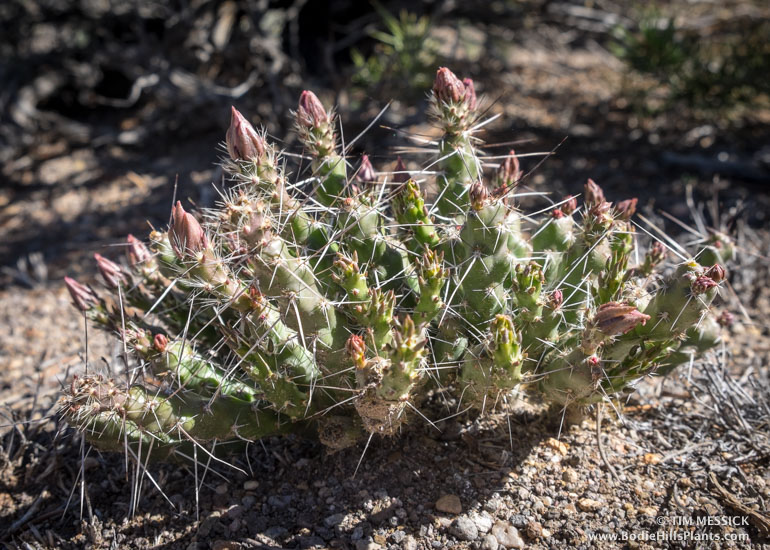
Grusonia pulchella

Grusonia pulchella (above) is a club-cholla that also has long spines, but generally less dense than in the Opuntia. Common names include Beautiful club-cholla and Sagebruch cholla. This plant “differs from other North American Opuntioid cacti in having a geophytic habit, where above-ground growth dies back to the crown in adverse conditions, and resprouts under more favorable conditions.” Here are some other photos of it, in flower.

Grusonia pulchella is found through much of the Great Basin, mostly in Nevada and Western Utah. In California it is recorded only from Deep Springs Valley in Inyo County. In the Bodie Hills, all occurrences are probably in Nevada.


Copyright © Tim Messick 2015. All rights reserved.
Green Creek in 1894

It’s always interesting to compare  a photograph taken a century or more ago with the same view today. Aside from the built features, like roads and buildings, it’s interesting to look at changes in vegetation and ask why that may have changed. Here’s an example from Green Creek, 13 miles west of Bodie:

Green Creek Power House in 1894

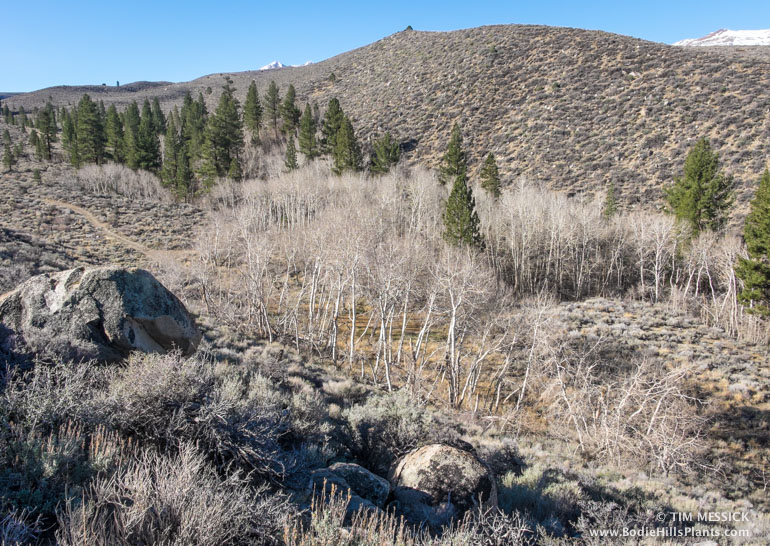
Above: The Green Creek Power Plant, source of electric power for the Standard Mill in Bodie, as shown in an 1894 article by Thomas Leggett. This was probably taken in late spring (notice the patches of snow and the leafless deciduous trees along the creek). Notice too, the scarcity of pine trees near the power house. Below: Green Creek from the same location, in March 2015. Water for the turbines came via ditch and penstock from Dynamo Pond, behind the pines near the left edge of both pictures.

Site of the Green Creek Power House in 2015

The power house is gone, but its foundations remain, near the center of that stand of aspens that haven’t leafed out yet. Clearly, far more aspens and conifers (both Jeffrey and lodgepole pines) are present today than in 1894. I presume more were present also before the mining era, when many trees throughout the region were cut down for building materials, mine shaft shorings, and fire wood. Were the pines felled to build the power house? Apparently not. Piatt (2011) says workers “erected a powerhouse with materials from the recently abandoned Bulwer-Standard mill.”

Power Plant foundations
Remains of the Green Creek Power Plant.
Dynamo Pond
Dynamo Pond today.
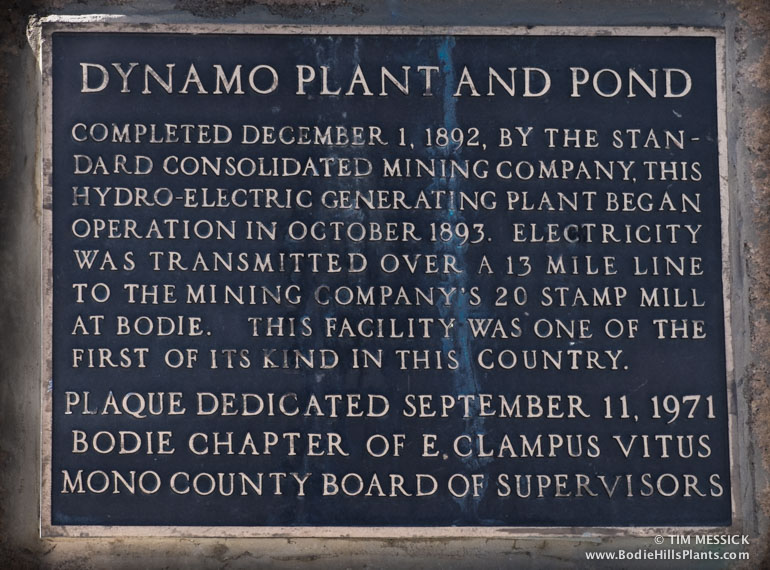
Dynamo Pond historic marker
Historic marker near Dynamo Pond.


Sources:
Leggett, Thomas H. 1894. Electric Power Transmission Plants and the Use of Electricity in Mining Operations, pp. 413–455 in Twelfth Report of the State Mineralogist (Second Biennial,) Two Years Ending September 15, 1894. California State Mining Bureau, J. J. Crawford, State Mineralogist. (link to Google Books)
Piatt, Michael H. 2011. Developments in Electricity and Bodie’s Long Distance Transmission Line. http://www.bodiehistory.com/power.pdf


Copyright © Tim Messick 2015. All rights reserved.