Category Archives: Bodie Hills

Buffalo Berries and Russian Olives: Elaeagnaceae in the Bodie Hills

Elaeagnus

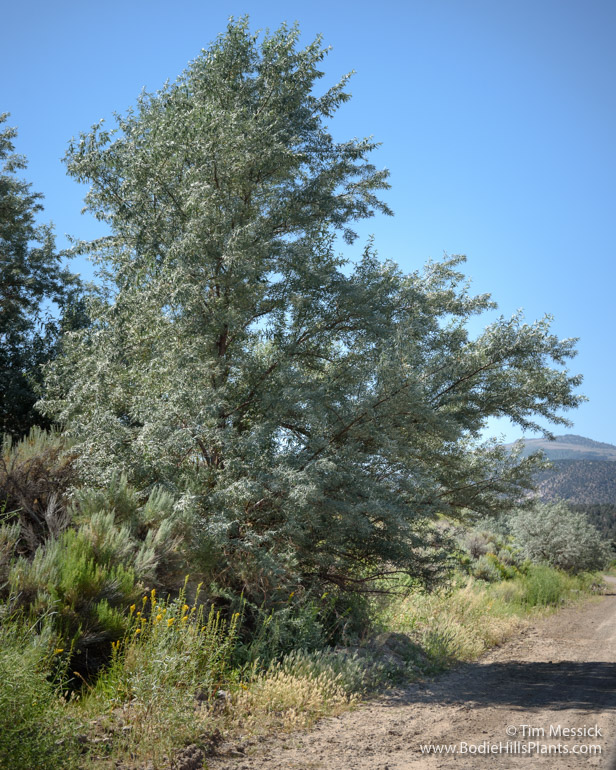
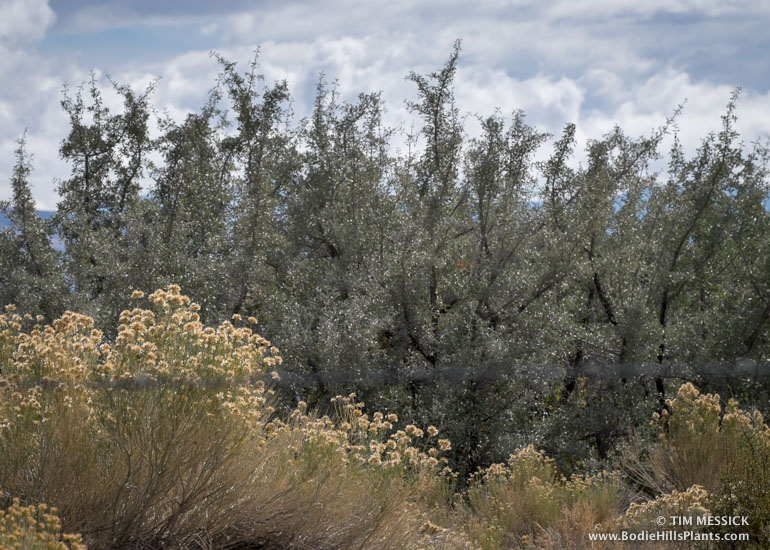
Russian olive (Eleagnus angustifolia) along the road from Fletcher to Aurora.

The Oleaster family, Elaeagnaceae (ee-lee-ag-NAY-see-ee) may be one of the less familiar plant families in eastern California and western Nevada, but the two species we find here are easily recognized and ecologically interesting. Both are large shrubs or small trees with silvery-green leaves and thorny branches. Both are riparian plants — found along streams and rivers. But one is a native plant; the other is an alien.
Shepherdia

Silver buffalo berry (Shepherdia argentea) thicket near
Cottonwood Creek at Dobie Meadows Road.

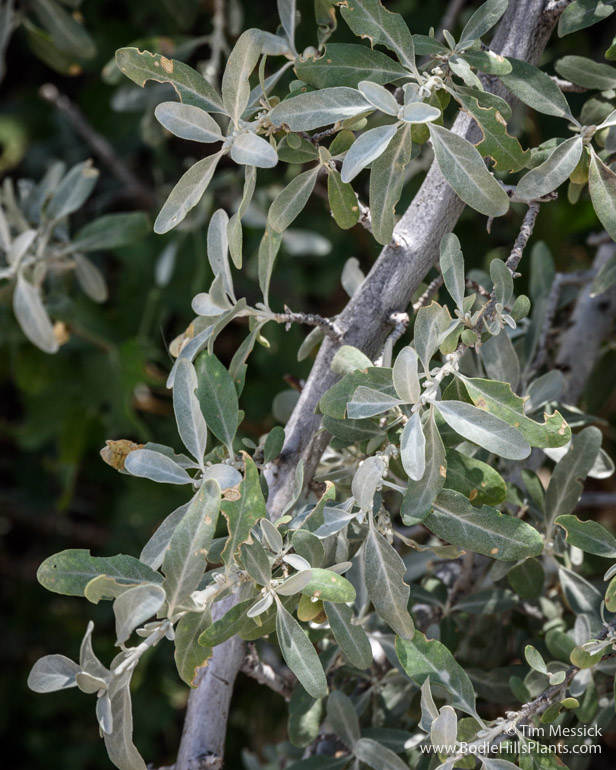
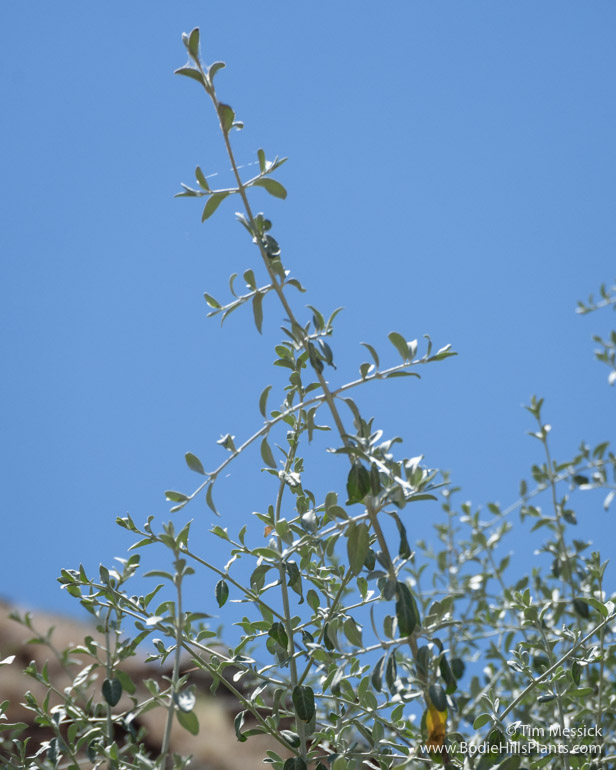
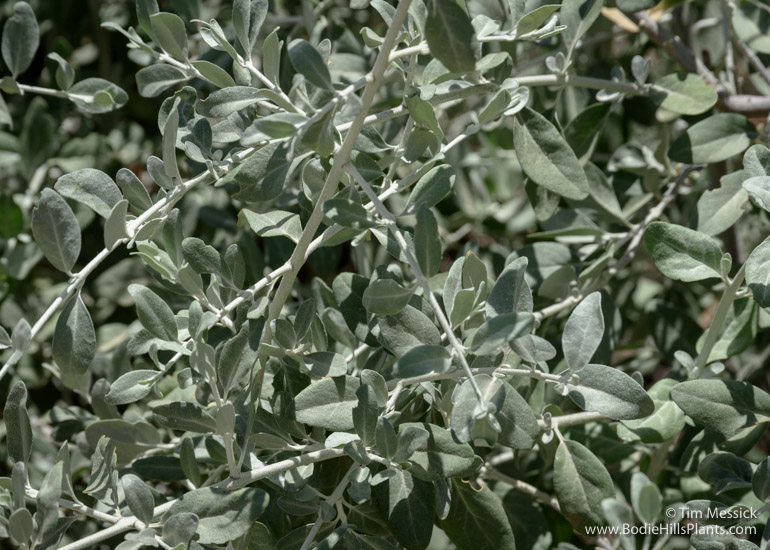
Silver buffalo berry (Shepherdia argentia) is native to the Bodie Hills and occurs from the western Transverse Ranges (north of Ventura) to the Rocky Mountains and upper midwest, as far as Wisconsin and Manitoba. In the Bodie Hills, Shepherdia argentia is common along the East Walker River and lower Bodie Creek, and is scattered along many other creeks and at some springs. Silver buffalo berry can be recognized by its opposite leaves and branchlets, ovate to oblong leaves less than 2.5 inches long, and in in late summer, by it’s bright red, berry-like fruits. Two other species are native to North America: Shepherdia canadensis (Rocky Mountains to Pacific Northwest, across Canada and northernmost counties of the U.S.) and S. rotundifolia (in Utah and Arizona) .
Shepherdia

Opposite leaves and branching in Shepherdia argentea.
Shepherdia

Foliage of Shepherdia argentea.

Shepherdia

Foliage of Shepherdia argentea.

Elaeagnus

Russian olive along the road from Fletcher to Aurora.

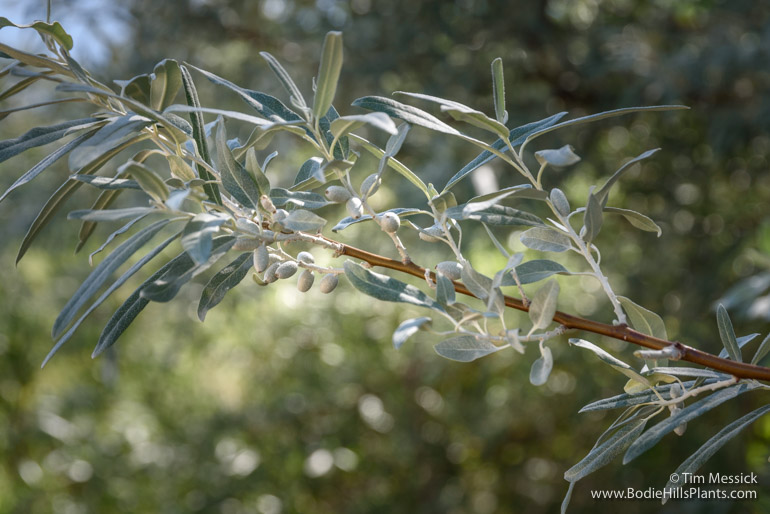
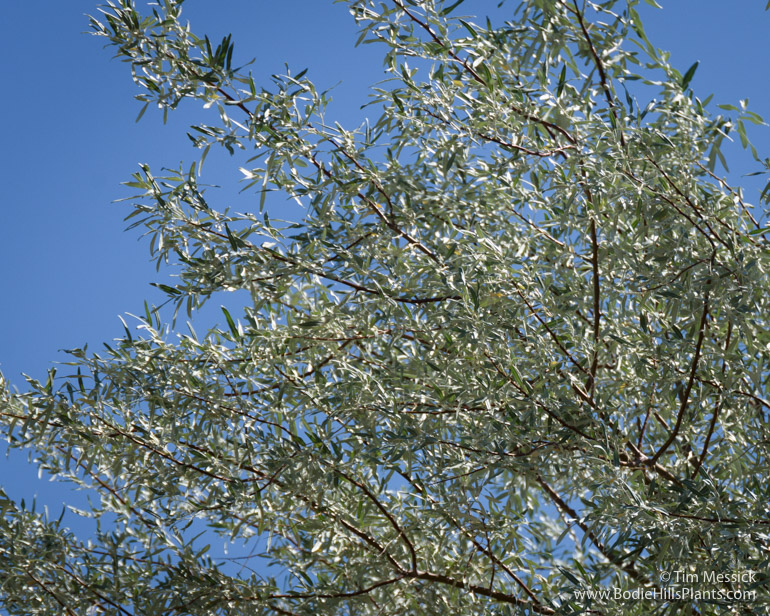
Russian olive (Eleagnus angustifolia) (ee-lee-AG-nus) can be recognized by its alternate, oblong to lanceolate leaves (generally longer and narrower than in buffalo berry), 4-lobed yellow flowers, and greenish-yellow, elliptic, olive-like fruits. Russian olive is native to most of western Asia (including parts of Russia), parts of tropical Asia, and southeastern Europe. It was cultivated in Europe as early as the 1630s. Russian olive was introduced to the central and western United States in the late 1800s as an ornamental tree and a windbreak, after which it spread into the wild.

Animals ate the fruits and dispersed the seeds. The plant tolerates drought and salinity, heat and shade, and a wide variety of soils, though it favors floodplains and riparian areas. Today it is naturalized across the American west and mid-west, several eastern states, and southern Canada. In the Bodie Hills, it’s mostly scattered along the lower part of Bodie Creek, the road from Fletcher to Aurora, and the East Walker River.
Elaeagnus

Besides spreading naturally, Russian olive was formerly also planted for restoration of disturbed lands, wildlife forage, windbreaks, erosion control, roadway landscaping, and ornamental use. It is no longer recommended for any of these uses and it’s considered a noxious weed in many areas. Although many birds and mammals eat the fruits, numerous sources suggest that native vegetation supports a greater diversity of wildlife than vegetation dominated by Russian olive. (Once again, Nature seems to do things better with less intervention from us.)
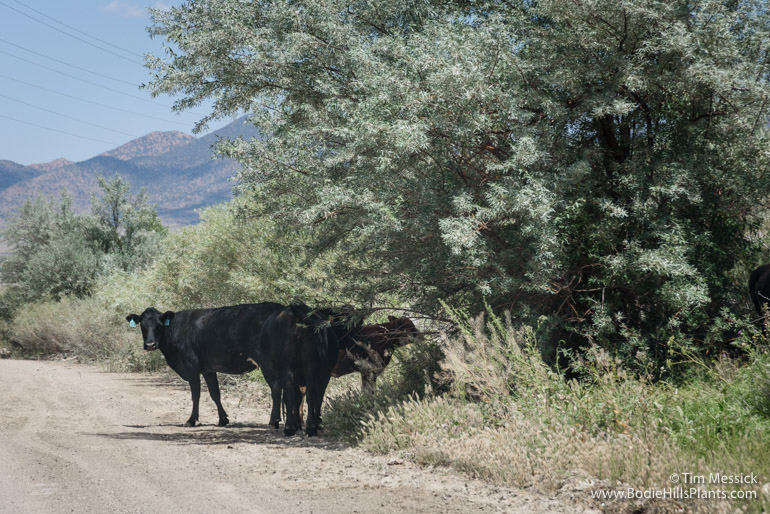
Elaeagnus

Cattle find a little shade under a Russian olive in July.


Copyright © Tim Messick 2016. All rights reserved.
DOWNLOAD THE CHECKLIST

A Herd of Pronghorn

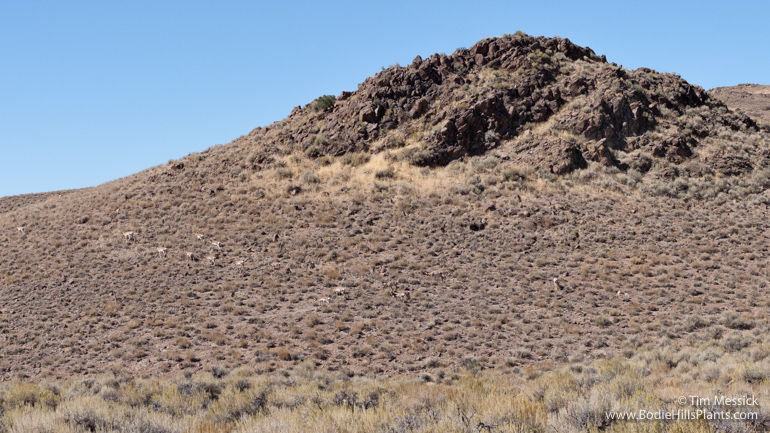
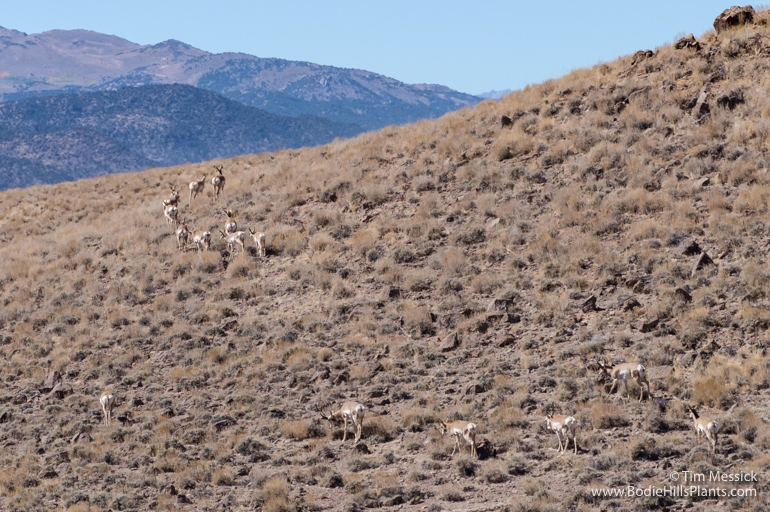
Pronghorn in Fletcher Valley

On a late-September drive along the East Walker River Road, at the north end of Fletcher Valley, I came upon a herd of pronghorn strolling through the sagebrush. I quickly stopped the car, stayed in car, and whipped out the binoculars and telephoto lens. They looked at me, but did not run away. They continued their leisurely walk up an unnamed hill and over the ridge, in the general direction of The Elbow and the Bodie Hills, six miles to the west.

Pronghorn in Fletcher Valley

I counted 21 of them, but I think a few more had already crossed the ridge before I put down the camera for a closer look with binoculars.

Pronghorn in Fletcher Valley

These animals are part of what’s recognized as the Bodie Hills herd of pronghorn. The Nevada Department of Wildlife2012-2013 Big Game Status” report notes: “This antelope herd is shared with California and utilizes upper elevation summer range in the Bodie Hills of California and winters primarily in Nevada. Because of the rain-shadow effect of the Sierra Nevada’s, the Nevada portion of winter range is often in poor condition. This can wreak havoc on fawn survival through the winter months. . . . Following good precipitation years, the population responds quite well with ample fawns contributing to a stable antelope herd.”

Pronghorn in Fletcher Valley

The “2013-2014 Big Game Status” report says, “In March of 2014, 10 pronghorn does were captured and fitted with satellite/telemetry receivers in the Rough Creek Aldridge Grade area. This was a collaborative project between the Nevada Department of Wildlife and the California Department of Fish and Wildlife to look at pronghorn distribution patterns and migration routes of the Bodie interstate herd. The follow up of this antelope herd will determine if fawns are being lost on summer range or on winter range.”

Pronghorn in Fletcher Valley

The “2015-2016 Big Game Status” report finds that 2015 was a better year for these animals: “The habitat located within these unit groups is in excellent condition because of the moisture received in fall 2015. . . . Precipitation in 2015 left the grasses and browse community in a productive state. This year’s fawn ratio should result in a stable population trend. At one time this herd numbered close to 200 animals. Consecutive years of low fawn recruitment have reduced the population to 100 animals. Future projects removing pinyon and juniper will allow for some limited expansion. Also creating corridors between California and Nevada will enable the herd to migrate easier from summer range to winter range. The population estimate for Bodie interstate herd is 110 animals.”

Fletcher Valley from Aldrich Pass

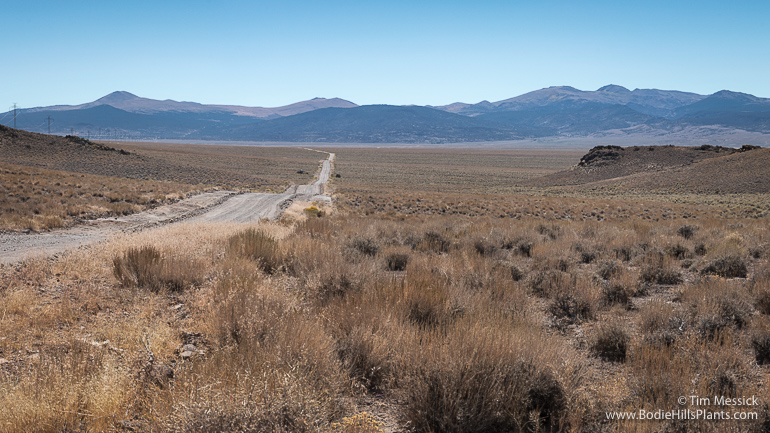
Pronghorn country: looking south from Aldrich Pass, across Fletcher Valley,
to the southeastern Bodie Hills.


Copyright © Tim Messick 2016. All rights reserved.
DOWNLOAD THE CHECKLIST

Sand Rice Grass

Stipa hymenoides

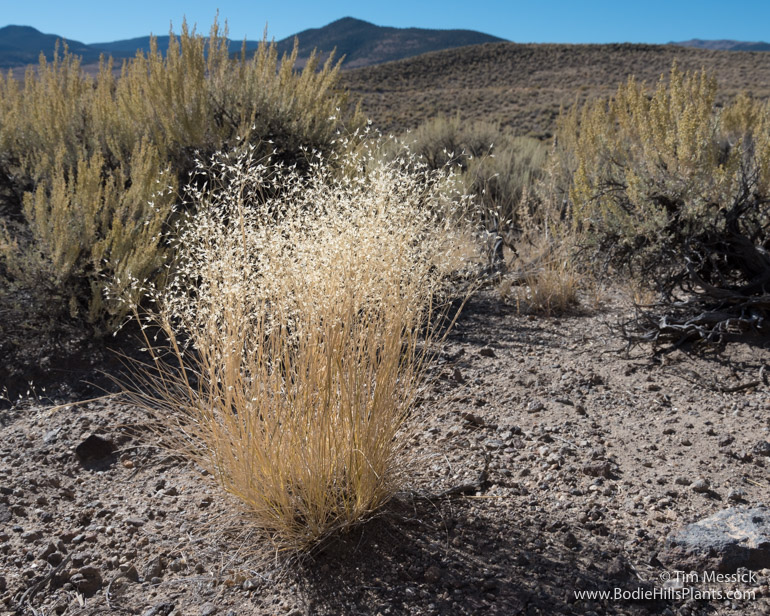
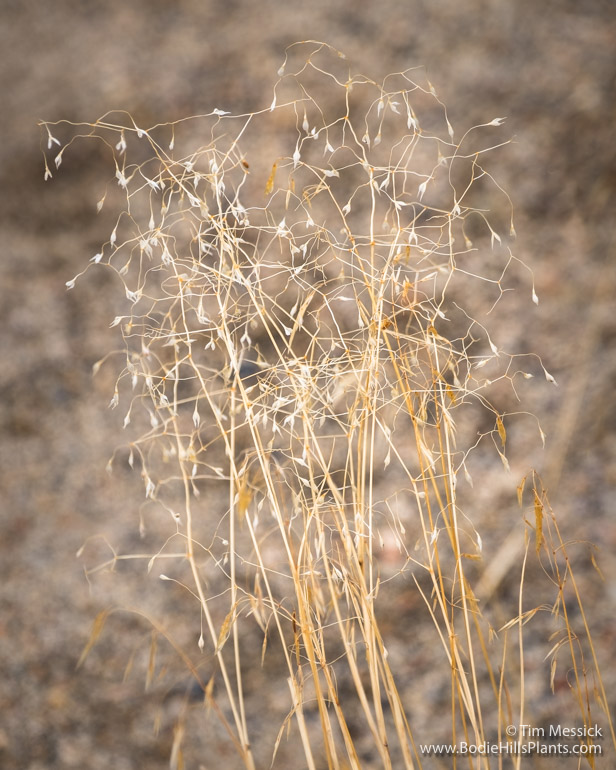
One of my favorite grasses of the Great Basin is the common and widespread sand rice grass (Stipa hymenoides). The rice grasses (or “ricegrasses”) were formerly treated in the genus Oryzopsis, which differed from the closely related needle grasses (Stipa spp.) in part by their short, generally straight and deciduous awns, rather than the mostly much longer, bent, and persistent awns of the needle grasses. Alas, Stipa and Oryzopsis were long known to hybridize promiscuously, and other morphological and developmental studies showed more similarities between the groups, so (to oversimplify the taxonomic story) Oryzopsis was lumped into Stipa. But in common parlance, the shorter-awned taxa are still “rice grasses” and the long-awned taxa are still “needle grasses”.

Stipa hymenoides

In late summer and fall, the seeds swell and push open the florets, making the plants catch the light especially well, so these bright little bunchgrasses can be seen easily from afar. The plants above, however, were right along the sandy edge of the Sweetwater-Aurora road (NF-028), west of The Elbow in Lyon County, in late September.

Stipa hymenoides

Rice grass seeds, especially those of Stipa hymenoides, are highly edible. Sand rice grass used to be called “Indian rice grass”, which is ethnologically and now also politically incorrect, but the name reflected the fact that the seeds were collected for food by Native Americans. Livestock and wildlife find the plants appealing too.

Stipa hymenoides

Sand rice grass is the official the State Grass of Utah and is planted for land reclamation, habitat improvement, and ornamental purposes. Let there be no confusion, however: “rice grass” is very different from true rice, which is also grass (Oryza spp.), but of tropical wetlands (and widely cultivated).

Stipa hymenoides

Stipa hymenoides, last October, at Lee Vining.


Copyright © Tim Messick 2016. All rights reserved.
DOWNLOAD THE CHECKLIST