Category Archives: Bodie Hills

How Big are the Bodie Hills?

How big are the Bodie Hills? How many square miles? That depends, but first, here are the numbers I’ve come up with:

  • in Mono, CA . . . . . . . . . . . .259 square miles (62%)
  • in Mineral, NV . . . . . . . . . .146 square miles (35%)
  • in Lyon, NV . . . . . . . . . . . . . 12 square miles (3%)
  • Total area . . . . . . . . . . . . . . . . 417 square miles

Overview of the Bodie Hills

Overview of the Bodie Hills from the southeast

It depends, of course, on where you draw the boundaries. There are relatively sharp natural boundaries in some areas — Virginia Creek along the southwest edge, the East Walker River in the canyon that separates the Bodie Hills from the Sweetwater Mountains, and the edge of Big Meadows south of Bridgeport.

In other areas the natural or physical boundary is less obvious. Along the east side of the range, the channels of Rough Creek and Mud Spring Wash are potential boundaries, but that would include a good bit of Fletcher Valley, with lower elevations and different vegetation than in the Bodie Hills proper. Along the south edge of the range, there is a relatively narrow transition in some areas from the rocky and wooded Bodie Hills to the sandy, mostly shrubby Mono Basin. But there’s no single elevation contour that consistently follows this transition, and the boundary becomes more vague east of Trench Canyon.

Should Cedar Hill (about 12 square miles) be included? I’ve left it outside the Bodie Hills, running the boundary instead through Trench Canyon, but that choice is fairly arbitrary.

Should the very young (<100,000 year-old) late Pleistocene trachyandesite of Mud Spring—the lava dome that fills the narrow far-southeast end of Fletcher Valley—be included? I’ve left it out, following instead the approximate route of the paleodrainage channel of Lake Russell (Pleistocene Mono Lake), along the southern edge of that formation.

Bodie Hills from the east

Bodie Hills from the east

Should boundary follow the East Walker River through the irrigated valley bottom just east of the state line? I’ve drawn it closer to the base of the hill slopes to the south, mostly excluding that valley bottom.
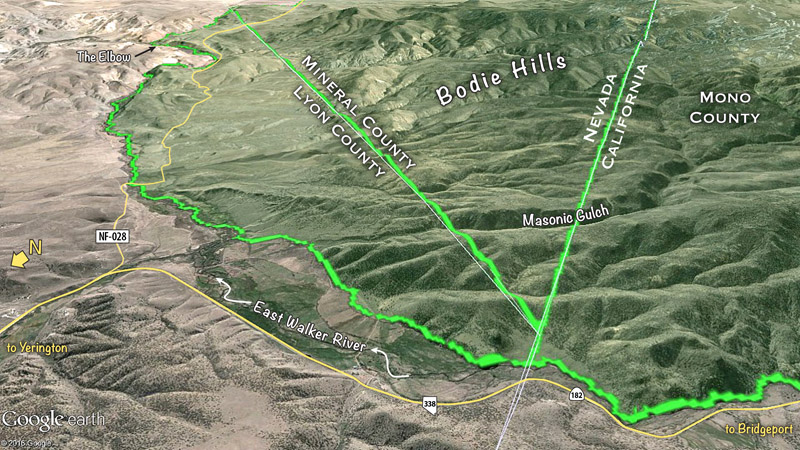
Bodie Hills from the north

Bodie Hills from the north

In some areas lacking a hard “edge” to the Bodie Hills, roads provide a convenient, if somewhat arbitrary boundary. My southern boundary follows roads from US 395 to Cottonwood Canyon. My eastern boundary follows roads in the vicinity of Alkali Lake and in Fletcher Valley from about Mud Spring to the Miocene trachyandesites incised by lower Rough Creek. For convenience, my western boundary follows US 395 south of Bridgeport and State Route 182 north of Bridgeport.

Bodie Hills from the southwest

Bodie Hills from the southwest

One could quibble and fuss over the boundary in a number of places, but further refinement would change the total area (and the number of plants included in the checklist) very little.

Methods: I imported 13 US Topo quadrangles (1:24,000 scale) covering the Bodie Hills into Adobe Illustrator, using Avenza’s MAPublisher plug-in to maintain the georeferencing from the GeoPDFs made by USGS. I drew and adjusted the boundaries described above for the entire range on a new georeferenced layer, copying and joining road and river line segments from other layers where available. I then divided that area using the county boundary lines. I exported the three resulting shapes to a KMZ file, opened that in Google Earth Pro, and looked at the their “measurements” info for the square miles in each county.


Copyright © Tim Messick 2016. All rights reserved.
DOWNLOAD THE CHECKLIST

Floral Mimicry in the Bodie Hills

Soon it will be early spring in sagebrush country, and insects will be eager to find plants that provide nectar, pollen, or other yummy flower parts for food. Many early-spring flowers are in the mustard family (Brassicaceae) and buttercup family (Ranunculaceae). Many mustards and buttercups have bright yellow flowers. Bright yellow is a good color for attracting insects, because this color is also bright in ultraviolet, which many insects see well.

Puccinia monoica

But not all bright yellow plants are flowers. The yellow stuff above and below is a parasitic fungus—a type of rust (order Pucciniales)—growing on the leaves of a rock cress (Boechera sp.). The rock cress hasn’t flowered yet, and because of the fungal infection, this plant won’t produce real flowers at all this year. It will attract insects, though, because the fungus has produced zillions of little bright yellow spermatogonia on the leaves that cause the leaves to look superficially like flower petals. These spermatogonia exude spores (spermatia) that are carried by the visiting, feeding insects to other rock cress plants, just as they would normally carry pollen from flower to flower.

This particular rust is Puccinia monoica (no relation to Mono County, as far as I can determine, though I’m not sure what the name refers to). Puccinia was named after Tommaso Puccini (1749-1811), a professor of anatomy in Florence, Italy.

Floral mimicry is a deceitful, counterfeit way to make a living, but the rusts are obligate parasites and they have few options. Not all rusts are floral mimics, but those practicing this ruse are experts in their trade and are highly successful because if it. The rusts, like many parasites, have beautifully complex life cycles. Puccinia monoica infects additional hosts (the grasses, Koeleria, Trisetum, and Stipa, all of which live in this area), for another stage in its reproductive cycle. While on the grasses it does not engage in floral mimicry — that would be wasted effort indeed.

Puccinia monoica
Puccinia should not, however,  be confused with Puccinellia, which is not a fungus, but a grass, Alkali grass. Three species (P. distans, P. lemmonii, and P. nuttalliana) occur in the Bodie Hills — at Travertine Hot Springs and other moist alkaline places in the region and across much of western North America. Puccinellia was named after another Italian, botanist Benedetto Luigi Puccinelli (1808- 1850).

⋅   ⋅   ⋅   ⋅   ⋅

Phragmidium is another genus of rusts that infects leaves, stems, fruits, and flowers of roses, blackberries, and other members of the rose family (Rosaceae). Here’s one on Woods rose (Rosa woodsii) near the stream in the aspen grove in Masonic Gulch, near Lower Town Masonic.

Phragmidium

Phragmidium rusts are not floral mimics, and their spores may be largely wind-dispersed, but the bright orange of their spore-filled uredinia may attract some insect attention.

Phragmidium


Copyright © Tim Messick 2016. All rights reserved.
DOWNLOAD THE CHECKLIST

Big Galls on Big Sagebrush

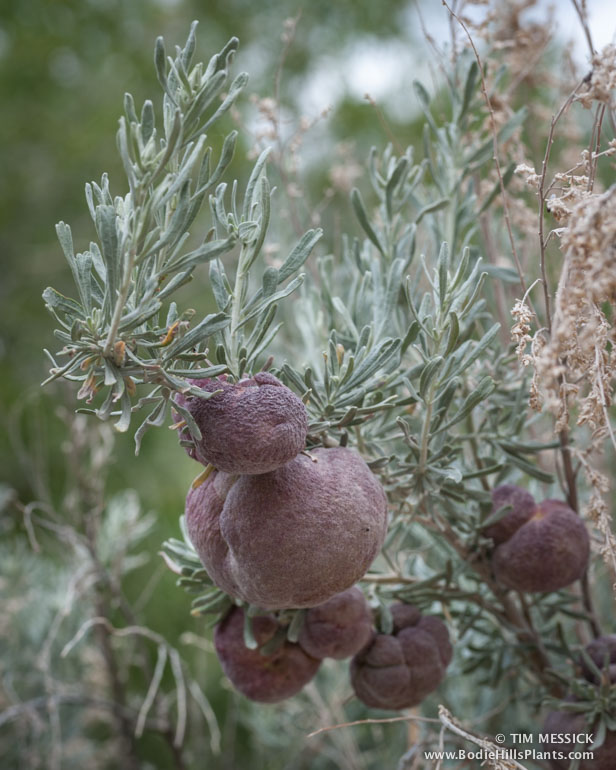
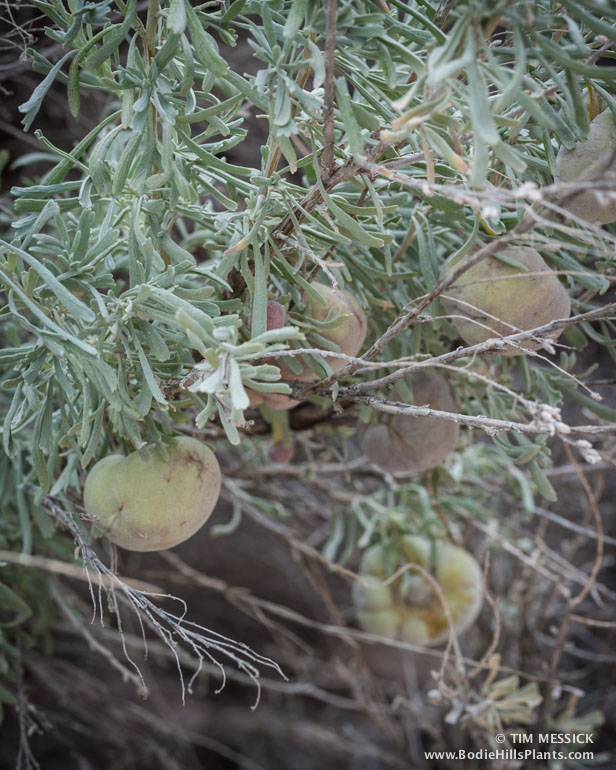
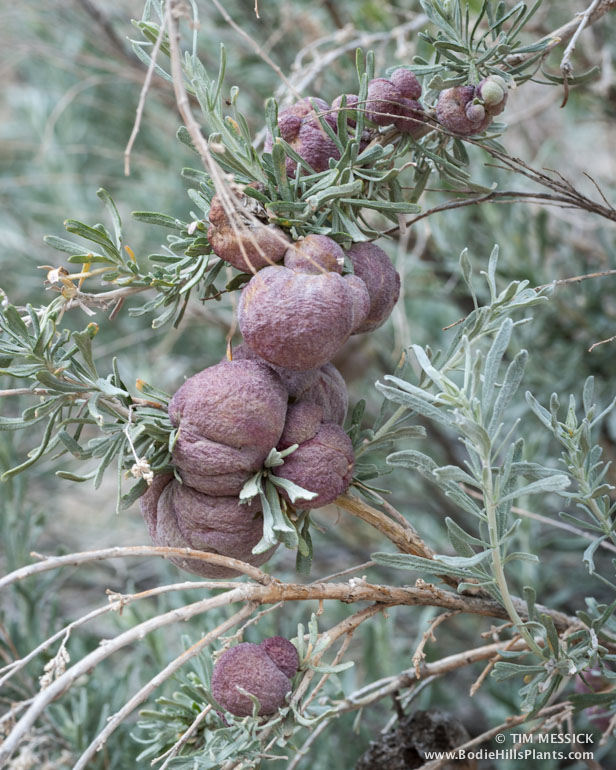
Early last spring, driving along the road past “The Elbow”—that sharp bend in the East Walker River that touches the northeast edge of the Bodie Hills—I was struck by the abundance of large galls on the branches of big sagebrush (Atremisia tridentata subsp. tridentata) beside the road. They were the size of walnuts to small apples.

Sagebrush galls

A bit of searching about galls on sagebrush led me to a post by Jonathan Neal on the Living with Insects Blog, which identified these as galls of the sponge gall midge (Rhopalomyia pomum, in the gall midge family, Cecidomyiidae).

Sagebrush galls

These tiny, delicate flies lay their eggs on the stems of big sagebrush. When the larvae hatch, they chew on the plant and chemicals in their saliva induce the growth of these large, soft-spongy galls on the stems. The larvae continue to grow and feed on the interior of the gall. With some luck, adult midges will emerge and renew the life cycle. Unlucky midge larvae may become hosts for tiny wasps. Wasps in Eulophidae and Platygastridae (and probably other families) are parisitoids (parasites that ultimately kill their hosts) that will lay their eggs in the developing midge larvae within the galls. The wasp larvae consume the midge larvae, and adult wasps, rather than adult midges emerge from the gall.

Sagebrush galls

Welch (2005) surveyed the literature and found mention of at least 42 midge and aphid species known to produce galls on big sagebrush. Many other insects and arthropods are associated with sagebrush in various ways. Not to mention the birds, mammals, fungi, and even lichens that will live in an area only because sagebrush is a dominant species. This all illustrates how sagebrush can be a “foundation species“—one that has a strong role in structuring a community and makes it possible for many other species to exist wherever it grows in abundance.

Reference: Welch, Bruce L. 2005. Big sagebrush: A sea fragmented into lakes, ponds, and puddles. Gen. Tech Rep. RMRS-GTR-144. Fort Collins, CO: U.S. Department of Agriculture, Forest Service, Rocky Mountain Research Station. 210 p.


Copyright © Tim Messick 2016. All rights reserved.
DOWNLOAD THE CHECKLIST