Category Archives: Botany

Violets in the Bodie Hills

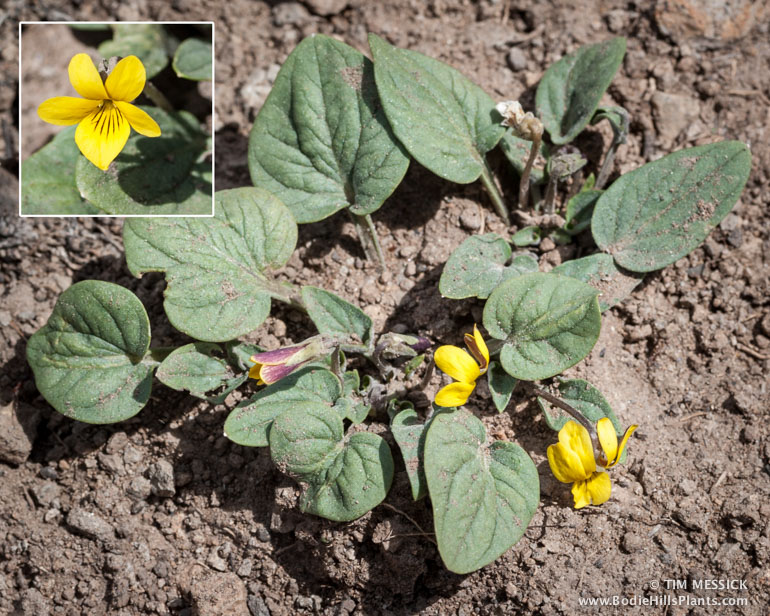
There are 2 species of violet in the Bodie Hills, easily distinguished by  flower color and habitat. The scientific name of the commonest violet, however, is misleading: Viola purpurea (Golden violet) isn’t obviously purple. It has bright yellow flowers, but the backs of the upper petals have some purplish-reddish-brown (see photo below). Golden violet grows in relatively dry woodland and sagebrush sites.  Viola nephrophylla (LeConte violet) has blue to violet flower petals (not quite purple either). LeConte violet grows in wet meadows.

Key to Viola in the Bodie Hills

  • 1. Petals deep blue-violet to white; growing in wet meadows; stem absent …… V. nephrophylla
  • 1′ Petals deep lemon-yellow, the upper 2 and sometimes lateral 2 reddish to purple-brown on the back; growing in drier soils, often in pinyon-juniper woodland and sagebrush; stems present but not always prominent, prostrate to erect, usually several …… V. purpurea
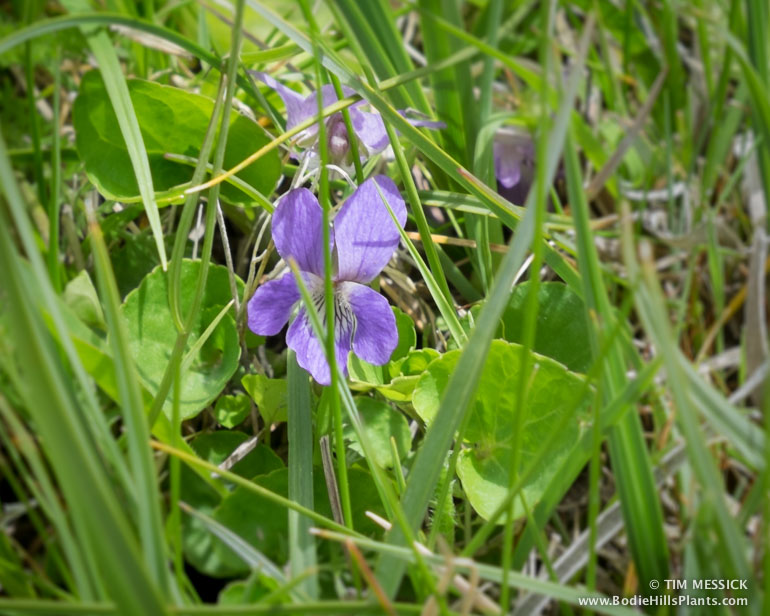
Viola nephrophylla
Viola nephrophylla

Viola purpurea
Viola purpurea

Several subspecies of V. purpura occur in the western Great Basin and eastern Sierra Nevada; but these are variable and they intergrade, so some plants may not fit neatly into any one of them. Plants growing in shade often produce larger leaves and longer stems than those in full sun. Subsp. aurea may be the most prevalent in the Bodie Hills, but subsp. mojavensis or others may be present also.

Subspecies of Viola purpurea in Mono County

  • 1. Leaves canescent to green-tomentose; basal leaves oblong, ovate, or round …… subsp. aurea
  • 1′ Leaves ± glabrous to puberulent
    • 2. Stems mostly buried, short, not much elongated by end of season; plant 3–8.5 (up to 12) cm tall; basal leaves coarsely serrate or generally irregularly dentate or crenate with 2–4 rounded lobes per side …… subsp. venosa
    • 2′ Stems generally not buried, generally elongated by end of season; plant 3–25 (up to 34.5) cm tall
      • 3. Basal leaf with 4–5 (up to 6) prominent lobes per side; basal leaf bases cordate to truncate …… subsp. mohavensis
      • 3′ Basal leaf without prominent lobes; basal leaf bases tapered …… subsp. purpurea

Keys adapted from: R. John Little 2014. Key to Viola, in Jepson Flora Project (eds.) Jepson eFlora, http://ucjeps.berkeley.edu/cgi-bin/get_IJM.pl?key=10278, accessed on December 22, 2015.

What does “canescent” mean? Check out the Jepson eFlora’s Glossary.


Copyright © Tim Messick 2016. All rights reserved.
DOWNLOAD THE CHECKLIST
Where’s the Checklist?

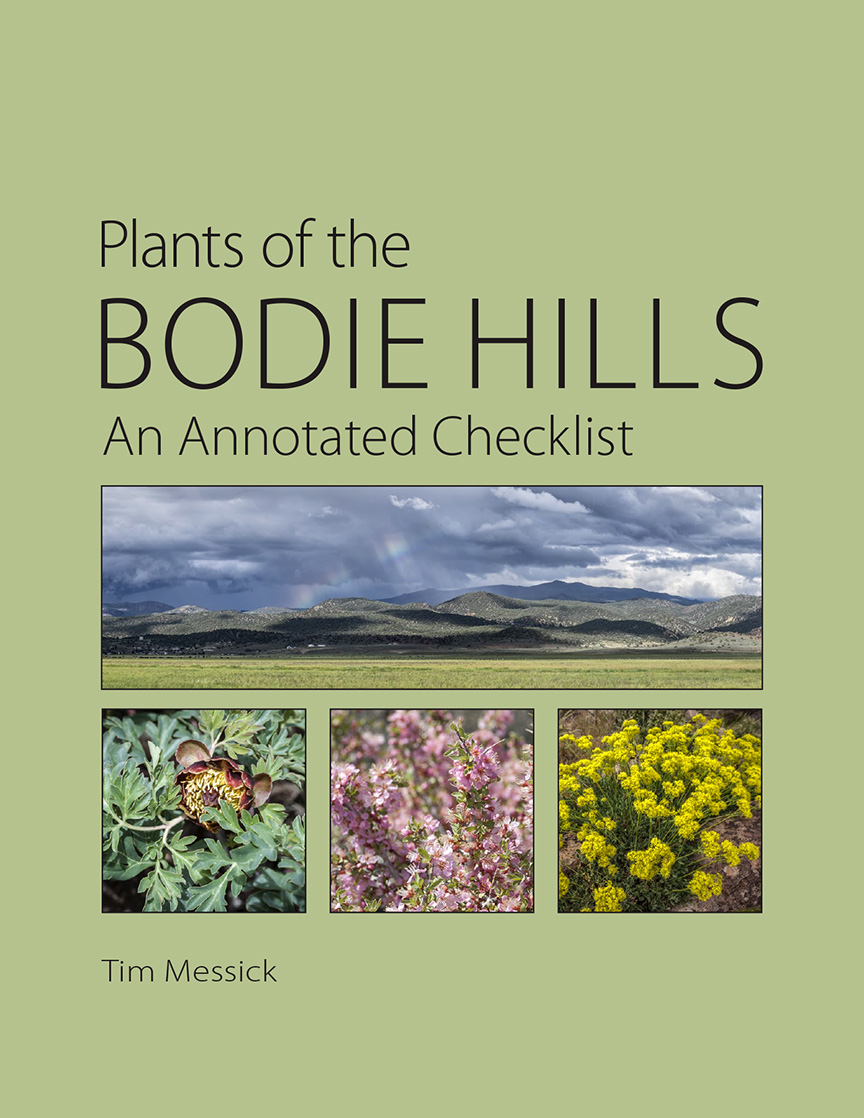
It’s almost done. Really! I’m making final edits now — fixing typos and inconsistencies, adding some missing details. I’ll be sending it to selected individuals for review and posting it here at BodieHillsPlants.com (a free downloadable PDF) in January, after the December holidays are over.

The cover:

Checklist Cover December 2015

And a typical page:

page_41

Happy Holidays!

Where are the Cottonwoods of Cottonwood Canyon?

Cottonwood Canyon
Mono Lake from the mouth of Cottonwood Canyon

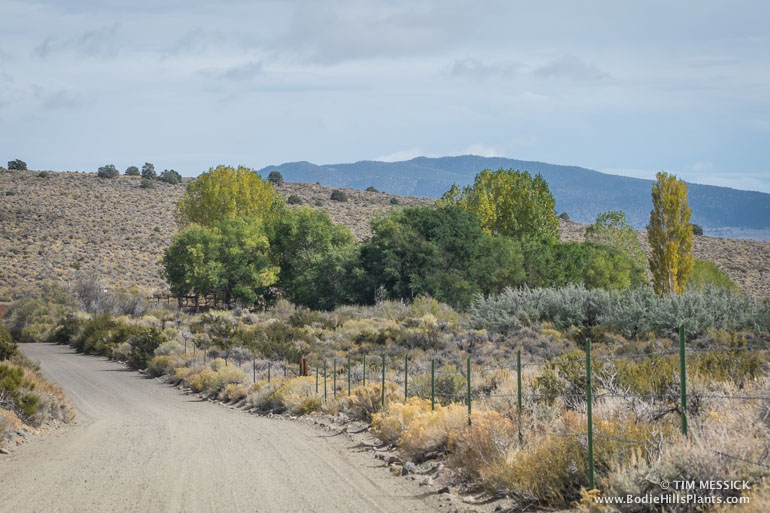
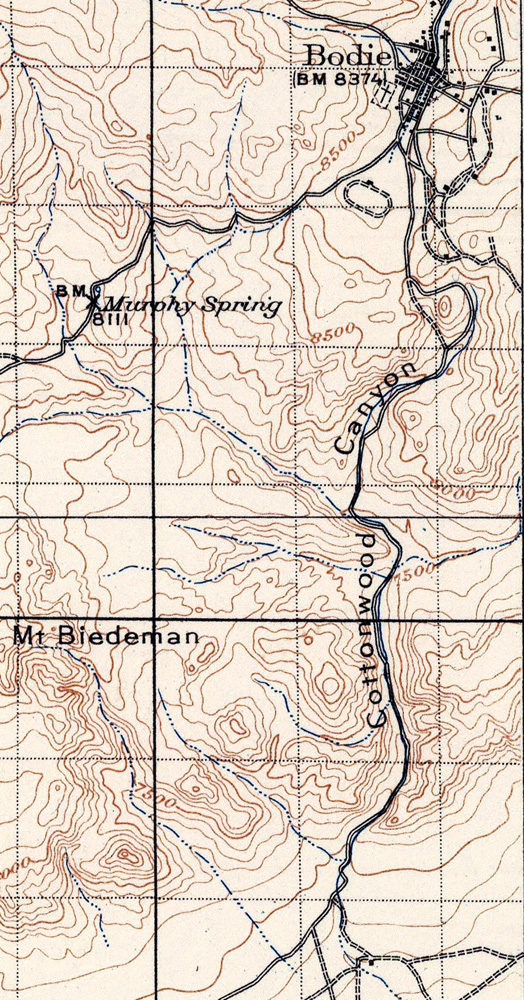
According to GeoNames, there are at least 19 places in California named “Cottonwood Canyon”, at least 18 more in Nevada, and perhaps 280 in all, nation-wide. This does not include all the places named “Cottonwood Creek,” “Cottonwood Wash,” “Cottonwood Spring,” etc. One of these Cottonwood Canyons is in the Bodie Hills, just south of Bodie. Many visitors to Bodie come or go via the Cottonwood Canyon Road, which meets State Route 167 just north of Mono Lake. This is one of the oldest and historically most used routes into Bodie.

Presumably all places named Cottonwood Canyon have now, or had at some time in the past, a species of cottonwood (Populus) growing in or near them.  But where, now, are the cottonwoods of this Cottonwood Canyon, here in the Bodie Hills? On a casual drive through, you will see pinyon pines and Utah junipers on the hillsides and occasional willow thickets along the creek. There appear to be 3 different cottonwoods (white, Lombardy, and Fremont) growing at Flying M Ranch, where the creek from Cottonwood Canyon crosses Dobie Meadows Road, but these are probably all planted, and these are below the mouth of Cottonwood Canyon.

Flying M Ranch
Cottonwoods at the Flying M Ranch site on Dobie Meadows Road

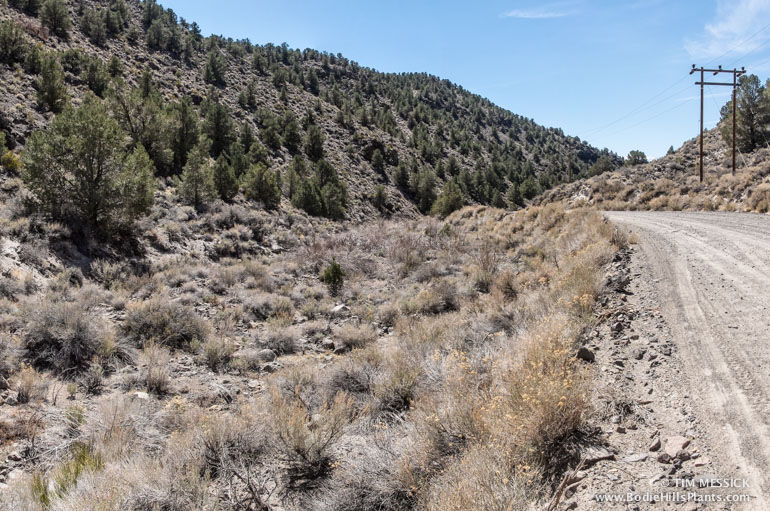
There are no cottonwoods in Cottonwood Canyon, that I can find. If they’re all gone, what happened to them? My guess is they succumbed to the axe and saw even before 1890, because wood of any kind was scarce near Bodie and in high demand for building, heating, and shoring up the mines. And again, this was right along a main road into Bodie. Perhaps, also, the water in this canyon wasn’t enough in historic times to support very many cottonwoods.

Cottonwood Canyon
Cottonwood Canyon . . . with no cottonwoods

Which cottonwood might have been here? Maybe black cottonwood (Populus trichocarpa)? It’s common in canyons along the eastern Sierra Nevada, including the Sierran streams that enter Mono Lake. It’s on lower Bodie Creek and at Fletcher on the east side of the Bodie Hills. It was  collected on September 7, 1932 by L. E. Hoffman, at “Mono Lake Region – road to Bodie” (see the specimen record). This was more recently mapped at a location along Coyote Springs Road (in Bridgeport Canyon), but I think “road to Bodie” in 1932 could more likely refer to the road in Cottonwood Canyon.

Black Cottonwood
Black cottonwoods (in October) on Lee Vining Creek

Or maybe Fremont cottonwood (Populus fremontii)? This tree is scarce in the Mono Basin, but it’s found in some east-side valleys watered by rivers north and south of here. There are some along the East Walker River north of Bridgeport.

Fremont Cottonwood
Fremont Cottonwood near the East Walker River

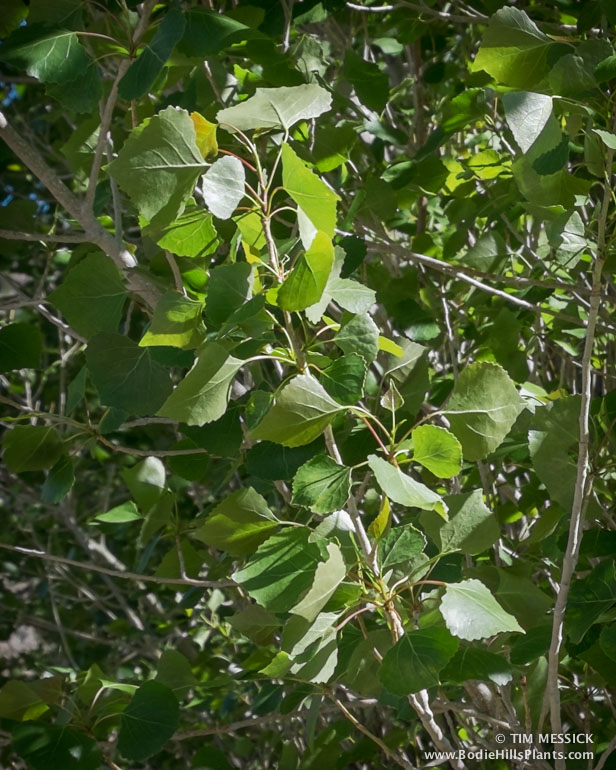
The trees in Cottonwood Canyon would not have been aspens (Populus tremuloides), because aspens are never called “cottonwoods” and aspens in the southern Bodie Hills grow at higher elevations. It’s unlikely they would have been the European cottonwoods that were planted by early settlers at settlements in the Mono Basin and Bridgeport Valley—white cottonwood (Populus alba) and Lombardy poplar (Populus nigra ‘Italica’). There are no settlements or ranches in Cottonwood Canyon, other than Flying M Ranch, which is along this drainage but well south of the canyon itself.

I’ll cast my vote for black cottonwood. The elevation and habitat in Cottonwood Canyon are similar to where black cottonwoods grow today elsewhere in the Mono Basin and on lower Bodie Creek. During times when the climate averaged just a little cooler and wetter than now, black cottonwoods may well have grown here. Closer examination in the field might offer a bit of old wood as evidence.


Part of the 1909 USGS Bridgeport, CA-NV 1:125,000 quadrangle


Copyright © Tim Messick 2015. All rights reserved.