Category Archives: Botany

Plants of Receding Shorelines

Shoreline habitats around water bodies with fluctuating water levels present challenging conditions for most plants. Such habitats occur along the shores and in the shallows of man-made reservoirs and natural depressions containing seasonal lakes. These habitats may be either dry and exposed for several years in succession during periods of drought, or continuously inundated during periods of above average precipitation.

Exposed lakebed on Dry Lakes Plateau

Some plants readily tolerate annual cycles of inundation and exposure, but fewer can thrive where there is both multi-year dewatering and multi-year inundation. Examples of such habitats in northern Mono County include the natural shallow seasonal lakes on Dry Lakes Plateau, and the shallows of Bridgeport Reservoir and Grant Lake Reservoir.

Surprisingly, some plants actually thrive in receding shoreline habitats, both natural and artificial. Some are annuals, some are perennials, some are native, some are introduced. They are most prevalent where the ground is nearly level or sloping only gradually; steeper slopes tend to be eroded, with thinner, less favorable substrates. The following highlights several species I’ve seen flourishing in these habitats during the recent series of drought years.


Taraxia tanacetifolia (Tansy-leaf evening primrose) can be the most abundant and colorful plant in receding shoreline habitats. In low-water years it creates a spectacular carpet of yellow across the exposed eastern shallows of Bridgeport Reservoir. Similar displays can occur across the beds of both seasonal lakes on Dry Lakes Plateau. These carpets of yellow can be seen from miles away.

Exposed lakebed at Bridgeport Reservoir

Tansy-leaf evening primrose is a stemless, taprooted perennial with leaves that are deeply and irregularly pinnately lobed, 4 petals up to an inch long that open bright yellow and fade to orange, and a capitate stigma that extends beyond the 8 anthers. It looks a lot like Oenothera flava, but Oenothera flowers have a prominently 4-branched stigma.


Potentilla rivalis (Brook cinquefoil) can be abundant too, but not necessarily together with the Taraxia, and its yellow flowers are much smaller and less showy. It can, nevertheless, form a patchy to dense groundcover in strands along the east shore of Bridgeport Reservoir and on shallow flats near the south end of Grant Lake Reservoir. This is a widespread species, found in many ecoregions and in a variety of habitats across western and central North America. It isn’t restricted to receding shoreline habitats, but it’s well adapted to be very successful in some such areas.

Brook cinquefoil is an annual or biennial with ascending stems. Its leaves are palmate with 3–5 leaflets; it has open, branching (cymose) inflorescence with many flowers, but tiny petals barely 2 mm long. It is a prolific seed producer, and you are likely to see uncountable thousands of these tiny achenes scattered on the ground among the plants.


Potentilla newberryi (Newberry’s cinquefoil) is known mostly from the shallows and shorelines of natural seasonal lakes in northeastern California (Modoc Plateau), south-central Oregon, and northwestern Nevada. It’s been collected in west-central Nevada from Silver Lake in Washoe County south to a pond in the Pine Nut Mountains in Douglas County. In 2021 it was discovered along the sandy/gravelly eastern shore of Bridgeport Reservoir, with additional observations there in 2022. Also in 2022 it was found on the south shore of Lake Tahoe.

When flowering, this plant is clearly Potentilla-like (though it was originally described as an Ivesia), with pinnately compound leaves and prostrate to decumbent stems, and is unusual among cinquefoils of our region in having white petals.


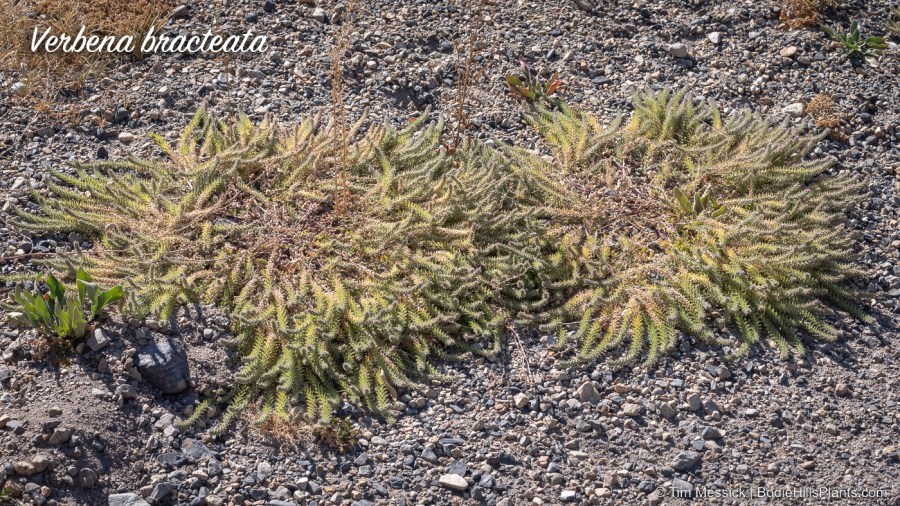
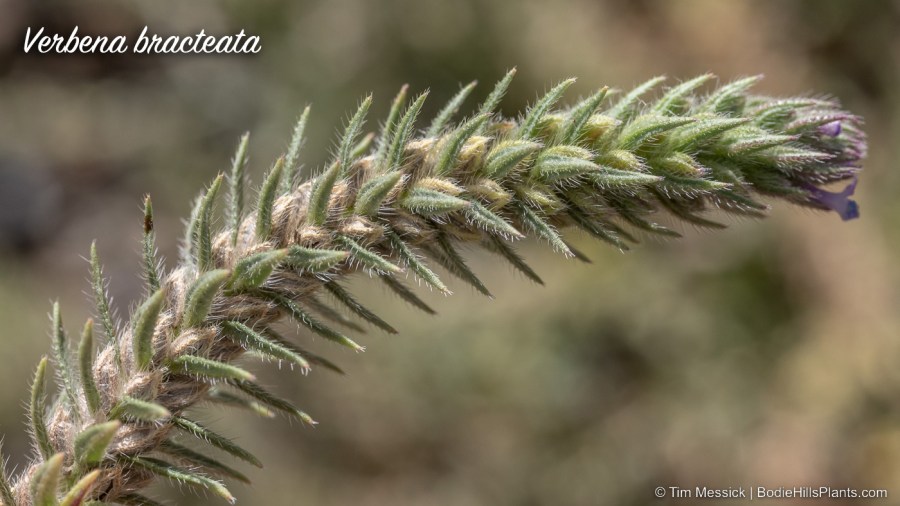
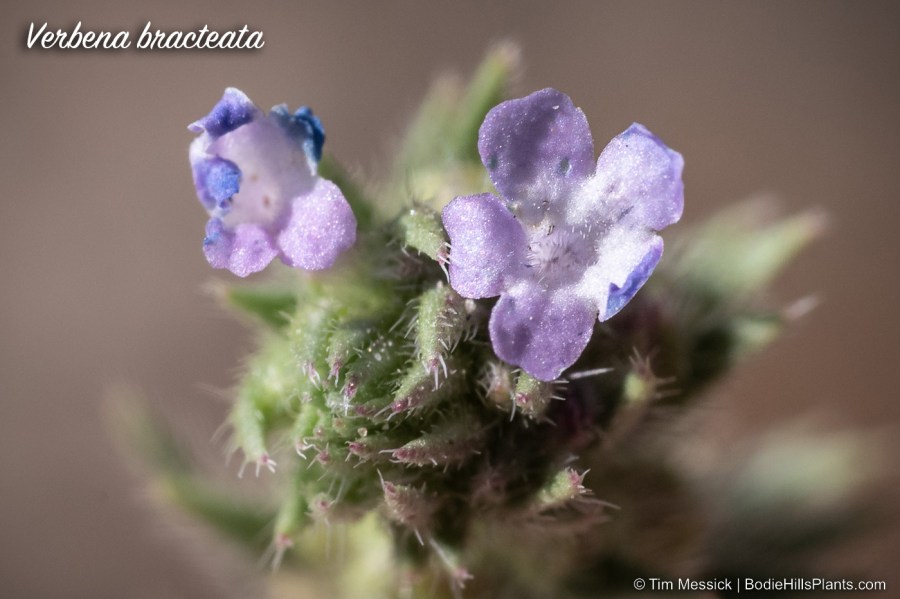
Verbena bracteata (Bigbract verbena) looks unlike anything else in this area, with its many narrow-triangular, hairy bracts along many-flowered spikes on long, lax stems. This is another widespread (mostly western) North American native, usually found at pond or lake margins or other open, disturbed places. These photos show it at the south end of Grant Lake Reservoir.


Persicaria amphibia (Water smartweed) flourishes during periods of shallow inundation rather than drought, but clearly it survives the dry periods easily. These photos show it rooted in a sandy beach at Bridgeport Reservoir. When the water is high, this site is a few feet under water. When inundated, the plants have several ovate-elliptic leaves floating on the surface, and a terminal spike of bright pink flowers.


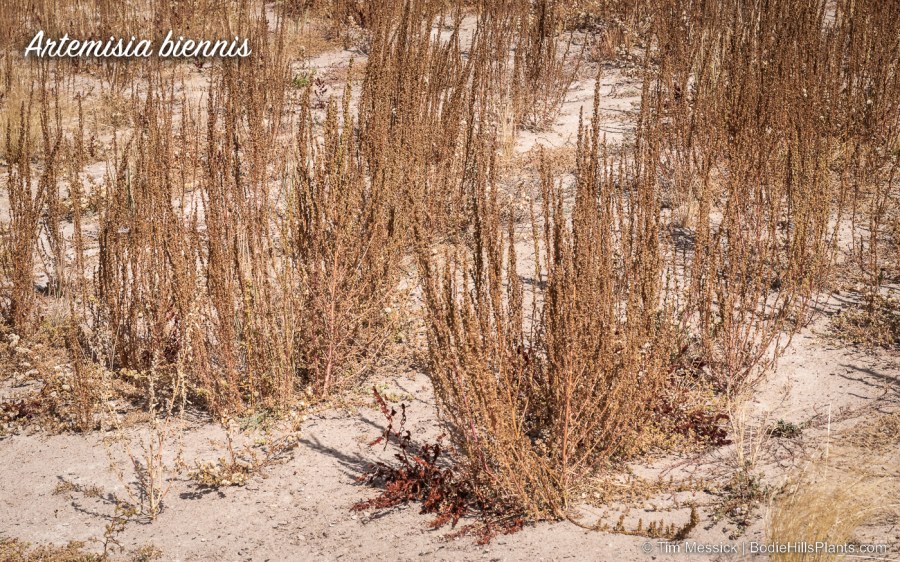
Artemisia biennis (Biennial wormwood) occurs in moist, disturbed sites across much of North America. It’s locally common in sandy soils at Bridgeport Reservoir, especially north of the boat launch at Ramp Road. The Flora of North America considers Artemisia biennis to be native in the northwestern United States and possibly introduced in other parts of its range; it is introduced in Europe.


The above is far from being an all-inclusive list of plants that can be found in these habitats. The list will vary from one lake or reservoir to another, depending on a variety of factors. The take-away for me, after looking at Bridgeport and Grant Lake Reservoirs particularly, is that the vegetation of receding shoreline habitats is not all weedy—some interesting and unexpected native plants are likely to be found there too.


Copyright © Tim Messick 2023. All rights reserved.

Plants of the Bodie Hills, 2023 Edition

Plants of the Bodie Hills, January 2023 Edition, is now available on the Downloads page (a free PDF). As in previous years, the new edition contains additions, corrections, nomenclatural updates, and refinements to the keys. A key to genera in the grass family (Poaceae) has at last been added.

New additions to the flora this past year are:

  • Astragalus platytropis (Broad-keeled milkvetch)
  • Eatonella nivea (Woolly bonnets or White false tickhead)
  • Eriogonum cernuum (Nodding wild buckwheat)
  • Glossopetalon spinescens var. aridum (Spiny greasebush) (Crossosomataceae)
  • Polemonium occidentale ssp. occidentale (Western polemonium)
  • Sporobolus cryptandrus (Sand dropseed)

Plants that had been expected and were finally found in the Bodie Hills in 2022 were:

  • Arceuthobium divaricatum (Pinyon dwarf-mistletoe)
  • Chaenactis macrantha (Mojave pincushion)
  • Claytonia perfoliata ssp. intermontana (Miner’s lettuce)
  • Festuca octoflora (Sixweeks fescue)

Many of these finds were made not by me, but by others posting their observations to iNaturalist (thanks to all who do this!). All observations within the Bodie Hills can be seen HERE.

As before, you have two options for how to use this document: 1) load the PDF onto a mobile device or 2) print the PDF yourself.

  1. Using a mobile device: I’ve found the PDF to be quite readable on my iPhone (in the Books app), although it helps that I’m near-sighted. It’s even easier to read on an iPad, other tablet, or laptop.
  2. Printing the PDF: You can print the PDF yourself or at a local print shop. I highly recommend printing the 124 pages 2-sided to conserve paper and reduce bulk and weight in the field. A comb or spiral binding, binder clip, or other binding will hold it together.

Your additions, corrections, comments, or questions are always welcome.

Here are a few plants I was pleased to see last year while roaming the Bodie Hills:

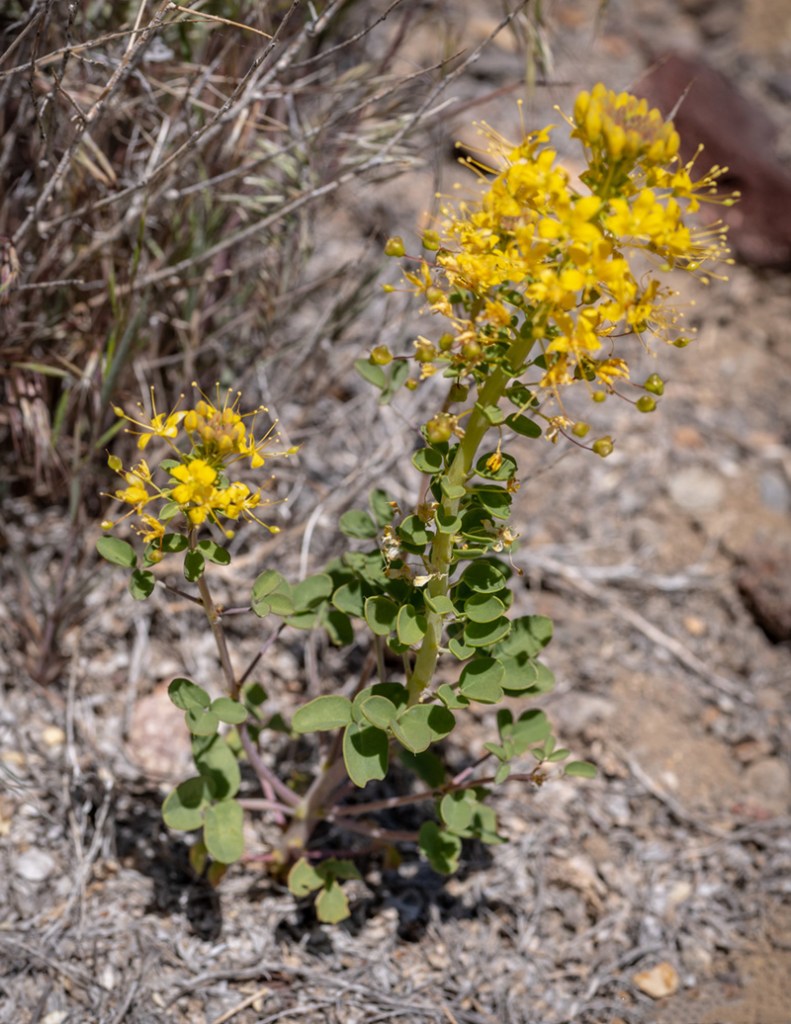
Cleomella hillmanii

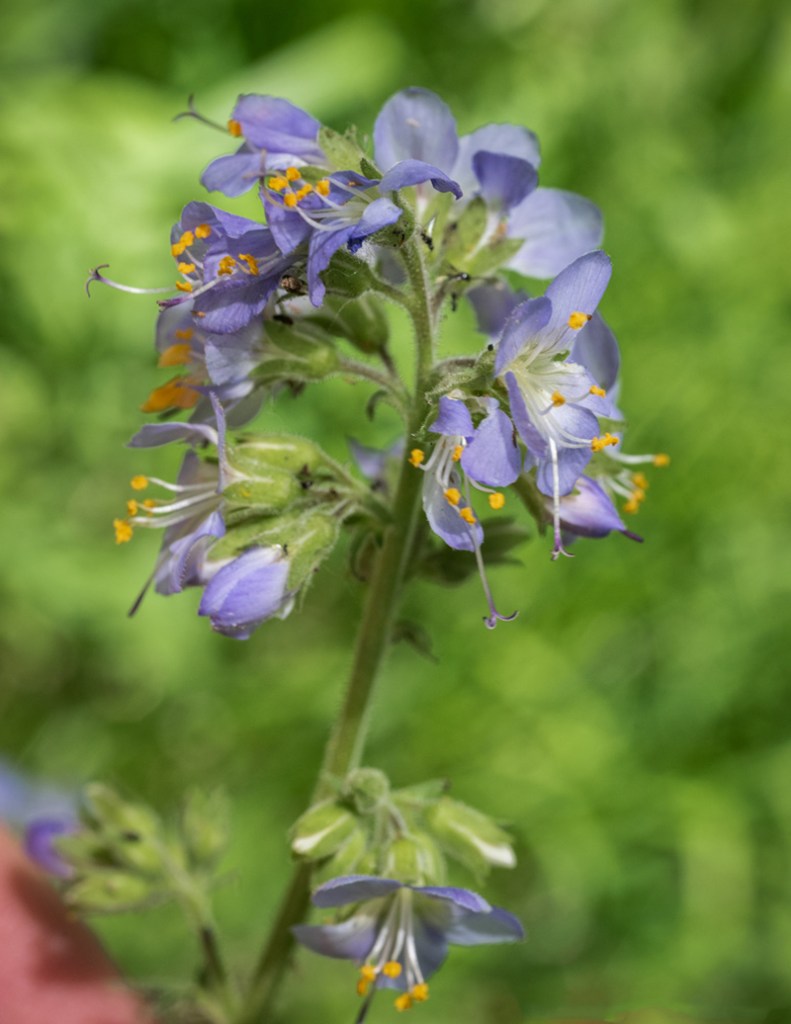
Polemonium occidentale

Lomatium foeniculaceum

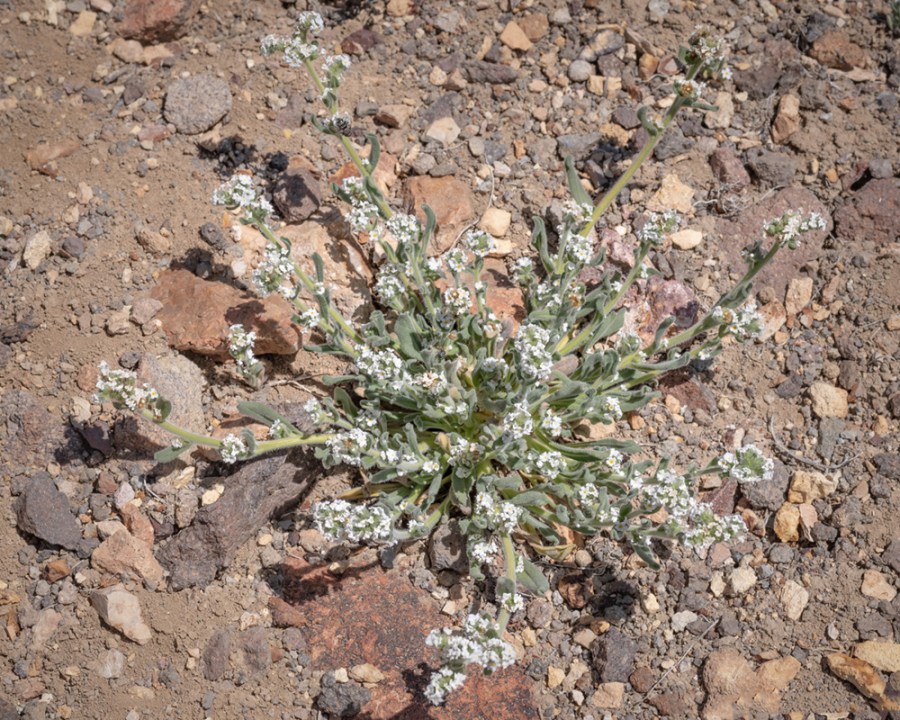
Stylocline psilocarphoides

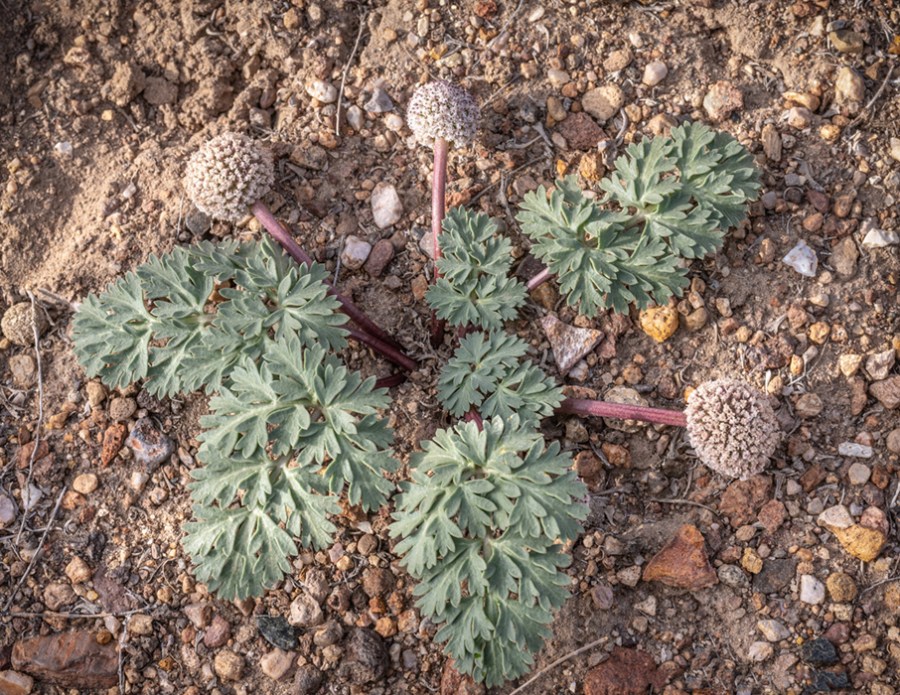
Cymopterus globosus

Claytonia perfoliata

Amsinckiopsis kingii


Copyright © Tim Messick 2023. All rights reserved.

Spring 2022 Additions to the Bodie Hills Flora

The Nevada side of the Bodie Hills continues to be an area where species previously undocumented in the area are found. Already this spring, three flowering plants new to the flora have turned up. Two were found by avid botanical explorers who shared their observations on iNaturalist; a third by me.

Why on the Nevada side? Probably a combination of factors. The area has been relatively little explored botanically prior to the last decade. Many of the early collectors of plants in the Bodie Hills were from California and focused on the more accessible California side of the range. In the northern perimeter of the Bodie Hills, the elevation is lower, so that temperatures warm up earlier than most of the rest of the Bodie Hills, favoring, in many cases, a different set of plants. The geology is varied, as indicated by the many exposures of colorful (white to red or orange) soils.

In the northern Bodie Hills.

The three species new to the Bodie Hills flora so far this year (all in May 2022) are:

Eatonella nivea (Woolly bonnets or White false tickhead): This diminutive annual in the Sunflower family (Asteraceae) is the only species in its genus (https://ucjeps.berkeley.edu/eflora/eflora_display.php?tid=2511). This was encountered independently by separate visitors to shallow sandy washes near NF-028 in Lyon County, west of Red Wash Creek: Chloe and Trevor Van Loon (iNaturalist observation) and David Greenberger (iNaturalist observation).

Before the flower heads open, Eatonella is a small, densely hairy cluster of leaves and buds, and could be mistaken for a member of the Cudweed tribe (Gnaphalieae), which locally includes Stylocline psilocarphoides, Gnaphalium palustre, and Antennaria spp. When the tiny heads open and the small white ray flowers emerge, however, it becomes more obviously a member of the Tarweed tribe (Madieae). Other tarweeds in the Bodie Hills are Madia glomerata, Layia glandulosa, Eriophyllum lanatum, and Arnica spp.

Eatonella nivea © DavidGreenberger/iNaturalist
Eatonella nivea © Chloe and Trevor Van Loon/iNaturalist

Astragalus platytropis (Broad-keeled milkvetch): This member of the Pea family (Fabaceae) is in the mega-genus Astragalus, which includes 97 species in California, 156 species in the intermountain region, 380 species in North America, and more than 2,500 species worldwide (approximate numbers, not counting varieties).

It was found on Bald Peak (north of Beauty Peak, northeast of Dry Lakes Plateau), again by Chloe and Trevor Van Loon (iNaturalist observation). Broad-keeled milkvetch is well documented in the Sweetwater Mountains just north of here, south to the Charleston Mountains near Las Vegas, on high ranges across the Great Basin to western Utah and northern Nevada, central Idaho, southwest Montana, and even a site west of Cody, Wyoming (map). Nearly all occurrences appear to be on rocky hilltops and ridges, on open slopes and in forest openings at subalpine to alpine elevations, often on limestone (none of this in the Bodie Hills), but also on granitic or volcanic substrates. It’s on rhyolite at Bald Peak.

Astragalus platytropis © Chloe and Trevor Van Loon/iNaturalist

Glossopetalon spinescens var. aridum (Spiny greasebush): Glossopetalon is a genus of only about 5 species in a family that is also new to the Bodie Hills flora, Crossosomataceae. I encountered Glossopetalon spinescens unexpectedly near the summit of a hill I had not previously climbed (there are still many of these), east of The Elbow, overlooking the East Walker River (iNaturalist observation).

It’s a small, densely branched shrub, with sharp, thorny stem-tips. It lives in dry, rocky places, often on on limestone, but here on a volcanic ridge-top. At first glance, its appearance made me think of Menodora spinescens (Oleaceae), also present in this area, but the flowers were different, with much narrower petals, not fused into a tube.

Glossopetalon spinescens
Overlooking the East Walker River. South end of the Pine Grove Hills across the river at right; Sweetwater Mountains in the distance. Glossopetalon spinescens near the rocks at left.

Three other species have been confirmed in the Bodie Hills that were previously listed as “uncertain or unconfirmed status in the Bodie Hills,” i.e., species likely to be present, but not yet documented, or else reported decades ago, but needing confirmation: Chaenactis macrantha (Mojave pincushion), Arceuthobium divaricatum (Pinyon dwarf-mistletoe), and Festuca octoflora (Sixweeks fescue).

The Chaenactis (Asteraceae) is an annual with much larger flower heads than other pincushion species in the area. It was found in coarse alluvium along Red Wash Creek by Conor Moore (iNaturalist observation).

Chaenactis macrantha (photographed at Fort Churchill, NV)

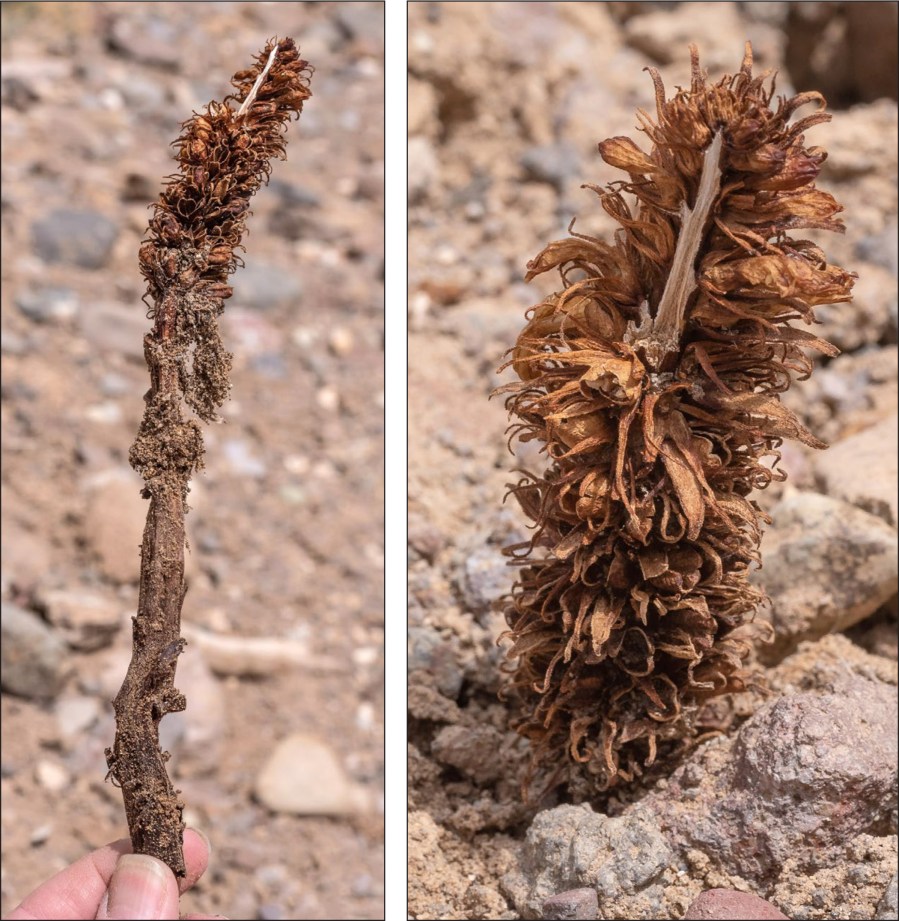
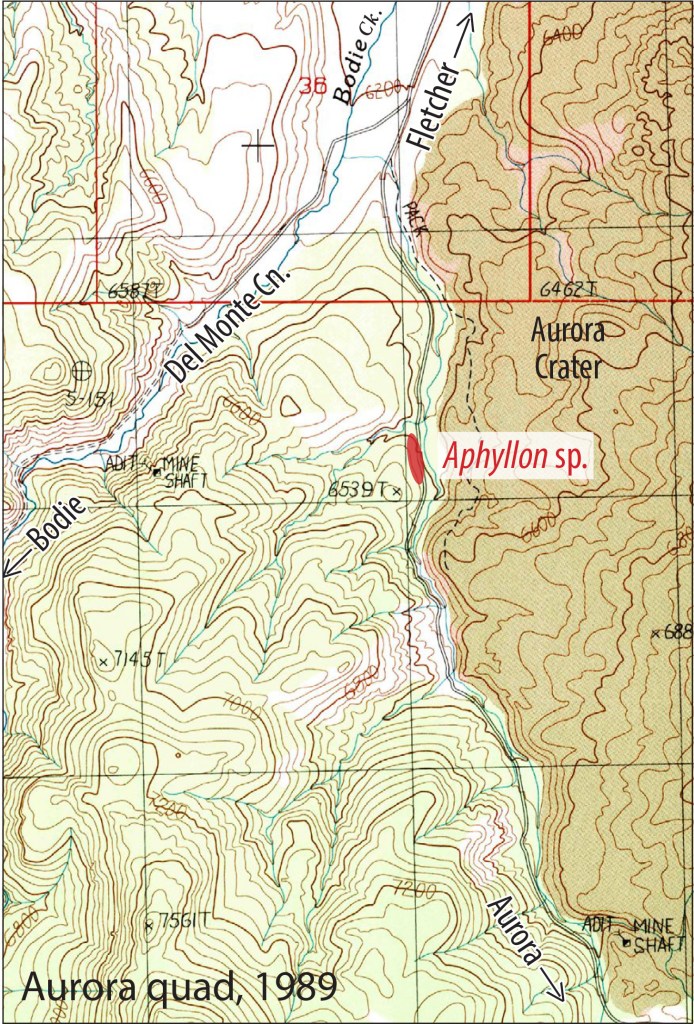
The Arceuthobium (Viscaceae) is a parasite that occurs only on pinyon pines, though it is sometimes treated as part of Arceuthobium campylopodum (Western dwarf-mistletoe), which is common on Ponderosa and Jeffrey pines. It was found to be locally abundant in a stand of pinyons along the road from Fletcher to Aurora (iNaturalist observation).

Arceuthobium divaricatum

The Festuca (Poaceae, formerly in genus Vulpia) is an early-season annual grass found on the same hill as the Glossopetalon (iNaturalist observation), and likely to be common in rocky places around the northern and eastern margins of the Bodie Hills. It dries out and falls apart by early summer, though, so it’s easy to overlook in all but very early-season surveys.

Festuca octoflora

Are still other “new” species out there waiting to be added to the Bodie Hills flora? Almost certainly. Where and when might they be found? I would suggest looking in places that haven’t been thoroughly explored in the past, including the canyons and tributaries of Rough Creek (downstream from the Bodie-Masonic Road) and Bodie Creek (Del Monte Canyon), and the more remote peaks in the range, such as Bald Peak and Mount Hicks. I would also look anywhere with moist soil during the spring of increasingly infrequent “wet” years, after a good amount of winter snow and spring rain.

Bodie Creek in Del Monte Canyon.

Copyright © Tim Messick 2022. All rights reserved.