
There are 2 species of violet in the Bodie Hills, easily distinguished by flower color and habitat. The scientific name of the commonest violet, however, is misleading: Viola purpurea (Golden violet) isn’t obviously purple. It has bright yellow flowers, but the backs of the upper petals have some purplish-reddish-brown (see photo below). Golden violet grows in relatively dry woodland and sagebrush sites. Viola nephrophylla (LeConte violet) has blue to violet flower petals (not quite purple either). LeConte violet grows in wet meadows.
Key to Viola in the Bodie Hills
- 1. Petals deep blue-violet to white; growing in wet meadows; stem absent …… V. nephrophylla
- 1′ Petals deep lemon-yellow, the upper 2 and sometimes lateral 2 reddish to purple-brown on the back; growing in drier soils, often in pinyon-juniper woodland and sagebrush; stems present but not always prominent, prostrate to erect, usually several …… V. purpurea
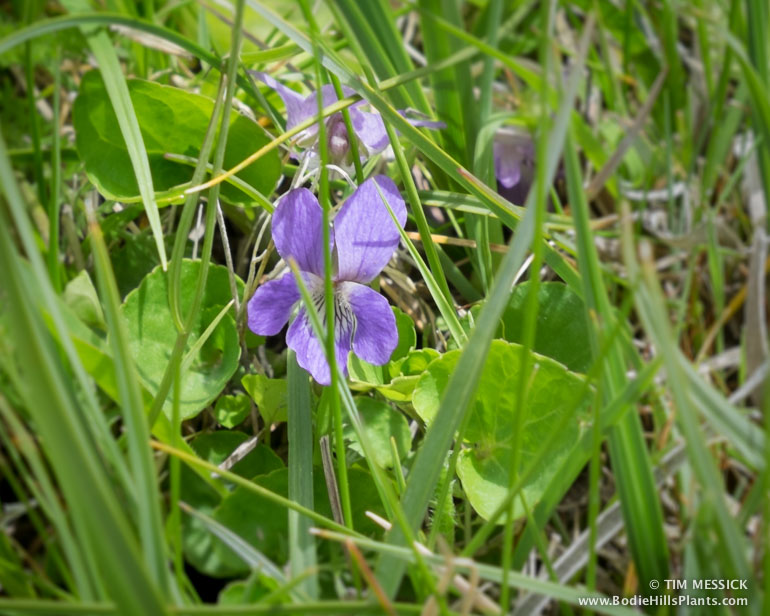
Viola nephrophylla
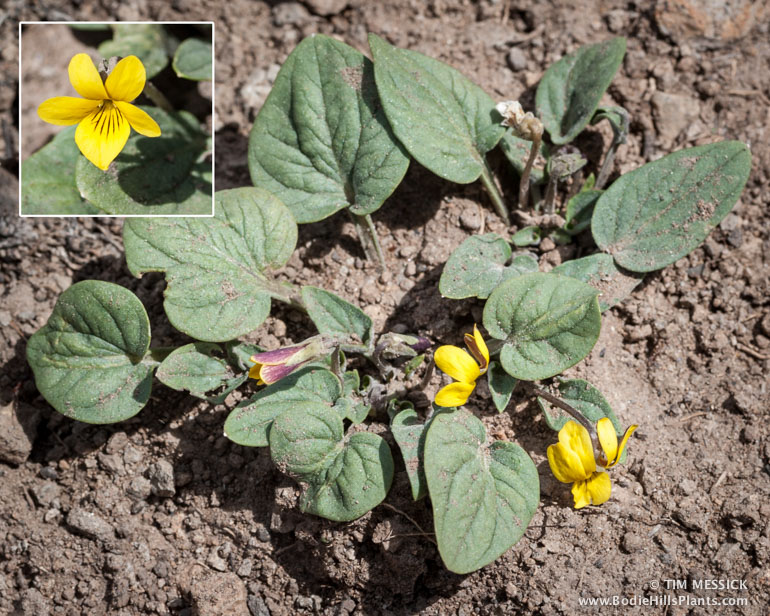
Viola purpurea
Several subspecies of V. purpura occur in the western Great Basin and eastern Sierra Nevada; but these are variable and they intergrade, so some plants may not fit neatly into any one of them. Plants growing in shade often produce larger leaves and longer stems than those in full sun. Subsp. aurea may be the most prevalent in the Bodie Hills, but subsp. mojavensis or others may be present also.
Subspecies of Viola purpurea in Mono County
- 1. Leaves canescent to green-tomentose; basal leaves oblong, ovate, or round …… subsp. aurea
- 1′ Leaves ± glabrous to puberulent
- 2. Stems mostly buried, short, not much elongated by end of season; plant 3–8.5 (up to 12) cm tall; basal leaves coarsely serrate or generally irregularly dentate or crenate with 2–4 rounded lobes per side …… subsp. venosa
- 2′ Stems generally not buried, generally elongated by end of season; plant 3–25 (up to 34.5) cm tall
- 3. Basal leaf with 4–5 (up to 6) prominent lobes per side; basal leaf bases cordate to truncate …… subsp. mohavensis
- 3′ Basal leaf without prominent lobes; basal leaf bases tapered …… subsp. purpurea
Keys adapted from: R. John Little 2014. Key to Viola, in Jepson Flora Project (eds.) Jepson eFlora, http://ucjeps.berkeley.edu/cgi-bin/get_IJM.pl?key=10278, accessed on December 22, 2015.
What does “canescent” mean? Check out the Jepson eFlora’s Glossary.
Copyright © Tim Messick 2016. All rights reserved.
DOWNLOAD THE CHECKLIST


 Plants of the Bodie Hills