
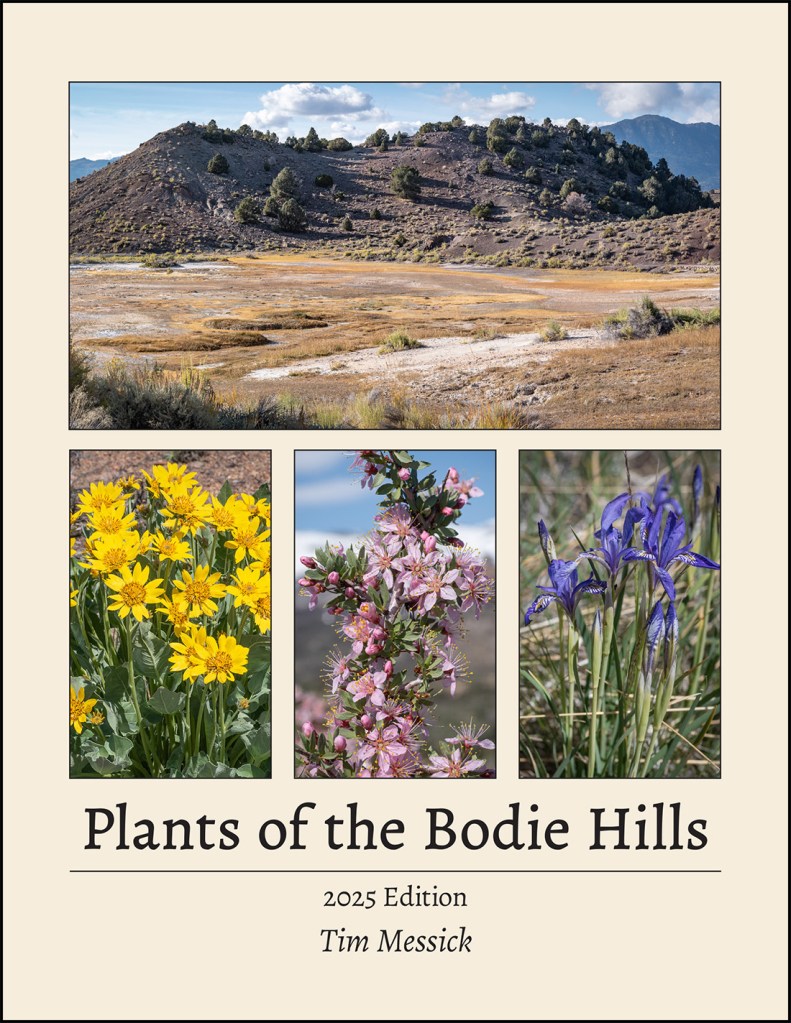
Plants of the Bodie Hills, 2025 Edition, is now available on the Downloads page (a free PDF). As in previous years, the new edition contains additions, corrections, nomenclatural updates, and refinements to the keys.
Nearly 700 “minimum rank” taxa in 79 families are known to occur in the Bodie Hills. (Minimum rank taxa are the subspecies or varieties within a species, if the species has those, or just the species itself if it contains no lower taxa.) Up to about 100 more such taxa may be possible here—because they occur nearby and suitable habitats are present, or because they were collected very long ago but have not been seen in recent decades. These remain uncertain, not yet confirmed by recent collections or observations within the Bodie Hills.
Here are the notable changes included in this year’s edition:
Two vascular plants not previously known or expected to occur in the Bodie Hills were recently documented here:
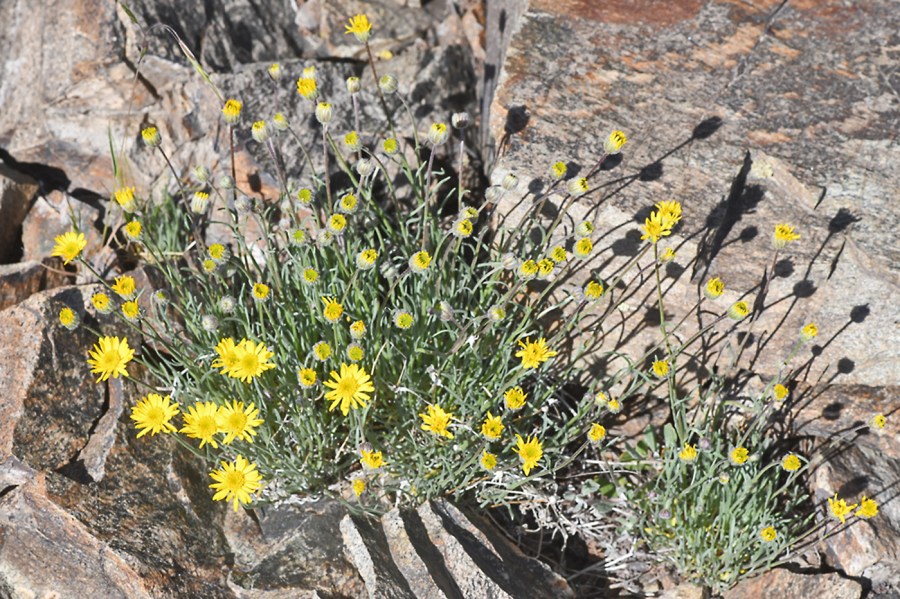
Erigeron linearis (Desert yellow fleabane) was observed in 2023 in talus on a high ridge west of Masonic Mountain and in 2024 at two locations on rocky slopes in sagebrush scrub south of Hwy 270, east of Mormon Meadow (https://www.inaturalist.org/observations?captive=false&place_id=121648&subview=map&taxon_id=76926).
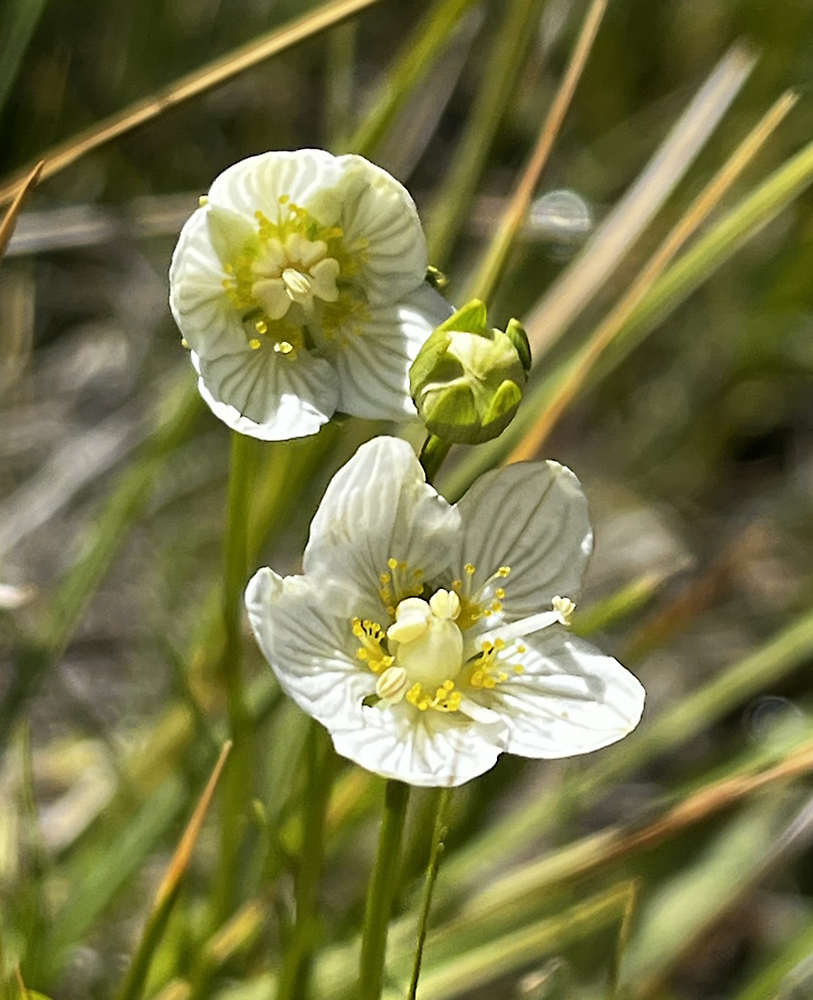
A Parnassia (Grass-of-Parnassus), probably P. palustris, was discovered in late July 2024 at a hillside spring near the east end of Cow Camp Road. The observation photos were somewhat inconclusive as to whether this was P. palustris or P. parviflora, so follow-up site visits (in July–August) are needed to confirm which one is present.
Several plants that had been previously reported or expected to occur in the Bodie Hills were confirmed to be present:
Allium lemmonii (Lemmon’s onion) was previously observed in 2023 and confirmed in 2024 near Success Mine and at Chemung Lake. This is typically on seasonally saturated clayey soils. As with many wild onions, one has to closely examine the shape of the ovary crests (around the center of the flower) to identify the species. In Allium lemmonii, the crests are thick and rounded in cross-section; in other species that may appear similar (A. atrorubens and A. bisceptrum), the ovary crests are thin and triangular.

Tiquilia nuttallii (Annual tiquilia) is common in sandy soils throughout the Mono Basin, and as expected, has been found along the southwestern and northeastern edges of the Bodie Hills. The genus Tiquilia was formerly in the broadly-defined Boraginaceae (Borage or Forget-me-not family), but under the newer 11-family concept of order Boraginales, supported by much genetic work, Tiquilia is now in Ehretiaceae (Ehretia family).

Geranium californicum (California geranium) was collected at or near Bodie Ranch (5.3 road miles northeast of Bodie) by Annie Alexander and Louise Kellogg in 1945 and has not been collected or observed in the Bodie Hills since then. In May of 2024, a Geranium assumed to be G. californicum was discovered near this location—in leaf, but not yet in flower. Flower characters rather than leaf characters are necessary for distinguishing G. californicum from G. richardsonii, another common species of the Sierra Nevada. This new observation is most likely the same species observed by Alexander and Kellogg, but further observations of the flowers are needed to confirm which of these two potential species it is.
An often-misidentified (by me and others) lupine along the Bodie-Masonic road near Bodie Mountain was confirmed to be Lupinus angustiflorus (Narrowflower lupine), not L. andersonii (Anderson’s lupine). Vegetatively they are quite similar, and are distinguished only by subtle characters of the flower and inflorescence. In Lupinus angustiflorus the banner back is generally hairy (but the hairs may be very sparse), the banner spot is orange to yellow, and the inflorescence bracts are more or less persistent. In Lupinus andersonii the banner back is glabrous, the banner spot is white turning purple, and the inflorescence bracts are deciduous. These lupines are best keyed with fresh flowers. The hairiness of banner backs is often best seen on flowers near the top of the inflorescence that are still in bud.

The small and easily overlooked Suaeda occidentalis (Western seablite), which I had collected near Travertine Hot Springs in 1981, was again found there in 2024. It occurs on moist or dried, alkaline soils and is uncommon in California, but more common throughout the Great Basin.

Three more species are likely additions, but need confirmation:
- Sphaeralcea grossulariifolia (Gooseberry-leaved globemallow) was collected on the west side of the east Walker River along Highway 182—so, technically on the very edge of the Sweetwater Mountains—but if it’s there, then it’s also likely to occur somewhere in the northern Bodie Hills.
- An immature (not yet flowering) specimen that appears to be Solidago multiradiata (Northern goldenrod) was found at Murphy Spring. Let’s hope this can be confirmed in the future with plants in flower.
- An Agoseris (False dandelion) that might be A. retrorsa (Spearleaf Agoseris) was observed in 2023 in the southwestern Bodie Hills at Sage Flat.
Two “mystery plants” remain to be properly identified: an Aphyllon (Broomrape) along the road to Aurora from Fletcher, and a Pinus (likely P. flexilis, Limber pine) at the top of a steep slope near Millersville. The Aphyllon beside the road to Aurora may be the same as one observed in 2022 but posted just recently to iNaturalist from Fletcher Valley, near Nine-Mile Ranch.
Aside from these species additions and confirmations, the 2025 edition includes substantially revised or improved keys to species in several genera, notably Arnica (Arnicas), Chrysothamnus (Rabbitbrushes), Solidago (Goldenrods), and Salix (Willows).
Finally, a major new feature this year is an index to the scientific and common names of families and genera. In the PDF, the page numbers in the index are live links, so you can click (or tap) on those to immediately go to the indicated page. The many other web links throughout the document will open the indicated resource in your web browser.
As before, you have two options for how to use this document: 1) load the PDF onto a mobile device or 2) print the PDF yourself.
- Using a mobile device: I’ve found the PDF to be quite readable on my iPhone (in the Books app), although it helps that I’m near-sighted. It’s even easier to read on a tablet or laptop.
- Printing the PDF: You can print the PDF yourself or at a local print shop. I highly recommend printing the 136 pages 2-sided to conserve paper and to reduce bulk and weight in the field. A comb or spiral binding, binder clip, or other binding will hold it together.
Thanks to everyone who posts their observations from the Bodie Hills to iNaturalist. This citizen-science platform has provided much useful information for Plants of the Bodie Hills over the last several years. Thanks also to herbaria that post recent collections to online databases. And special thanks this year to Chauncey Parker for his painstaking proofreading of the manuscript (but any remaining errors are mine).
Your additions, corrections, comments, or questions are always welcome.

Copyright © Tim Messick 2025. All rights reserved.






 Plants of the Bodie Hills