Tag Archives: California

Dr. Munz at the Hot Springs

Travertine Hot Springs

A travertine ridge at Travertine Hot Springs (Sierra Nevada in the background).

Philip A. Munz (1892–1974) is a name well known to generations of California botanists. In the 1950s he collaborated with David Keck to write A California Flora, published in 1959 by the University of California Press. A decade later Munz compiled the Supplement to A California Flora (1968), and in 1973, U.C. Press published the combined volume A California Flora and Supplement. This is the 1,900-page book I carried with me on most of my plant collecting forays in the Bodie Hills, beginning in 1978. This is the book in which I keyed most of my collections for many years.

Munz visited the Bodie Hills several times from 1928 to 1960. He seems to have found Travertine Hot Springs, a mile southeast of Bridgeport,  an especially interesting place to collect. According to my geographic search of herbarium specimens using Calflora, he collected at Travertine Hot Springs on:

  • 21 May, 1947 (18 specimens)
  • 16 June 1949 (67 specimens)
  • 28 July 1950 (20 specimens)
  • 12 September 1960 (12 specimens)

He also collected 36 specimens in the Masonic Mountain area on 20 July, 1955, plus several more along Virginia Creek near the confluence with Clearwater Creek in June 1928 and May 1947.

Travertine Hot Springs

One of the wet meadow areas at Travertine Hot Springs.

Some of the plants Munz collected at Travertine Hot Springs more than a half-century ago have not been documented by subsequent visitors to the area (including me, during my 1978-81 visits), as far as I can determine from my searches of herbarium databases. I doubt the plants have gone away—but to find them—especially the annuals—you need to be in the right place at the right time during a favorable year, and you need to be looking and paying attention. Most visitors to Travertine are focused on taking dip in the springs. Still, it would be great to confirm the continued presence of the plants Munz found here.

So here’s a challenge for interested field botanists: Before or after immersing yourself in a pool of hot water, look for the following plants at Travertine Hot Springs, note their location, and please let me know if you find them:

DICOTS
ASTERACEAE: Crepis runcinata subsp. hallii (Hall’s meadow hawksbeard), “Wet alkaline flats and meadows.”
BORAGINACEAE: Cryptantha gracilis (Slender cryptantha), “On disintegrated travertine.”
BORAGINACEAE: Cryptantha scoparia (Gray cryptantha), “Abundant in dry loose disintegrated travertine.”
PLANTAGINACEAE: Antirrhinum kingii (King’s snapdragon), “Abundant in dry loose disintegrated travertine; pinyon-juniper woodland.”
POLEMONIACEAE: Aliciella humillima (Smallest aliciella), “Abundant in dry loose disintegrated travertine; pinyon-juniper woodland.”
POLEMONIACEAE: Aliciella leptomeria (Sand aliciella), “Hot springs, in dry loose disintegrated travertine, pinyon-juniper woodland.”
POLEMONIACEAE: Gilia ophthalmoides (Eyed gilia), “loose dry disintegrated travertine.”
POLEMONIACEAE: Ipomopsis polycladon (Branching gilia), “Disintegrated travertine.”
POLYGONACEAE: Eriogonum hookeri (Hooker’s buckwheat), “Infrequent annual on sunny, dry, loose, alkaline soil.”
POLYGONACEAE: Eriogonum ovalifolium var. purpureum (Purple cushion wild buckwheat), “Crevices in travertine deposit.”

MONOCOTS
ALLIACEAE: Allium atrorubens var. cristatum (Crested onion, Inyo onion), “Dry volcanic heavy soil, wet in early season.”
LILIACEAE: Calochortus excavatus (Inyo County star tulip), “Infrequent on dry disintegrated travertine. More common in nearby volcanic soil.”
POACEAE: Elymus multisetus (Big squirreltail), “along foot of travertine ridge.”

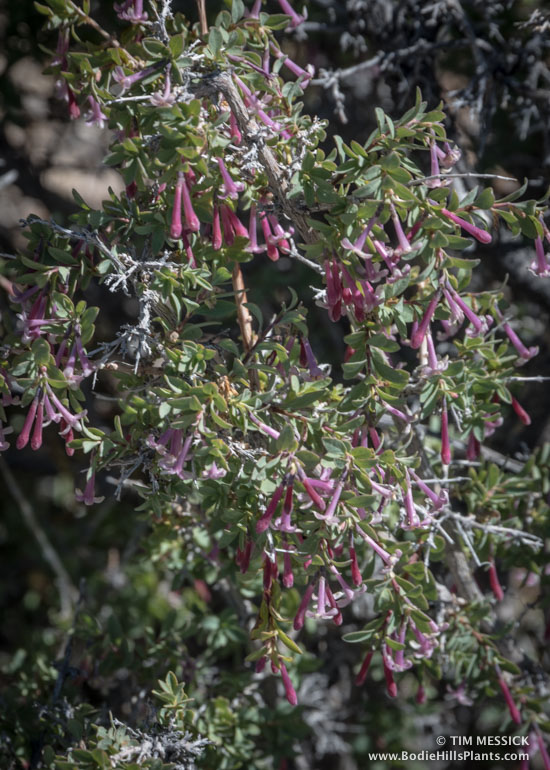
On a recent visit to Travertine Hot Springs (early June 2016), I did run into a population of  Symphoricarpos longiflorus (Desert snowberry), collected here by Munz in 1949. Here it is, along with some of the other cool plants I saw during the same visit:
Symphoricarpos longiflorus

Symphoricarpos longiflorus (Desert snowberry)

Symphoricarpos longiflorus

Another Symphoricarpos longiflorus with paler corollas

Penstemon speciosus

Penstemon speciosus (Showy penstemon)
Packera multilobata

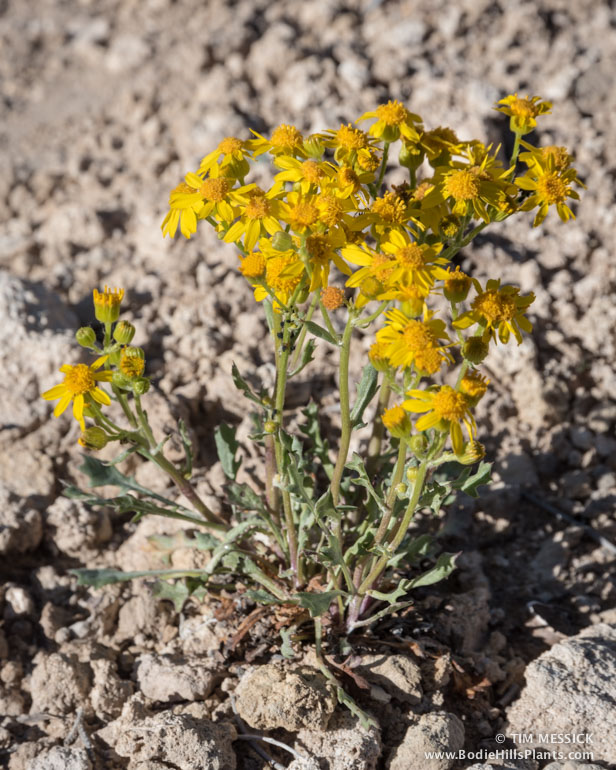
Packera multilobata (Lobeleaf groundsel)

Cleomella parviflora

Cleomella parviflora (Slender cleomella)

Minuartia nuttallii

Minuartia nuttallii var. gracilis (Nuttall’s sandwort)

Triglochin maritima

Triglochin maritima (Common arrow-grass)


Copyright © Tim Messick 2016. All rights reserved.
DOWNLOAD THE CHECKLIST

How Big are the Bodie Hills?

How big are the Bodie Hills? How many square miles? That depends, but first, here are the numbers I’ve come up with:

  • in Mono, CA . . . . . . . . . . . .259 square miles (62%)
  • in Mineral, NV . . . . . . . . . .146 square miles (35%)
  • in Lyon, NV . . . . . . . . . . . . . 12 square miles (3%)
  • Total area . . . . . . . . . . . . . . . . 417 square miles

Overview of the Bodie Hills

Overview of the Bodie Hills from the southeast

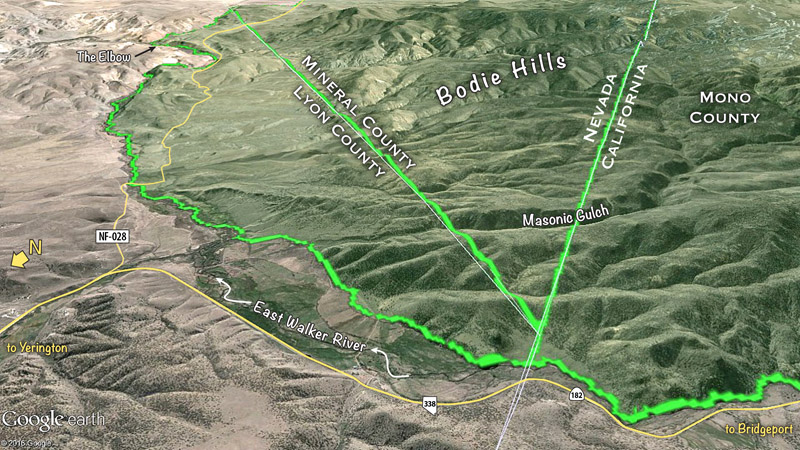
It depends, of course, on where you draw the boundaries. There are relatively sharp natural boundaries in some areas — Virginia Creek along the southwest edge, the East Walker River in the canyon that separates the Bodie Hills from the Sweetwater Mountains, and the edge of Big Meadows south of Bridgeport.

In other areas the natural or physical boundary is less obvious. Along the east side of the range, the channels of Rough Creek and Mud Spring Wash are potential boundaries, but that would include a good bit of Fletcher Valley, with lower elevations and different vegetation than in the Bodie Hills proper. Along the south edge of the range, there is a relatively narrow transition in some areas from the rocky and wooded Bodie Hills to the sandy, mostly shrubby Mono Basin. But there’s no single elevation contour that consistently follows this transition, and the boundary becomes more vague east of Trench Canyon.

Should Cedar Hill (about 12 square miles) be included? I’ve left it outside the Bodie Hills, running the boundary instead through Trench Canyon, but that choice is fairly arbitrary.

Should the very young (<100,000 year-old) late Pleistocene trachyandesite of Mud Spring—the lava dome that fills the narrow far-southeast end of Fletcher Valley—be included? I’ve left it out, following instead the approximate route of the paleodrainage channel of Lake Russell (Pleistocene Mono Lake), along the southern edge of that formation.

Bodie Hills from the east

Bodie Hills from the east

Should boundary follow the East Walker River through the irrigated valley bottom just east of the state line? I’ve drawn it closer to the base of the hill slopes to the south, mostly excluding that valley bottom.

Bodie Hills from the north

Bodie Hills from the north

In some areas lacking a hard “edge” to the Bodie Hills, roads provide a convenient, if somewhat arbitrary boundary. My southern boundary follows roads from US 395 to Cottonwood Canyon. My eastern boundary follows roads in the vicinity of Alkali Lake and in Fletcher Valley from about Mud Spring to the Miocene trachyandesites incised by lower Rough Creek. For convenience, my western boundary follows US 395 south of Bridgeport and State Route 182 north of Bridgeport.

Bodie Hills from the southwest

Bodie Hills from the southwest

One could quibble and fuss over the boundary in a number of places, but further refinement would change the total area (and the number of plants included in the checklist) very little.

Methods: I imported 13 US Topo quadrangles (1:24,000 scale) covering the Bodie Hills into Adobe Illustrator, using Avenza’s MAPublisher plug-in to maintain the georeferencing from the GeoPDFs made by USGS. I drew and adjusted the boundaries described above for the entire range on a new georeferenced layer, copying and joining road and river line segments from other layers where available. I then divided that area using the county boundary lines. I exported the three resulting shapes to a KMZ file, opened that in Google Earth Pro, and looked at the their “measurements” info for the square miles in each county.


Copyright © Tim Messick 2016. All rights reserved.
DOWNLOAD THE CHECKLIST

Available Now: Plants of the Bodie Hills, an Annotated Checklist

Lewisia rediviva var. minor

Lewisia rediviva var. minor

A year ago I decided to update the “Flora of the Bodie Hills” I had written 3.3 decades ago as my MA thesis at Humboldt State University. Why? There have been many nomenclatural and taxonomic changes in the flora, many more species have been found by subsequent collectors in the area, and there is now greatly simplified access to all this information through the internet. The Bodie Hills are rich in plants, wildlife, human history, geological interest, and recreational opportunities. More than ever, the natural resources of the Bodie Hills should be explored, documented, managed, and protected for all who enjoy the area.

Checklist Cover December 2015Plants of the Bodie Hills, an Annotated Checklist is a free, 47-page PDF document (5.1 MB), available for DOWNLOAD HERE. This first edition is dated January 3, 2016. Future editions will be released occasionally, as additions and corrections are made. This annotated checklist is an alphabetized list of plants by family and scientific name, with notes on distribution, habitat, and information gleaned from herbarium specimens. There are currently no keys, photographs, or illustrations, but I hope to add these in the future.  Meanwhile, selected keys, photos, and other natural history notes will be posted occasionally here at BodieHillsPlants.com.

Let me know what you think! And please tell me if you find additional plants in the Bodie Hills or errors that need correcting. Leave a comment below, go to the Contact Page, or email me at tmessick1[at]gmail.com. Thanks!

Masonic Upper Town

Masonic Upper Town (site) and the road south to Bodie


Copyright © Tim Messick 2016. All rights reserved.
DOWNLOAD THE CHECKLIST