It’s past time for an update to the vascular plant checklist for Hot Springs Valley and Grover Hot Springs State Park, in Alpine County, California. Since the last version of the checklist (November 2018), several plants have been added to the list, based on observations posted to iNaturalist (https://www.inaturalist.org/observations?place_id=127882). The list now includes 348 “minimum rank” taxa (distinct species, subspecies, or varieties) in 64 plant families. The March 2024 version of this checklist (a free 8-page PDF) is available on the Downloads Page.
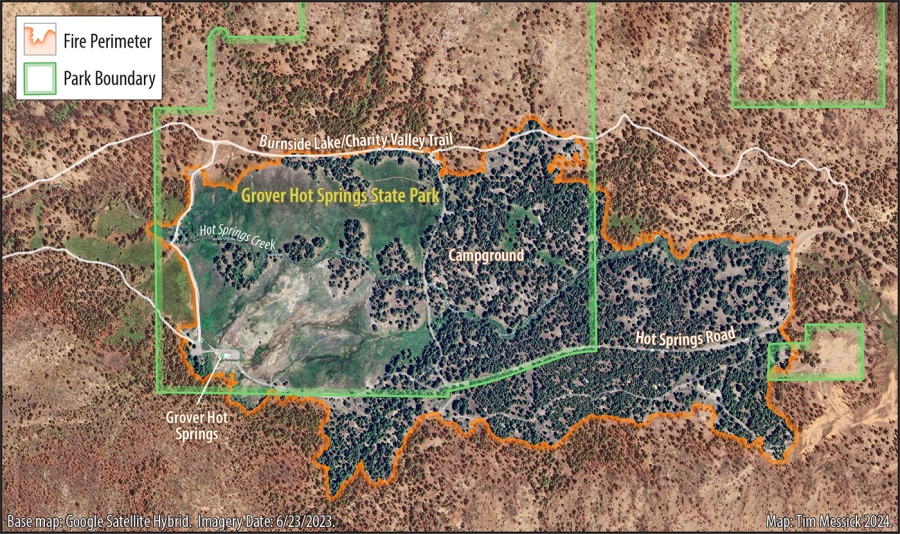
Some of these additions are a result of disturbance and habitat changes caused by the Tamarack Fire, which burned much of the valley (but not the hot springs, meadows, or campground) in July 2021. Below are two views of the Tamarack Fire perimeter. The first shows the burned area in relation to all of Hot Springs Valley, including Grover Hot Springs State Park; the second is zoomed in to the fire perimeter around the meadows within the main part of the park.
Recent additions to the list of plants here include:
Argemone munita (Flatbud Prickly Poppy)
Eriogonum umbellatum (Sulfur Buckwheat)
Heterotheca orovillosa (Hairy Goldenaster)
Mimetanthe pilosa (False Monkeyflower)
Nicotiana attenuata (Coyote Tobacco)
Ranunculus alismifolius Plantainleaf Buttercup)
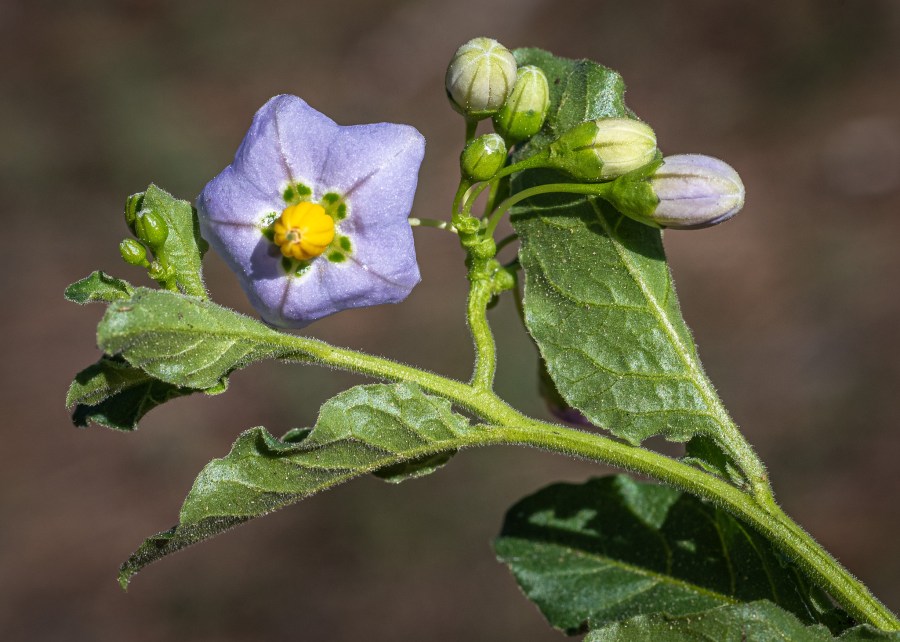
Solanum xanti (Purple Nightshade)
It will be interesting to continue exploring burned areas and monitoring habitat recovery this year and for some years to come. I was impressed with the abundance of native flora growing in some burned areas (especially near moisture) during my last visit, in June 2023.
Update, March 13, 2024: I’ve corrected a bunch of typos and other minor errors in the January 2024 edition, and have replaced it with a new, updated and corrected March 2024 edition, at the same link on the Downloads page. There you will also find a new, short (9 pages), simple Checklist (without lengthy keys and annotations) as a quick reference for printing or to load onto your smartphone.
Plants of the Bodie Hills, 2024 Edition, is now available on the Downloads page (a free PDF). As in previous years, the new edition contains additions, corrections, nomenclatural updates, and refinements to the keys. A key to families of Dicots (Magnoliopsida) in the area has at long last been added. Several place names, road names, and boundaries have been added to the map on the back cover (last page of the PDF).
The total number of “minimum rank” vascular plant taxa documented to occur in the Bodie Hills now stands at 727, in 80 families. Another 96 taxa, including 2 additional dicot families, are still considered to be potentially present, but not yet confirmed by collections or observations within the Bodie Hills.
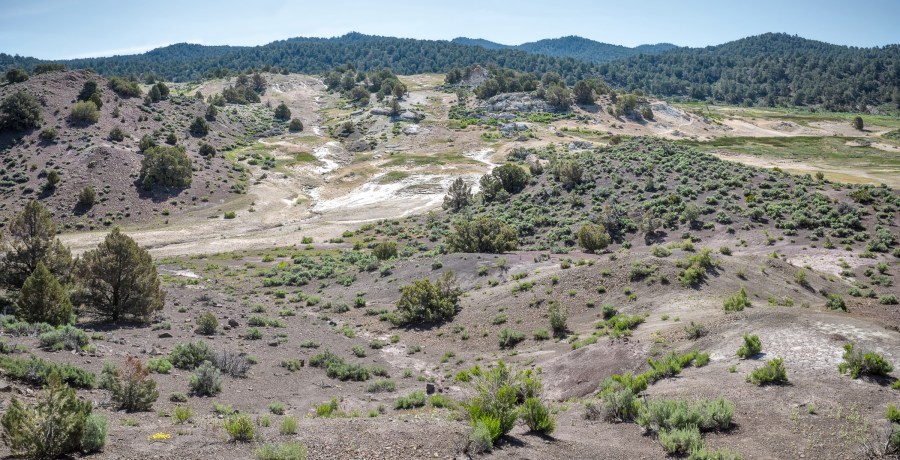
Below Travertine Hot Springs
New additions to the 2024 edition (found during 2023) are:
Lupinus uncialis (Lilliput lupine) at the Bodie Hills Preserve and at Travertine Hot Springs,
Micromonolepis pusilla (Dwarf monolepis) at Mormon Meadow,
Phacelia curvipes (Washoe phacelia) in the southwestern Bodie Hills,
Platanthera tescamnis (Great Basin bog orchid) at a remote spring in the northeastern Bodie Hills in Mineral County, and
Saponaria officinalis (Common soapwort) at Conway Summit.
Plants seen in 2023 that had been expected in the Bodie Hills or not seen here for decades were:
Antirrhinum (Sairocarpus) kingii (King’s snapdragon) at Travertine Hot Springs,
Collomia grandiflora (Large-flowered collomia) near Mormon Meadow,
Eriogonum hookeri (Hooker’s buckwheat) at Travertine Hot Springs,
Erythranthe rubella (Little redstem monkeyflower) at “Sage Flat,” (near the Little Bodie Mine historical marker),
Malacothrix glabrata (Desert dandelion) in Red Creek Wash (from a 1983 collection),
Penstemon deustus (Hot rock penstemon) north of Bridgeport Reservoir Dam, and
Silene nuda (Sticky catchfly) along Cow Camp Road.
Nearly all of these were found, not by me, but by others posting their observations to iNaturalist (thanks to all who do this!). All observations within the Bodie Hills on iNaturalist can be seen HERE.
Jeffrey and Lodgepole pines in the western Bodie Hills
As before, you have two options for how to use this document: 1) load the PDF onto a mobile device or 2) print the PDF yourself.
Using a mobile device: I’ve found the PDF to be quite readable on my iPhone (in the Books app), although it helps that I’m near-sighted. It’s even easier to read on an iPad, other tablet, or laptop.
Printing the PDF: You can print the PDF yourself or at a local print shop. I highly recommend printing the 128 pages 2-sided to conserve paper and to reduce bulk and weight in the field. A comb or spiral binding, binder clip, or other binding will hold it together.
Your additions, corrections, comments, or questions are always welcome.
Following a winter of heavy snowfall and continued rain into the spring, 2023 has been a great year for additions to the flora of the Bodie Hills. Here’s a list of species added, confirmed, or newly expected to occur in the Bodie Hills, as of mid-October, 2023. These additions and updates will all be included in the 2024 edition of “Plants of the Bodie Hills,” available for download early next year.
Species ADDED, not previously known to occur in the Bodie Hills
Lupinus uncialis (Lilliput lupine or Inch-high lupine) is the most exciting discovery this year in the Bodie Hills. It was found in large numbers at The Wildland Conservancy’s Bodie Hills Preserve south of Bridgeport and a day later at Travertine Hot Springs (here and here). Of all the lupines in the world (more than 260 species, mostly in western North and South America), this one is the smallest. Why has this never been seen in (or even near) the Bodie Hills before? Maybe this tiny annual thrives only in wet years. And it’s very inconspicuous: big plants measure about 4 cm across and 2 cm tall, and the tiny flowers (1–2 per inflorescence) are mostly concealed among the leaves and around the edges of the plant. Who pollinates this thing?
This find counts as a range extension of 87.5 miles miles (140.8 km) from the nearest collection (in Fairview Valley, Nevada), or about 67 miles (108 km) from the nearest confirmed observation in iNaturalist (near Gabbs Valley, Nevada). It occurs across much of central and northern Nevada, plus southeast Oregon and probably eastern Modoc County, California (though documentation for Modoc County is scant). Lupinus uncialis is on CNPS list 2B.2 (rare, and probably moderately threatened in California).
Lupinus uncialis
Micromonolepis pusilla
Micromonolepis pusilla (Dwarf Monolepis) was chanced upon in the middle of Coyote Springs Road at Mormon Meadow. This small annual with plump little reddish leaves occurs more often in “alkaline flats” and is very inconspicuous (especially when on reddish soil). It occurs eastward to Wyoming and north to Washington, but is on CNPS list 2B.3 (rare, but not very threatened in California).
Platanthera tescamnis (Great Basin bog orchid) has been found at a remote spring in the northeastern Bodie Hills in Mineral County. This is only the second orchid known to occur in the Bodie Hills (along with Corallorhiza maculata in Masonic Gulch).
Phacelia curvipes (Isaiah Woodard/iNaturalist)
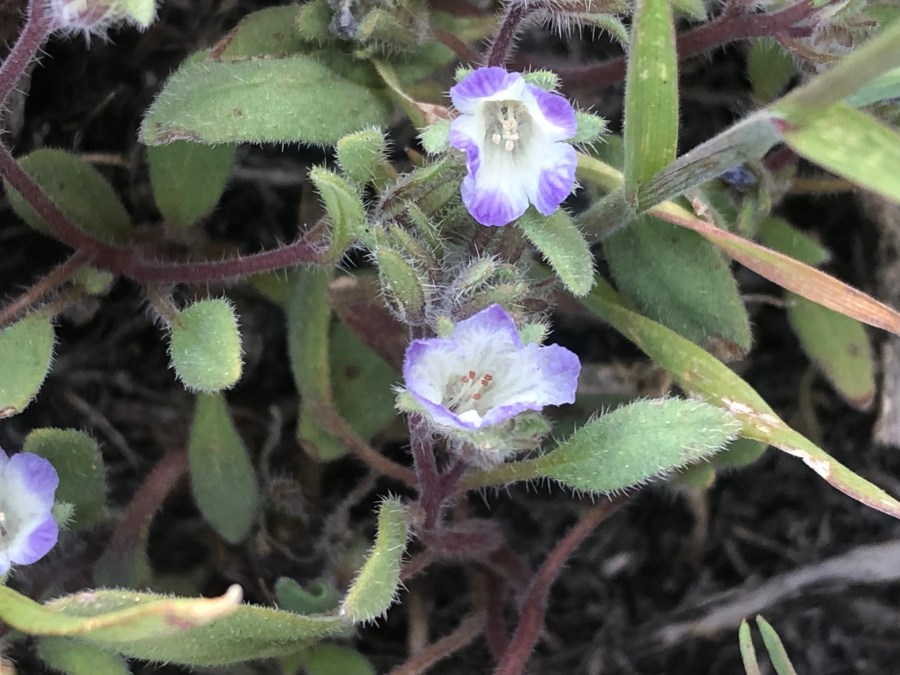
Phacelia curvipes (Washoe phacelia) has been found at two locations in the southwestern Bodie Hills (here and here). It’s a small annual with blue and white flowers, somewhat like the locally very common Phacelia humilis, but with more decumbent, spreading (rather than erect) stems. Phacelia curvipes has been seen and collected in many places near the west edges of the Mojave and Great Basin deserts in California and Nevada, and across to southwestern Utah and northwestern Arizona, but these are the first records of it in the Bodie Hills.
Saponaria officinalis (Common soapwort, Bouncing-bet, Wild sweet William, etc.) is native to southern Europe. It’s an attractive, but unwanted weed along Lee Vining Creek and in other moist, disturbed areas. It was recently observed beside the Caltrans Sand/Salt Storage facility on Conway Summit.
Species CONFIRMED, previously considered likely to occur, or not documented for many years in the Bodie Hills
Collomia grandiflora (Large-flowered Collomia or Grand Collomia) is fairly common in mountains across the west from southern California to southern British Columbia. It’s been seen in the Sweetwaters and Wassuk Range, so was considered possible in the Bodie Hills. This year, Jeff Bisbee found it on a slope north of Mormon Meadow.
Eriogonum hookeri (Hooker’s wild buckwheat) has been documented in the Bodie Hills, again only at Travertine Hot Springs, three times previously: in 1937 by G. A. Graham, in 1950 by Philip Munz, and in 2003 by Dean Taylor. This year it was first noticed at Travertine by Chloe and Trevor Van Loon, and soon after that by several other visitors. It also occurs in the Inyo-White Mountains and across most of Nevada to central Utah.
LEFT: Collomia grandiflora (at a site near Sonora Junction); RIGHT: Eriogonum hookeri
Erythranthe rubella (Redstem monkeyflower) can be difficult to distinguish from the very common E. breweri, and sometimes from the also common E. suksdorfii. All three tend to be very tiny annuals. A plant identified as E. rubella and confirmed by monkeyflower scholar Naomi Fraga has been observed at “Sage Flat,” east of Hwy 395 and a bit north of the Little Bodie Mine historical marker. Erythranthe rubella is probably more common than realized in the Bodie Hills, as misidentifications may be common.
Malacothrix glabrata (Desert dandelion) is common in arid areas of western North America, and has been seen east of the Bodie Hills. Recently, a 1983 collection by Glenn Clifton in Red Creek Wash appeared in the herbarium databases.
Sairocarpus kingii, aka Antirrhinum kingii (Least snapdragon), is found mostly in the western Great Basin, east of the Sierra Nevada, but also to eastern Oregon and central Utah. It was collected on 6/16/1949 by Philip Munz at Travertine Hot Springs. In 2023, 74 years later, it was finally seen there again. There’s another occurrence just north of the Bodie Hills, near the south end of the Pine Grove Hills, in Lyon County.
Silene nuda (Sticky catchfly) was the tentative ID of a plant photographed along Cow Camp Road by a resident of Bridgeport Valley. The photos were a bit unclear, so there was some uncertainty about the ID. The site was visited in July 2023 by Patrick Silbey and confirmed as Silene nuda with an excellent set of photos.
Penstemon deustus (Hot rock penstemon) is fairly common from about Alpine County to northwest California, Washington, Oregon, and Wyoming. It seems to be uncommon south of about Alpine County. This year it was finally found on the northwest edge of the Bodie Hills north of the Bridgeport Reservoir dam.
LEFT: Silene nuda (Patrick Silbey/iNaturalist); RIGHT: Penstemon deustus (at a site east of Monitor Pass).
Species POSSIBLY in the Bodie Hills, but still needing confirmation
Allium lemmonii (at a site west of Monitor Pass)
Allium lemmonii (Lemmon’s onion) may have been found on a hillside near Success Mine. The ovary crests are very distinctive and should make identifying A. lemmonii easy from fresh flowers, but closer photos or a collection are needed to confirm which species was seen here.
Sphaeralcea grossulariifolia (Gooseberryleaf globemallow) has been found (in 2020 and 2022) on the northwest side of the East Walker River north of Murphy Pond, at the very edge of the Sweetwater Mountains—a stone’s throw from the Bodie Hills, so it should be here too, perhaps across the river. Although fairly common throughout the Great Basin and Colorado Plateau, it just barely enters California near Topaz Lake, the southern Wellington Hills east of Topaz, and here along the East Walker River. It’s on CNPS list 2B.3 (rare, but not very threatened in California).
The Aphyllon near Aurora The Aphyllon seen previously along the road to Aurora, but not in a condition enabling identification, remains a mystery. I didn’t get over there this year and to my knowledge, no one else has looked. Next year, perhaps.
The Silene near Cow Camp Road As noted above, the Silene nuda at a site along Cow Camp road was confirmed this past July.
The Pines near Millersville The pines on a high slope north of Potato Peak, near the site of Millersville, also remain a mystery. Road conditions up Aurora Canyon were terrible for most or all of the summer (so I’m told), so access to this location would have been difficult also.
A New Mystery Plant, Maybe: An Allium near Success Mine The wild onion mentioned above, possibly Allium lemmonii, counts as a new “mystery plant” needing a return visit to confirm its identity.








 Plants of the Bodie Hills