Tag Archives: Lyon County

Some Additions to the Bodie Hills Flora

The northern Bodie Hills

Last weekend (in mid-May, 2017), I hit the jackpot (appropriately, as this was in Nevada) for interesting plants in one part of the Bodie Hills. It was along the northern perimeter of the Bodie Hills, mostly in Lyon County, along the Sweetwater-Aurora Road (NF-028) and some side roads, ridges, and ravines. The diversity and abundance of native annual and perennial plants in flower was delightful! At least 5 species (and 4 genera) were new additions for the checklist:

Eremothera nevadensis

Nevada suncup (Eremothera nevadensis) was widespread in openings among low sagebrush throughout the low northern foothills of the range. Eremothera was formerly treated as a Section of the widespread evening-primrose or suncup genus Camissonia. Nevada suncup apparently has a somewhat limited distribution in west-central Nevada, and has yet to be found across the state line in California.
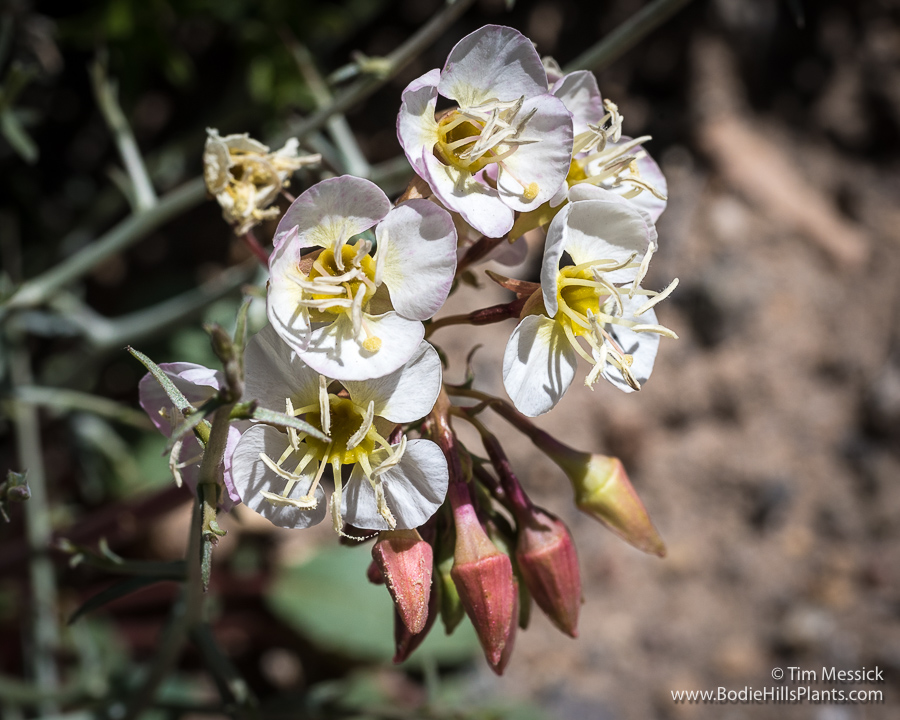
Eremothera boothii

Booth’s evening-primrose (Eremothera boothii, subspecies to be determined) was locally common, here and there, in loose sandy soil along the edges of NF-028. Eremothera boothii is  widespread, with several subspecies, throughout the arid southwest.

Amsinckia tessellata

Desert fiddleneck (Amsinckia tessellata var. tessellata) was also found on a disturbed roadside.

Lycium shockleyi

Spiny menodora (Menodora spinescens), a viciously spiny low shrub in the olive family, was in full bloom (with small, pale flowers) on a ridge on the western edge of Fletcher Valley.

Streptanthella longirostris

Hairy jewelflower (Caulanthus pilosus) was also scattered among low shrubs on this same ridge (near the Bursage and the Lycium). At first I thought this was Longbeak streptanthella (Streptanthella longirostris), which has been reported not far from this location and has similar flowers and growth habit. Nope. The plant I found (reviewing other photos and specimens) has ascending fruits (vs. recurved to reflexed in Streptanthella) and basal leaves that are pinnatifid—deeply divided (vs. entire in Streptanthella).

There may be a few more “new” plants for the list in this area, but I haven’t finished keying my specimens yet. And some Astragalus and Eriogonum plants weren’t mature enough yet to firmly identify.

I also confirmed the presence of one plant that I was unsure whether to include in the checklist:

Artemisia spinosa

Bursage (Artemisia spinosa) on a ridge on the western edge of Fletcher Valley (same place as the Lycium).

And another species previously collected by others in this area, but which I hadn’t seen before:
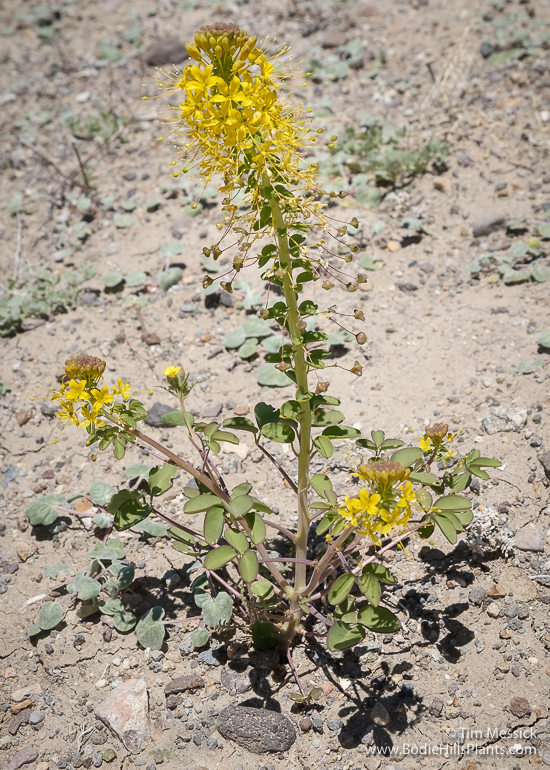
Cleomella hillmanii

Hillman’s cleomella (Cleomella hillmanii) was locally abundant on a hillside crossed by the road. It looked just like many other hillsides out there, so why did the Cleomella favor this one in particular?

Last, but not least, there was the largest population and the largest individual plants of Mono phacelia (Phacelia monoensis) I’ve ever seen:
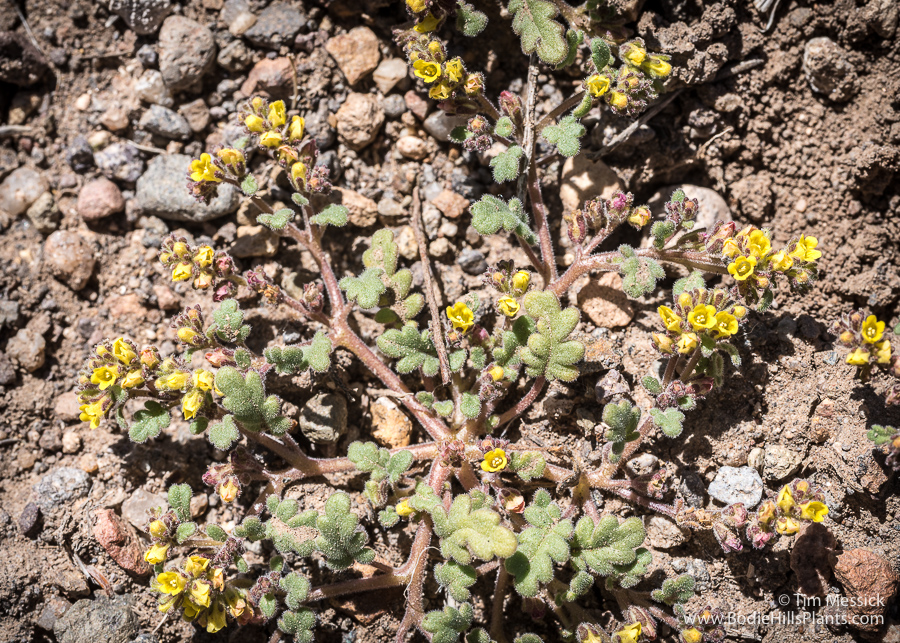
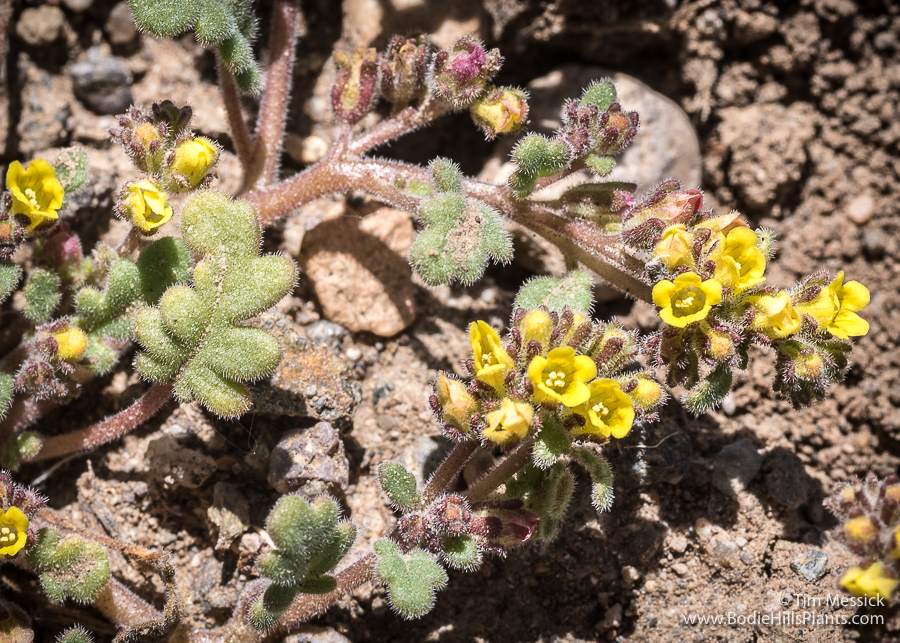
Phacelia monoensis

Phacelia monoensis

Phacelia monoensis


Copyright © Tim Messick 2017. All rights reserved.
DOWNLOAD THE CHECKLIST
Food of the Gods in the Bodie Hills

How can a scrawny plant, growing in disturbed soils, with painfully sharp spines all over its fruits come to be named  for the mythical “food of the Greek gods”—Ambrosia—a name also related, apparently, to the Greek word for immortality, αθανασία (athanasia)? Carl Linnaeus himself, the “father of modern taxonomy,” bestowed the name in 1754. But why Ambrosia? I haven’t found an explanation. The authoritative Flora North America says “allusion unclear.” One might say it’s a crusty old botanist’s joke on posterity, but I won’t impugn the intentions of the great Linnaeus. The genus isn’t native to Sweden and he may have examined only a few specimens from North America (collected by others). Maybe they smelled nice, but he probably didn’t get to know the genus well enough.

Ambrosia

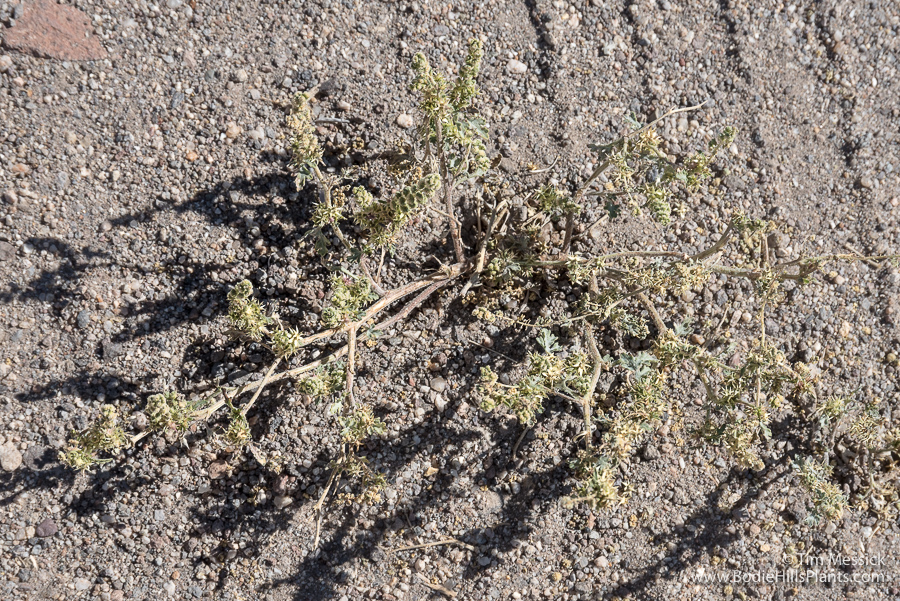
Ambrosia acanthicarpa, annual bur-weed or annual ragweed, grows on disturbed, sandy soils, often along roadsides, throughout much of western—especially southwestern—North America. The plants seen here were on a dirt road near the north edge of the Bodie Hills, in Lyon County, Nevada. I’ve also seen it beside Hwy 270 at Mormon Meadow and I’ve probably overlooked it at other locations. (Though you’re not likely to overlook it if you encounter it while wearing open-toed sandals.)

It’s not immediately obvious, but Ambrosia is a composite—in the sunflower family (Asteraceae). There are more than 40 species of Ambrosia in the New World, mostly in western North America. Ambrosia now includes plants formerly placed in Hymenoclea and Franseria.

Ambrosia

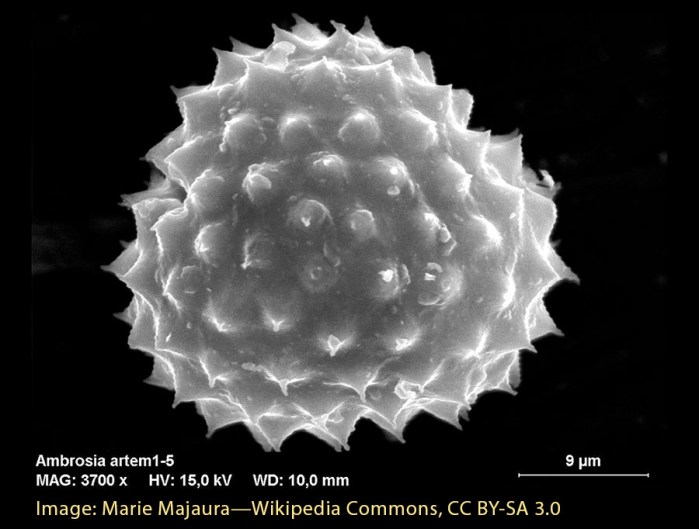
Despite its vicious demeanor, Ambrosia has an intriguing anatomy. The male flowers, bulging with stamens, are tightly clustered into numerous small heads, dangling along the axis of a tall raceme. The pollen shed from those anthers causes agonizing irritation of eyes and sinuses in anyone getting a face-full of the stuff. Magnified, the pollen grains look like lethal medieval weapons.

ambrosia_artem-wikipedia

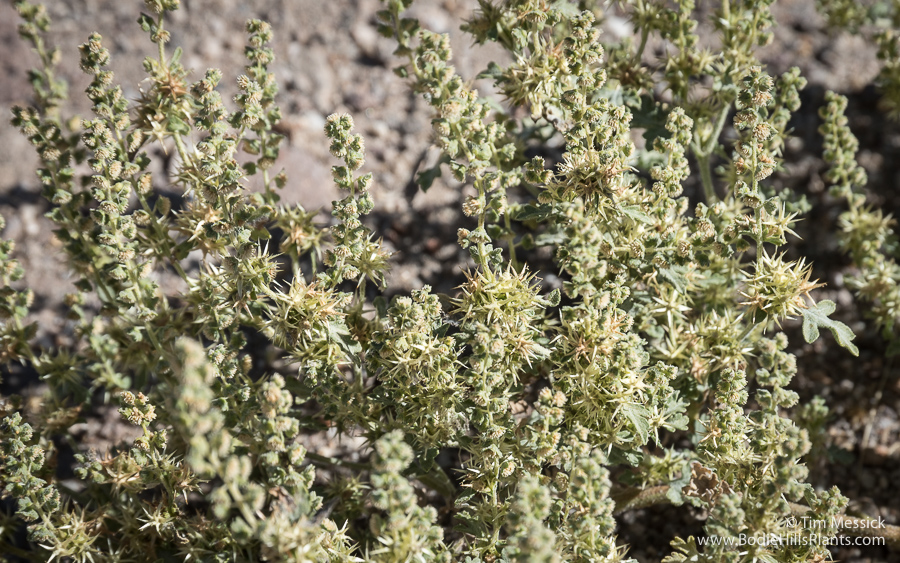
While the male flowers will insult your eyes and upper respiratory system, it is the female flowers that will draw blood from your toes and fingers. Pistillate flowers are in the axils of leaves below the staminate inflorescence—the better to catch those heavily armed pollen grains. They lack corollas and are encased, usually one at a time, in a long-spined “bur.” (These spines are derived from the paleas—in Asteraceae, the usually very thin, papery, scale-like or bristle-like “chaffy bracts” at the base of each flower.)  As the fruit matures, the bur becomes very hard. The spines stiffen and become very sharp.

Ambrosia

Did you notice the tire tracks in the first photo? Above you see evidence for one of this plant’s long-range dispersal mechanisms. The mature burs attach themselves freely to automobile tires. No doubt this is one reason Ambrosia acanthicarpa is fairly common along disturbed road shoulders and many lesser-used unpaved tracks throughout the American west.


Copyright © Tim Messick 2017. All rights reserved.
DOWNLOAD THE CHECKLIST
A Herd of Pronghorn

Pronghorn in Fletcher Valley

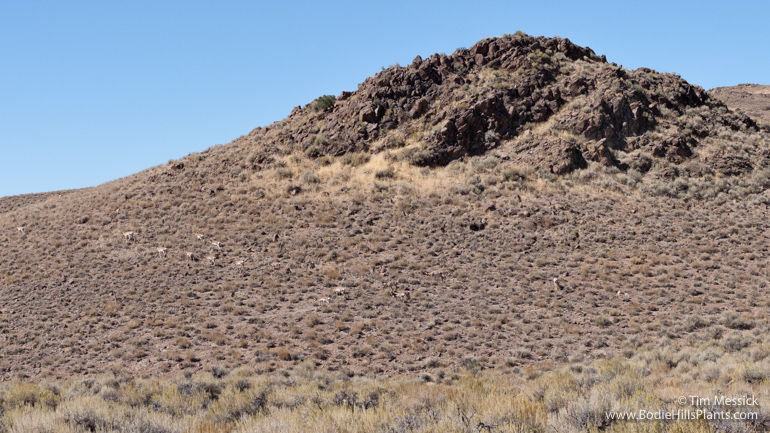
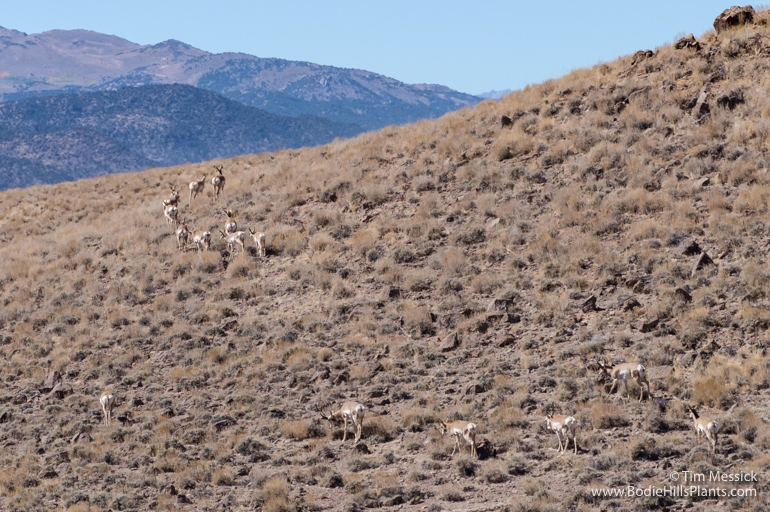
On a late-September drive along the East Walker River Road, at the north end of Fletcher Valley, I came upon a herd of pronghorn strolling through the sagebrush. I quickly stopped the car, stayed in car, and whipped out the binoculars and telephoto lens. They looked at me, but did not run away. They continued their leisurely walk up an unnamed hill and over the ridge, in the general direction of The Elbow and the Bodie Hills, six miles to the west.

Pronghorn in Fletcher Valley

I counted 21 of them, but I think a few more had already crossed the ridge before I put down the camera for a closer look with binoculars.

Pronghorn in Fletcher Valley

These animals are part of what’s recognized as the Bodie Hills herd of pronghorn. The Nevada Department of Wildlife2012-2013 Big Game Status” report notes: “This antelope herd is shared with California and utilizes upper elevation summer range in the Bodie Hills of California and winters primarily in Nevada. Because of the rain-shadow effect of the Sierra Nevada’s, the Nevada portion of winter range is often in poor condition. This can wreak havoc on fawn survival through the winter months. . . . Following good precipitation years, the population responds quite well with ample fawns contributing to a stable antelope herd.”

Pronghorn in Fletcher Valley

The “2013-2014 Big Game Status” report says, “In March of 2014, 10 pronghorn does were captured and fitted with satellite/telemetry receivers in the Rough Creek Aldridge Grade area. This was a collaborative project between the Nevada Department of Wildlife and the California Department of Fish and Wildlife to look at pronghorn distribution patterns and migration routes of the Bodie interstate herd. The follow up of this antelope herd will determine if fawns are being lost on summer range or on winter range.”

Pronghorn in Fletcher Valley

The “2015-2016 Big Game Status” report finds that 2015 was a better year for these animals: “The habitat located within these unit groups is in excellent condition because of the moisture received in fall 2015. . . . Precipitation in 2015 left the grasses and browse community in a productive state. This year’s fawn ratio should result in a stable population trend. At one time this herd numbered close to 200 animals. Consecutive years of low fawn recruitment have reduced the population to 100 animals. Future projects removing pinyon and juniper will allow for some limited expansion. Also creating corridors between California and Nevada will enable the herd to migrate easier from summer range to winter range. The population estimate for Bodie interstate herd is 110 animals.”

Fletcher Valley from Aldrich Pass

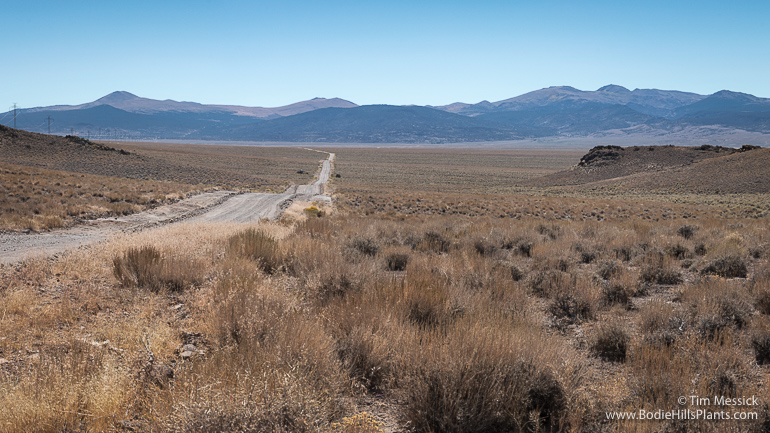
Pronghorn country: looking south from Aldrich Pass, across Fletcher Valley,
to the southeastern Bodie Hills.


Copyright © Tim Messick 2016. All rights reserved.
DOWNLOAD THE CHECKLIST