Tag Archives: Mono County

Additions to Plants of the Bodie Hills in 2023, with an update on “Mystery Plants”

Following a winter of heavy snowfall and continued rain into the spring, 2023 has been a great year for additions to the flora of the Bodie Hills. Here’s a list of species added, confirmed, or newly expected to occur in the Bodie Hills, as of mid-October, 2023. These additions and updates will all be included in the 2024 edition of “Plants of the Bodie Hills,” available for download early next year.

Species ADDED, not previously known to occur in the Bodie Hills

Lupinus uncialis (Lilliput lupine or Inch-high lupine) is the most exciting discovery this year in the Bodie Hills. It was found in large numbers at The Wildland Conservancy’s Bodie Hills Preserve south of Bridgeport and a day later at Travertine Hot Springs (here and here). Of all the lupines in the world (more than 260 species, mostly in western North and South America), this one is the smallest. Why has this never been seen in (or even near) the Bodie Hills before? Maybe this tiny annual thrives only in wet years. And it’s very inconspicuous: big plants measure about 4 cm across and 2 cm tall, and the tiny flowers (1–2 per inflorescence) are mostly concealed among the leaves and around the edges of the plant. Who pollinates this thing?

This find counts as a range extension of 87.5 miles miles (140.8 km) from the nearest collection (in Fairview Valley, Nevada), or about 67 miles (108 km) from the nearest confirmed observation in iNaturalist (near Gabbs Valley, Nevada). It occurs across much of central and northern Nevada, plus southeast Oregon and probably eastern Modoc County, California (though documentation for Modoc County is scant). Lupinus uncialis is on CNPS list 2B.2 (rare, and probably moderately threatened in California).

Lupinus uncialis
Micromonolepis pusilla

Micromonolepis pusilla (Dwarf Monolepis) was chanced upon in the middle of Coyote Springs Road at Mormon Meadow. This small annual with plump little reddish leaves occurs more often in “alkaline flats” and is very inconspicuous (especially when on reddish soil). It occurs eastward to Wyoming and north to Washington, but is on CNPS list 2B.3 (rare, but not very threatened in California).

Platanthera tescamnis (Great Basin bog orchid) has been found at a remote spring in the northeastern Bodie Hills in Mineral County. This is only the second orchid known to occur in the Bodie Hills (along with Corallorhiza maculata in Masonic Gulch).

Phacelia curvipes (Isaiah Woodard/iNaturalist)

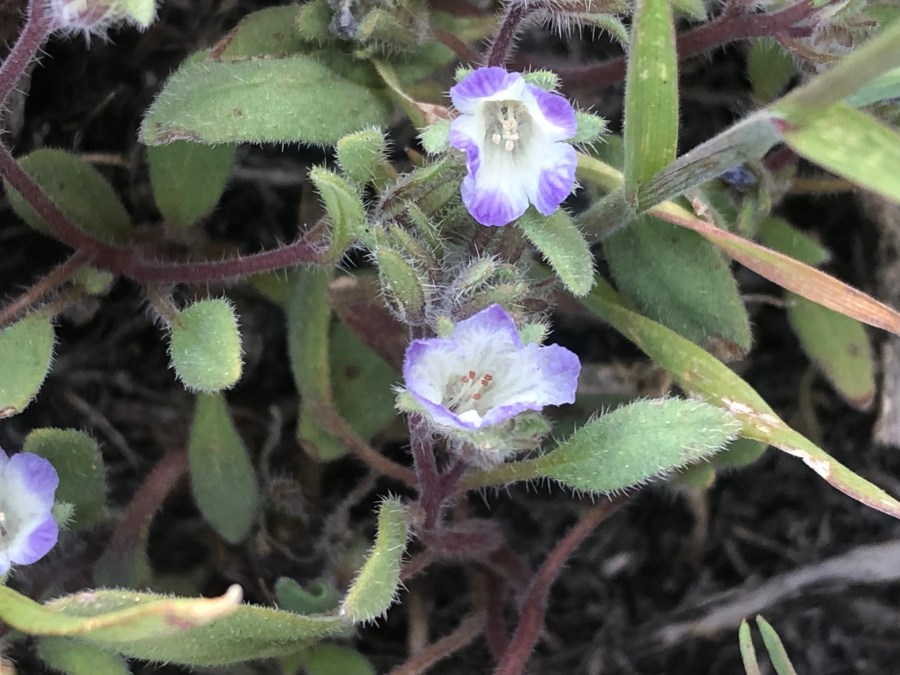
Phacelia curvipes (Washoe phacelia) has been found at two locations in the southwestern Bodie Hills (here and here). It’s a small annual with blue and white flowers, somewhat like the locally very common Phacelia humilis, but with more decumbent, spreading (rather than erect) stems. Phacelia curvipes has been seen and collected in many places near the west edges of the Mojave and Great Basin deserts in California and Nevada, and across to southwestern Utah and northwestern Arizona, but these are the first records of it in the Bodie Hills.

Saponaria officinalis (Common soapwort, Bouncing-bet, Wild sweet William, etc.) is native to southern Europe. It’s an attractive, but unwanted weed along Lee Vining Creek and in other moist, disturbed areas. It was recently observed beside the Caltrans Sand/Salt Storage facility on Conway Summit.


Species CONFIRMED, previously considered likely to occur, or not documented for many years in the Bodie Hills

Collomia grandiflora (Large-flowered Collomia or Grand Collomia) is fairly common in mountains across the west from southern California to southern British Columbia. It’s been seen in the Sweetwaters and Wassuk Range, so was considered possible in the Bodie Hills. This year, Jeff Bisbee found it on a slope north of Mormon Meadow.

Eriogonum hookeri (Hooker’s wild buckwheat) has been documented in the Bodie Hills, again only at Travertine Hot Springs, three times previously: in 1937 by G. A. Graham, in 1950 by Philip Munz, and in 2003 by Dean Taylor. This year it was first noticed at Travertine by Chloe and Trevor Van Loon, and soon after that by several other visitors. It also occurs in the Inyo-White Mountains and across most of Nevada to central Utah.

LEFT: Collomia grandiflora (at a site near Sonora Junction); RIGHT: Eriogonum hookeri

Erythranthe rubella (Redstem monkeyflower) can be difficult to distinguish from the very common E. breweri, and sometimes from the also common E. suksdorfii. All three tend to be very tiny annuals. A plant identified as E. rubella and confirmed by monkeyflower scholar Naomi Fraga has been observed at “Sage Flat,” east of Hwy 395 and a bit north of the Little Bodie Mine historical marker. Erythranthe rubella is probably more common than realized in the Bodie Hills, as misidentifications may be common.

Malacothrix glabrata (Desert dandelion) is common in arid areas of western North America, and has been seen east of the Bodie Hills. Recently, a 1983 collection by Glenn Clifton in Red Creek Wash appeared in the herbarium databases.

Sairocarpus kingii, aka Antirrhinum kingii (Least snapdragon), is found mostly in the western Great Basin, east of the Sierra Nevada, but also to eastern Oregon and central Utah. It was collected on 6/16/1949 by Philip Munz at Travertine Hot Springs. In 2023, 74 years later, it was finally seen there again. There’s another occurrence just north of the Bodie Hills, near the south end of the Pine Grove Hills, in Lyon County.

Silene nuda (Sticky catchfly) was the tentative ID of a plant photographed along Cow Camp Road by a resident of Bridgeport Valley. The photos were a bit unclear, so there was some uncertainty about the ID. The site was visited in July 2023 by Patrick Silbey and confirmed as Silene nuda with an excellent set of photos.

Penstemon deustus (Hot rock penstemon) is fairly common from about Alpine County to northwest California, Washington, Oregon, and Wyoming. It seems to be uncommon south of about Alpine County. This year it was finally found on the northwest edge of the Bodie Hills north of the Bridgeport Reservoir dam.

LEFT: Silene nuda (Patrick Silbey/iNaturalist); RIGHT: Penstemon deustus (at a site east of Monitor Pass).

Species POSSIBLY in the Bodie Hills, but still needing confirmation

Allium lemmonii (at a site west of Monitor Pass)

Allium lemmonii (Lemmon’s onion) may have been found on a hillside near Success Mine. The ovary crests are very distinctive and should make identifying A. lemmonii easy from fresh flowers, but closer photos or a collection are needed to confirm which species was seen here.

Sphaeralcea grossulariifolia (Gooseberryleaf globemallow) has been found (in 2020 and 2022) on the northwest side of the East Walker River north of Murphy Pond, at the very edge of the Sweetwater Mountains—a stone’s throw from the Bodie Hills, so it should be here too, perhaps across the river. Although fairly common throughout the Great Basin and Colorado Plateau, it just barely enters California near Topaz Lake, the southern Wellington Hills east of Topaz, and here along the East Walker River. It’s on CNPS list 2B.3 (rare, but not very threatened in California).


Updates on the “Mystery Plants” post of April 2023

The Aphyllon near Aurora
The Aphyllon seen previously along the road to Aurora, but not in a condition enabling identification, remains a mystery. I didn’t get over there this year and to my knowledge, no one else has looked. Next year, perhaps.

The Silene near Cow Camp Road
As noted above, the Silene nuda at a site along Cow Camp road was confirmed this past July.

The Pines near Millersville
The pines on a high slope north of Potato Peak, near the site of Millersville, also remain a mystery. Road conditions up Aurora Canyon were terrible for most or all of the summer (so I’m told), so access to this location would have been difficult also.

A New Mystery Plant, Maybe: An Allium near Success Mine
The wild onion mentioned above, possibly Allium lemmonii, counts as a new “mystery plant” needing a return visit to confirm its identity.


Copyright © Tim Messick 2023. All rights reserved.

A History of Plant Collecting in the Bodie Hills

Back in March 2023, I did a presentation for the Nevada Native Plant Society on plants of the Bodie Hills. One small part of that presentation was a review of the history of botanical collecting, and more recently, iNaturalist observations of plants, in the Bodie Hills. It was an interesting topic to research, so what follows is an expanded summary of my findings, along with some charts and maps.

Collections of Plant Specimens in Herbaria

I compiled a list of all plant collections in the Bodie Hills using search tools of the Consortium of California Herbaria (CCH). Their CCH2 portal serves data from all specimens (vascular and nonvascular, in California and beyond) housed in all 55 CCH member herbaria. These data portals allow anyone to search digitized records of herbarium specimens in a variety of ways. Because about a third of the Bodie Hills is in Nevada, and CCH2 data are not restricted to California, I used the CCH2 portal to find and download records of 4,268 plant collections throughout the Bodie Hills from 1866 through 2021.

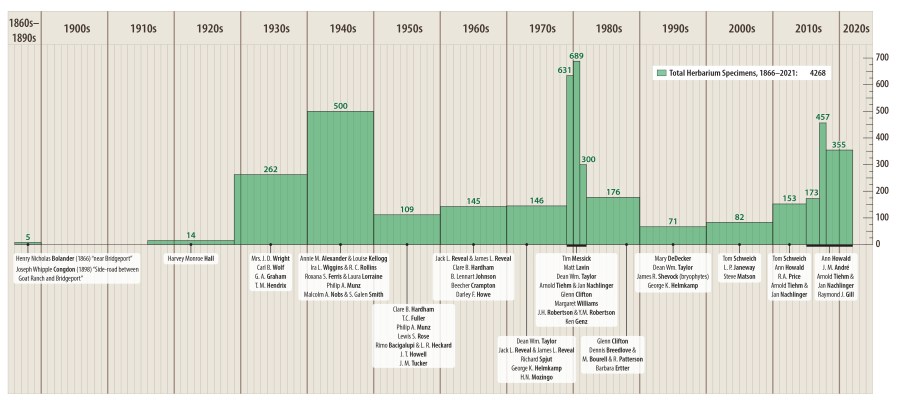
Here, then, is a timeline (below), summarizing the number of herbarium specimens collected over various periods of time. Below each of the green bars are the names of botanists who collected the most during those periods.

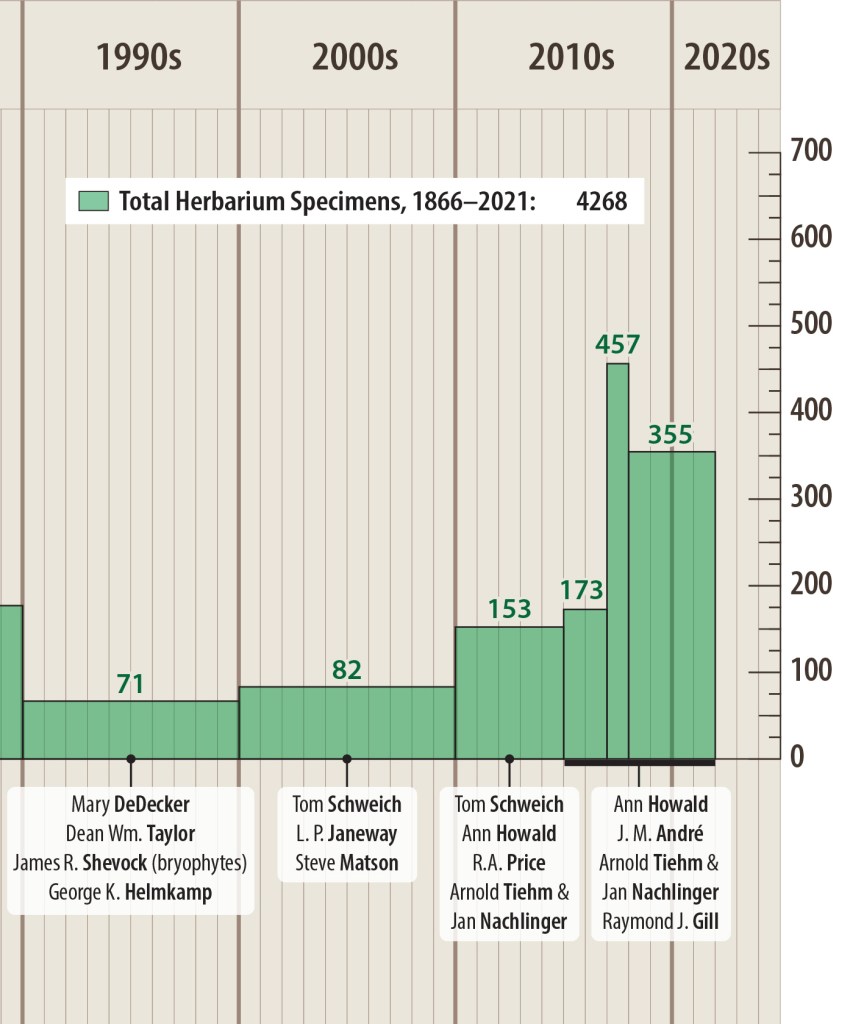
The timeline above may appear too small to read on your screen, so below I’ve divided the same thing into three larger sections.

The earliest collections listed were of Ericameria nauseosa and Sphaeralcea ambigua by Henry Bolander in 1866. The locations were recorded as simply “near Bridgeport,” so these may not have been exactly in the Bodie Hills. Bolander was an energetic collector while he was California State Botanist, 1864–1873 (and later, State Superintendent of Public Instruction, then San Francisco Superintendent of Schools).

Thirty-two years later, in 1898, Joseph Congdon collected Atriplex canescens, Opuntia polyacantha, and probably also Artemisia nova along a what he called the “Mono to Bodie (Desert Road)” and a “side-road between Goat Ranch and Bridgeport.” I believe these were along what is now Coyote Springs Road in Bridgeport Canyon. This was for many years the main route from Mono Basin to Bridgeport, before roads were established over Conway Summit. Congdon was a lawyer who lived in Mariposa, 1882–1905, and contributed significantly to early botanical exploration, particularly in the Yosemite region.

Harvey Monroe Hall made at least 7 collections in the hills between Mono Basin and Bridgeport in 1918, 1921, and 1925. Hall at that time worked at the Carnegie Institution Division of Plant Sciences at Stanford University; throughout his life he collected over 200,000 specimens. Philip A. Munz made a few collections in the same area in 1928. Munz was then a young professor of botany at Pomona College. Decades later, Munz and David Keck authored A California Flora (UC Press 1959), which became a standard reference for identifying California plants for more than 30 years.

Botanical collecting took a leap forward and across the state line in 1929, when “Mrs. John D. Wright” collected at least 29 specimens around Aurora. Ysabel Galban Wright, born in Cuba in 1885, married John Dutton Wright (founder of the Wright Oral School for the Deaf in New York City, where Helen Keller was an early student) in 1912. The couple relocated to Santa Barbara about 1919, where Ysabel became an avid gardener with a special interest in cacti and California native plants. She visited Aurora during a botanical collecting trip that also included Mono and Tuolumne counties in 1929.

During the 1930s several botanists collected in the area, notably Carl B. Wolf (Botanist at Rancho Santa Ana Botanic Garden 1930–1945), and G. A. Graham and T. M. Hendrix (both collecting and documenting vegetation in 1937 for what was then Mono National Forest).

In the 1940s, additional names familiar to California botanists appear in the list, including Annie Alexander & Louise Kellogg, Ira Wiggins & Reed Rollins, Roxanna Ferris & Laura Lorraine, and again, Philip Munz (who took a particular interest in the flora at Travertine Hot Springs). It was in the summer of 1945 that Wiggins & Rollins collected type specimens of both Streptanthus oliganthus (Masonic Mountain jewelflower) and Boechera bodiensis (Bodie Hills rock-cress). Also in the summer of ’45, Alexander & Kellogg collected type specimens of Cusickiella quadricostata (Bodie Hills Cusickiella) and Phacelia monoensis (Mono County Phacelia). Others collecting here during the ’40s included C. Leo Hitchcock, Robert F. Hoover, Beecher Crampton, and Malcolm A. Nobs & S. Galen Smith.

During the 1950s, Philip Munz visited the Chemung Mine area. Thomas C. Fuller (Plant Taxonomist for the California Department of Food and Agriculture) collected along the west side of the Bodie Hills. Clare B. Hardham collected along the Bodie-Masonic Road near Potato Peak.

In the 1960s, Jack Reveal (forest ranger) and his son James L. Reveal (renowned Eriogonum taxonomist and professor) collected in the area. Clare Hardham again visited the Rough Creek/Potato Peak area, and Masonic Mountain. Darley F. Howe collected near Bodie.

During the 1970s, Dean Taylor collected extensively throughout the Mono Basin and surrounding areas. Other collectors included Dennis Breedlove, Glenn Clifton, Ken Genz, and George K. Helmkamp (chemistry professor at UC Riverside). A spike in collecting occurred in 1979, because that’s when I arrived on the scene, collecting for my MA thesis (a local flora of the Bodie Hills) at Humboldt State University. I continued collecting for that project in 1980-81.

During the early 1980s, Matt Lavin, then a graduate student at UNR, collected extensively in the northern Bodie Hills for his floristic study of the upper Walker River watershed. Others active in the ’80s included Arnold (Jerry) Tiehm (Herbarium Curator at University of Nevada Reno) and Jan Nachlinger (plant ecologist), Dennis Breedlove, Glenn Clifton, Mary DeDecker, Barbara Ertter, and Hugh Mozingo (author of Shrubs of the Great Basin: A Natural History).

During the 1990s and 2000s there was less collecting in the Bodie Hills, though Tom Schewich and others were quite active in and around the Mono Basin.

In the 2010s Ann Howald started collecting intensively throughout Mono County, including the Bodie Hills. Jerry Tiehm and Jan Nachlinger made more visits to the Nevada side of the range. In recent years, Ann Howald (preparing a Flora of Mono County) and James André (of the Granite Mountains Desert Research Center) have been the most active collectors in the Bodie Hills.

In summary, my search produced a list of about 4,268 specimens from the Bodie Hills, collected from 1866 to 2021. I say “about”, because a few were probably collected outside the area but their locations were mis-mapped or misinterpreted as being within the Bodie Hills (erring on the side of too many specimens). On the other hand, some specimens probably exist that have not been digitized and georeferenced, or reside in herbaria that are outside the scope of CCH2 (erring on the side of too few specimens). Also, the search area boundary is a bit arbitrary in some areas and can be adjusted to include more or fewer collections.

Much more interesting than the exact number, though, is to see the names of people who have collected there, if only briefly, over the decades. Many of them became well known for their contributions to western American botany.

You can generate an updated search, and change the boundaries or other search criteria if you wish, HERE.

Observations of Plants on iNaturalist

Several years ago an ambitious citizen science project called iNaturalist came on the scene, providing me and many others with a different way to document biodiversity—by uploading photographs of identifiable species, along with location, date/time, and sometimes other metadata for each observation. There are many caveats to consider in assessing the quality and value of any particular set of iNaturalist data, but on the whole, it’s an effective way for anyone from casual, curious non-specialists to seasoned professional biologists to quickly share observations, get feedback, and learn from what others have posted. Physical specimens enable types of research that cannot be done from photographs alone, but I think iNaturalist provides a useful compliment to traditional herbarium-based collections.

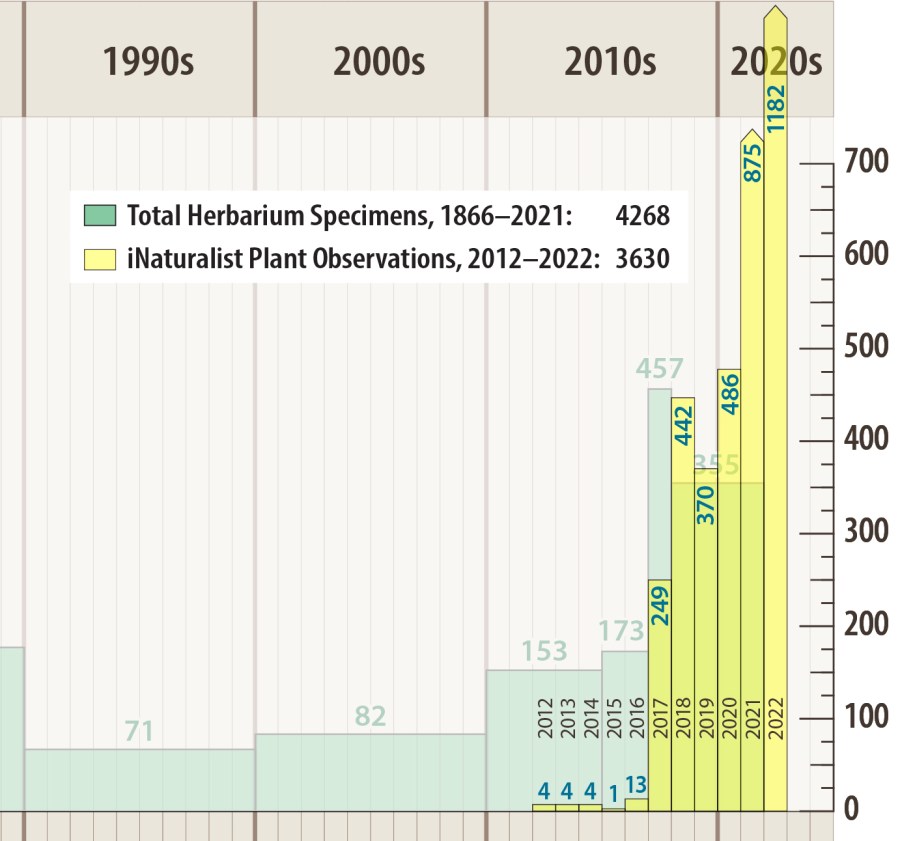
The timeline below shows plant observations in the Bodie Hills posted to iNaturalist, by year, from 2012 through 2022. In the background, for comparison, are the numbers of herbarium specimens from the charts above. The number of observations is growing rapidly. Many of these observations are mine, but certainly not all, and some very noteworthy observations (documenting species neither collected nor observed previously in the Bodie Hills) have been posted by others.

You can generate an updated search in iNaturalist, and revise the search criteria if you wish, HERE.

Locations of Collections and Observations

The maps below show you that both collections and observations have been concentrated along (1) roads that provide relatively easy access and (2) other popular areas to visit in the Bodie Hills.

Little or no collecting or observing has occurred in some other areas. These are among the more remote and difficult-to-access corners of the Bodie Hills. Such areas include:
• Mount Hicks and Spring Peak
• Aurora Crater
• Bald Peak
• Southeast perimeter of the Bodie Hills
• Atastra Creek and the middle reaches of Rough Creek
• Masonic Gulch north of Masonic Lower Town
• Aspen groves south of upper Aurora Canyon
• Big Alkali

Treks into these remote areas could be rewarded with interesting discoveries!


Copyright © Tim Messick 2023. All rights reserved.

Mystery Plants in the Bodie Hills

I need your help—those of you who live somewhat close to the Bodie Hills. Three plants have yet to be identified there because they have not been seen up close, photographed clearly, or observed under the right conditions for identification. Since my home is a nearly 5-hour drive from their locations, I don’t know when I might be in the right places at the right times to identify these plants. So, I invite anyone who is interested to do a bit of “citizen science” botanical field work and post the observations on iNaturalist. Details follow.

Mystery Plant #1: An Aphyllon Near Aurora

This plant has been observed twice, in June 2021 and April 2022 at the base of a road cut along the road to Aurora (Mineral County, Nevada), about 0.85 mile south of the intersection with the road through Del Monte Canyon to Bodie (elevation about 6,400 feet). Both times the plants were well past flowering, dried out and crumbling to the point where critical features for identifying the species were no longer present.

When might these plants be in fresh, identifiable condition? Similar plants have been observed in Adobe Valley southeast of Mono Lake (Mono County, CA)(elevation about 6,500 feet). Plants in that area appear to have been in good condition during July. The plants in the photos above had probably flowered during the previous summer.

This plant is clearly in the genus Aphyllon (Broomrapes) of Orobanchaceae (Broomrape family). They are parasites. Lacking chlorophyll, they derive sugars and other nutrients needed for growth from the root systems of nearby shrubs, often sagebrush or rabbitbrush. The inflorescence emerges directly from the ground. It tends to be mostly purplish, yellowish, or brownish in color, with the corollas various combinations of purple, pink, yellow, and white. A taxonomic note: All Broomrapes in North America (about 17 species) were formerly in Orobanche, before that genus was split mid-Atlantic, with all the New World Broomrapes placed in genus Aphyllon and all Old World species remaining in Orobanche (see PhytoKeys 75: 107–118 for an explanation).

Our mystery plant also clearly has an elongate above-ground stem that bears flowers on short pedicels, as in Aphyllon parishii and several other species. In some other species the flowers emerge on much longer pedicels from a very short, below-ground stem—which is the case in two other species of Aphyllon found in the Bodie Hills: A. corymbosum and A. fasciculatum.

The Aphyllon observations in Adobe Valley have been difficult to identify and it’s been speculated (here and here) that an undescribed taxon may be lurking in that area. Could the Aphyllon near Aurora fit into this potentially new taxon also? Photographs showing details of flowers, bracts, and stem are needed.


Mystery Plant #2: A Silene Near Cow Camp Road

This plant is definitely in Caryophyllaceae (Pink family); I think it’s a Silene (because of the notched petals), maybe Silene nuda (Sticky catchfly). But in these photos that came to me by way of the Eastern Sierra Land Trust, from someone wanting to identify it, the image resolution is just a bit too low for a confident identification, so it needs to be revisited in the field. This was seen (in early August, 2019) in the central Bodie Hills, roughly mid-way between Cow Camp Road and Rough Creek, a little north of “Halfway Camp”, elevation about 7650 feet.

Another tall, perennial Silene reported to occur in the eastern Sierra is S. verecunda (San Francisco campion). In Silene nuda, the pedicel and calyx are glandular-puberulent to glandular-hairy. In Silene verecunda, the pedicel and calyx are puberulent (short-hairy), but not glandular. Photos of the plants should therefore include close-ups of the flower, calyx, and pedicel. Clear views of the basal and cauline leaves (showing shape, hairiness, and relative size) would be helpful as well.

The nearest collection of Silene nuda is in Douglas County near Topaz Lake. The species occurs in the northern Sierra Nevada—mostly north of Tahoe—to south-central and southeast Oregon, southern Idaho and across northern and central Nevada. If confirmed here, the Bodie Hills would be the southwestern-most known occurrence of Silene nuda.

A map of Silene nuda collections (sources: CCH2 and IRHN)


Mystery Plant #3. A Pine Near Millersville

High on a remote mountain slope 1.2 miles north-northwest of Potato Peak, above the head of a steep gully at 9,540 feet, and surrounded by thickets of mountain-mahogany, is a small stand of pines. But which one? I think they’re most likely Limber pines (Pinus flexilis), because that’s what occurs at a similar elevation on the north slope of Bodie Mountain, but Lodgepole pines (Pinus contorta subsp. murrayana) occur in scattered, mostly small stands in the central Bodie Hills too. A much closer look at these pines is needed, ideally documenting their overall appearance, the number of needles per fascicle, and the size and appearance of the cones.

Viewed from far down in Aurora Canyon, the details needed for a confident identification are not visible. This stand of pines is a little north of the site of Millersville (topic of an earlier post).


Copyright © Tim Messick 2023. All rights reserved.