Tag Archives: Nevada

A History of Plant Collecting in the Bodie Hills

Back in March 2023, I did a presentation for the Nevada Native Plant Society on plants of the Bodie Hills. One small part of that presentation was a review of the history of botanical collecting, and more recently, iNaturalist observations of plants, in the Bodie Hills. It was an interesting topic to research, so what follows is an expanded summary of my findings, along with some charts and maps.

Collections of Plant Specimens in Herbaria

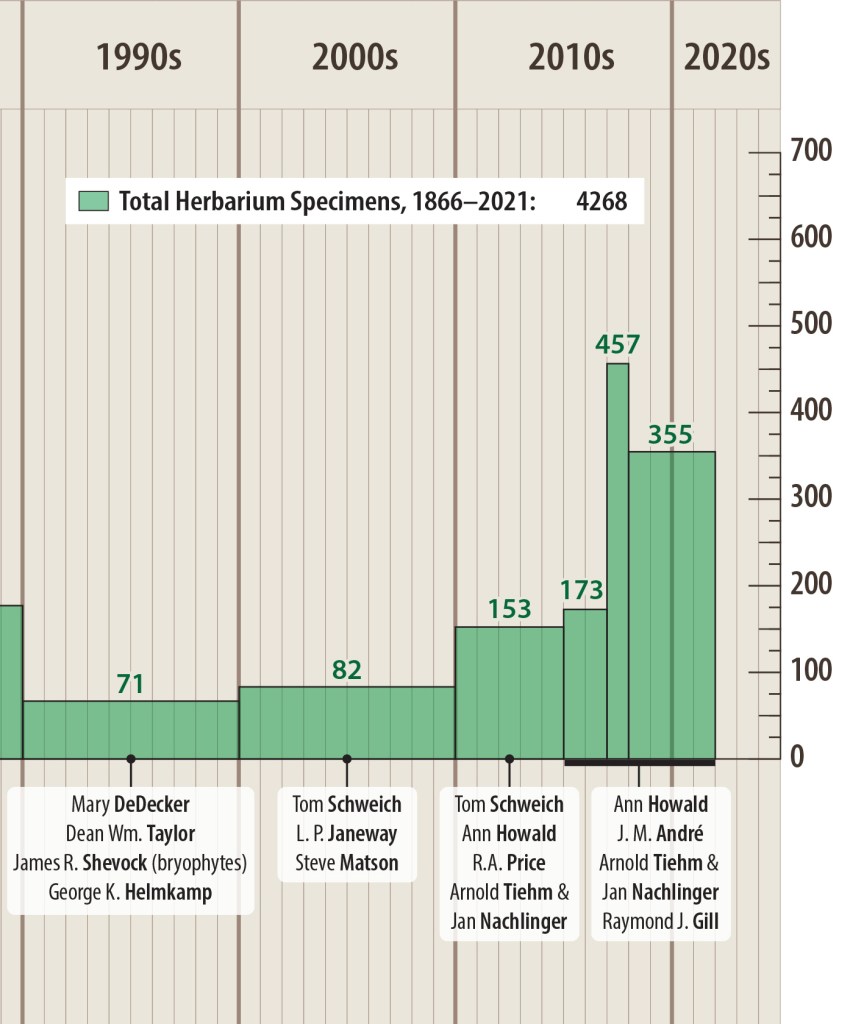
I compiled a list of all plant collections in the Bodie Hills using search tools of the Consortium of California Herbaria (CCH). Their CCH2 portal serves data from all specimens (vascular and nonvascular, in California and beyond) housed in all 55 CCH member herbaria. These data portals allow anyone to search digitized records of herbarium specimens in a variety of ways. Because about a third of the Bodie Hills is in Nevada, and CCH2 data are not restricted to California, I used the CCH2 portal to find and download records of 4,268 plant collections throughout the Bodie Hills from 1866 through 2021.

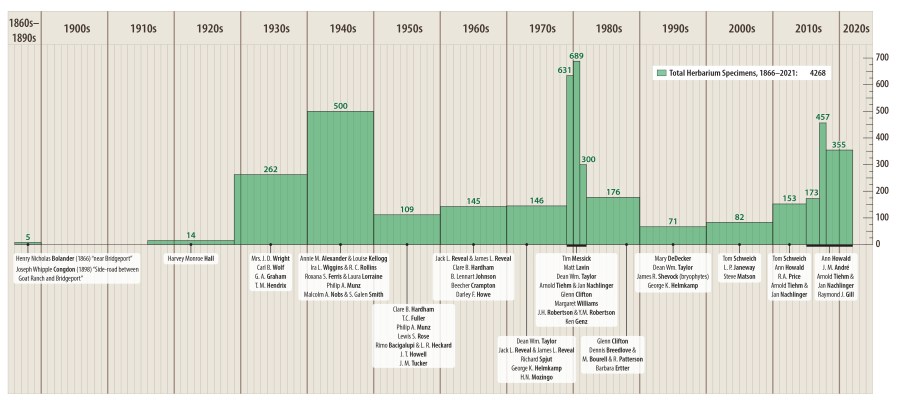
Here, then, is a timeline (below), summarizing the number of herbarium specimens collected over various periods of time. Below each of the green bars are the names of botanists who collected the most during those periods.

The timeline above may appear too small to read on your screen, so below I’ve divided the same thing into three larger sections.

The earliest collections listed were of Ericameria nauseosa and Sphaeralcea ambigua by Henry Bolander in 1866. The locations were recorded as simply “near Bridgeport,” so these may not have been exactly in the Bodie Hills. Bolander was an energetic collector while he was California State Botanist, 1864–1873 (and later, State Superintendent of Public Instruction, then San Francisco Superintendent of Schools).

Thirty-two years later, in 1898, Joseph Congdon collected Atriplex canescens, Opuntia polyacantha, and probably also Artemisia nova along a what he called the “Mono to Bodie (Desert Road)” and a “side-road between Goat Ranch and Bridgeport.” I believe these were along what is now Coyote Springs Road in Bridgeport Canyon. This was for many years the main route from Mono Basin to Bridgeport, before roads were established over Conway Summit. Congdon was a lawyer who lived in Mariposa, 1882–1905, and contributed significantly to early botanical exploration, particularly in the Yosemite region.

Harvey Monroe Hall made at least 7 collections in the hills between Mono Basin and Bridgeport in 1918, 1921, and 1925. Hall at that time worked at the Carnegie Institution Division of Plant Sciences at Stanford University; throughout his life he collected over 200,000 specimens. Philip A. Munz made a few collections in the same area in 1928. Munz was then a young professor of botany at Pomona College. Decades later, Munz and David Keck authored A California Flora (UC Press 1959), which became a standard reference for identifying California plants for more than 30 years.

Botanical collecting took a leap forward and across the state line in 1929, when “Mrs. John D. Wright” collected at least 29 specimens around Aurora. Ysabel Galban Wright, born in Cuba in 1885, married John Dutton Wright (founder of the Wright Oral School for the Deaf in New York City, where Helen Keller was an early student) in 1912. The couple relocated to Santa Barbara about 1919, where Ysabel became an avid gardener with a special interest in cacti and California native plants. She visited Aurora during a botanical collecting trip that also included Mono and Tuolumne counties in 1929.

During the 1930s several botanists collected in the area, notably Carl B. Wolf (Botanist at Rancho Santa Ana Botanic Garden 1930–1945), and G. A. Graham and T. M. Hendrix (both collecting and documenting vegetation in 1937 for what was then Mono National Forest).

In the 1940s, additional names familiar to California botanists appear in the list, including Annie Alexander & Louise Kellogg, Ira Wiggins & Reed Rollins, Roxanna Ferris & Laura Lorraine, and again, Philip Munz (who took a particular interest in the flora at Travertine Hot Springs). It was in the summer of 1945 that Wiggins & Rollins collected type specimens of both Streptanthus oliganthus (Masonic Mountain jewelflower) and Boechera bodiensis (Bodie Hills rock-cress). Also in the summer of ’45, Alexander & Kellogg collected type specimens of Cusickiella quadricostata (Bodie Hills Cusickiella) and Phacelia monoensis (Mono County Phacelia). Others collecting here during the ’40s included C. Leo Hitchcock, Robert F. Hoover, Beecher Crampton, and Malcolm A. Nobs & S. Galen Smith.

During the 1950s, Philip Munz visited the Chemung Mine area. Thomas C. Fuller (Plant Taxonomist for the California Department of Food and Agriculture) collected along the west side of the Bodie Hills. Clare B. Hardham collected along the Bodie-Masonic Road near Potato Peak.

In the 1960s, Jack Reveal (forest ranger) and his son James L. Reveal (renowned Eriogonum taxonomist and professor) collected in the area. Clare Hardham again visited the Rough Creek/Potato Peak area, and Masonic Mountain. Darley F. Howe collected near Bodie.

During the 1970s, Dean Taylor collected extensively throughout the Mono Basin and surrounding areas. Other collectors included Dennis Breedlove, Glenn Clifton, Ken Genz, and George K. Helmkamp (chemistry professor at UC Riverside). A spike in collecting occurred in 1979, because that’s when I arrived on the scene, collecting for my MA thesis (a local flora of the Bodie Hills) at Humboldt State University. I continued collecting for that project in 1980-81.

During the early 1980s, Matt Lavin, then a graduate student at UNR, collected extensively in the northern Bodie Hills for his floristic study of the upper Walker River watershed. Others active in the ’80s included Arnold (Jerry) Tiehm (Herbarium Curator at University of Nevada Reno) and Jan Nachlinger (plant ecologist), Dennis Breedlove, Glenn Clifton, Mary DeDecker, Barbara Ertter, and Hugh Mozingo (author of Shrubs of the Great Basin: A Natural History).

During the 1990s and 2000s there was less collecting in the Bodie Hills, though Tom Schewich and others were quite active in and around the Mono Basin.

In the 2010s Ann Howald started collecting intensively throughout Mono County, including the Bodie Hills. Jerry Tiehm and Jan Nachlinger made more visits to the Nevada side of the range. In recent years, Ann Howald (preparing a Flora of Mono County) and James André (of the Granite Mountains Desert Research Center) have been the most active collectors in the Bodie Hills.

In summary, my search produced a list of about 4,268 specimens from the Bodie Hills, collected from 1866 to 2021. I say “about”, because a few were probably collected outside the area but their locations were mis-mapped or misinterpreted as being within the Bodie Hills (erring on the side of too many specimens). On the other hand, some specimens probably exist that have not been digitized and georeferenced, or reside in herbaria that are outside the scope of CCH2 (erring on the side of too few specimens). Also, the search area boundary is a bit arbitrary in some areas and can be adjusted to include more or fewer collections.

Much more interesting than the exact number, though, is to see the names of people who have collected there, if only briefly, over the decades. Many of them became well known for their contributions to western American botany.

You can generate an updated search, and change the boundaries or other search criteria if you wish, HERE.

Observations of Plants on iNaturalist

Several years ago an ambitious citizen science project called iNaturalist came on the scene, providing me and many others with a different way to document biodiversity—by uploading photographs of identifiable species, along with location, date/time, and sometimes other metadata for each observation. There are many caveats to consider in assessing the quality and value of any particular set of iNaturalist data, but on the whole, it’s an effective way for anyone from casual, curious non-specialists to seasoned professional biologists to quickly share observations, get feedback, and learn from what others have posted. Physical specimens enable types of research that cannot be done from photographs alone, but I think iNaturalist provides a useful compliment to traditional herbarium-based collections.

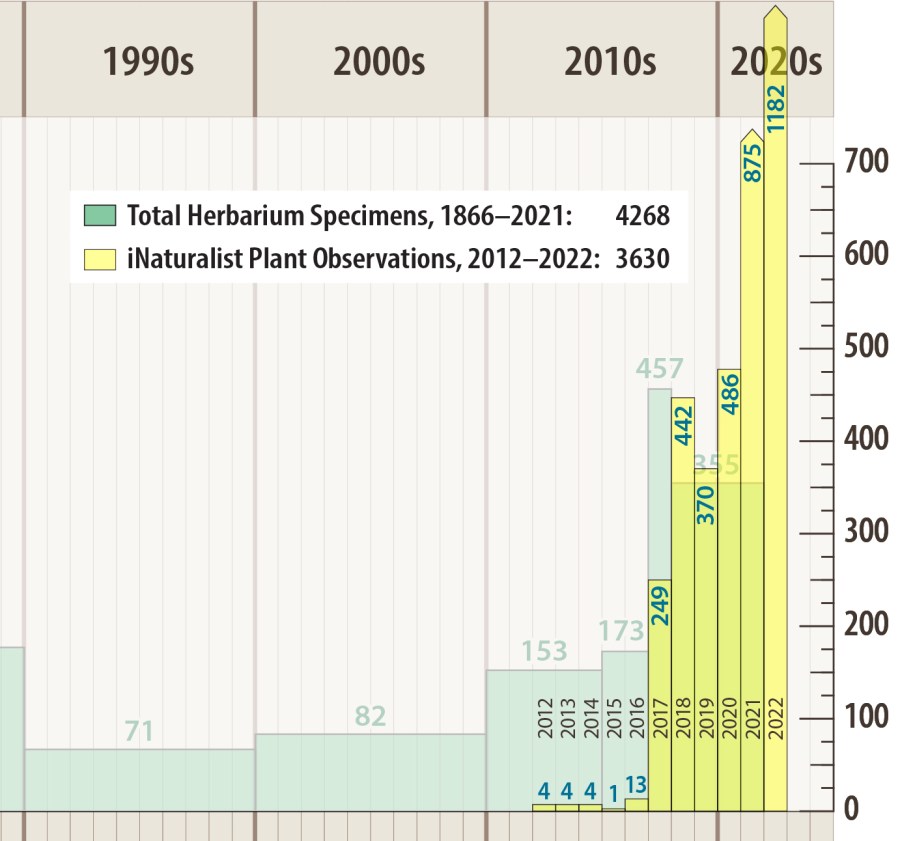
The timeline below shows plant observations in the Bodie Hills posted to iNaturalist, by year, from 2012 through 2022. In the background, for comparison, are the numbers of herbarium specimens from the charts above. The number of observations is growing rapidly. Many of these observations are mine, but certainly not all, and some very noteworthy observations (documenting species neither collected nor observed previously in the Bodie Hills) have been posted by others.

You can generate an updated search in iNaturalist, and revise the search criteria if you wish, HERE.

Locations of Collections and Observations

The maps below show you that both collections and observations have been concentrated along (1) roads that provide relatively easy access and (2) other popular areas to visit in the Bodie Hills.

Little or no collecting or observing has occurred in some other areas. These are among the more remote and difficult-to-access corners of the Bodie Hills. Such areas include:
• Mount Hicks and Spring Peak
• Aurora Crater
• Bald Peak
• Southeast perimeter of the Bodie Hills
• Atastra Creek and the middle reaches of Rough Creek
• Masonic Gulch north of Masonic Lower Town
• Aspen groves south of upper Aurora Canyon
• Big Alkali

Treks into these remote areas could be rewarded with interesting discoveries!


Copyright © Tim Messick 2023. All rights reserved.
Plants of the Bodie Hills, 2023 Edition

Plants of the Bodie Hills, January 2023 Edition, is now available on the Downloads page (a free PDF). As in previous years, the new edition contains additions, corrections, nomenclatural updates, and refinements to the keys. A key to genera in the grass family (Poaceae) has at last been added.

New additions to the flora this past year are:

  • Astragalus platytropis (Broad-keeled milkvetch)
  • Eatonella nivea (Woolly bonnets or White false tickhead)
  • Eriogonum cernuum (Nodding wild buckwheat)
  • Glossopetalon spinescens var. aridum (Spiny greasebush) (Crossosomataceae)
  • Polemonium occidentale ssp. occidentale (Western polemonium)
  • Sporobolus cryptandrus (Sand dropseed)

Plants that had been expected and were finally found in the Bodie Hills in 2022 were:

  • Arceuthobium divaricatum (Pinyon dwarf-mistletoe)
  • Chaenactis macrantha (Mojave pincushion)
  • Claytonia perfoliata ssp. intermontana (Miner’s lettuce)
  • Festuca octoflora (Sixweeks fescue)

Many of these finds were made not by me, but by others posting their observations to iNaturalist (thanks to all who do this!). All observations within the Bodie Hills can be seen HERE.

As before, you have two options for how to use this document: 1) load the PDF onto a mobile device or 2) print the PDF yourself.

  1. Using a mobile device: I’ve found the PDF to be quite readable on my iPhone (in the Books app), although it helps that I’m near-sighted. It’s even easier to read on an iPad, other tablet, or laptop.
  2. Printing the PDF: You can print the PDF yourself or at a local print shop. I highly recommend printing the 124 pages 2-sided to conserve paper and reduce bulk and weight in the field. A comb or spiral binding, binder clip, or other binding will hold it together.

Your additions, corrections, comments, or questions are always welcome.

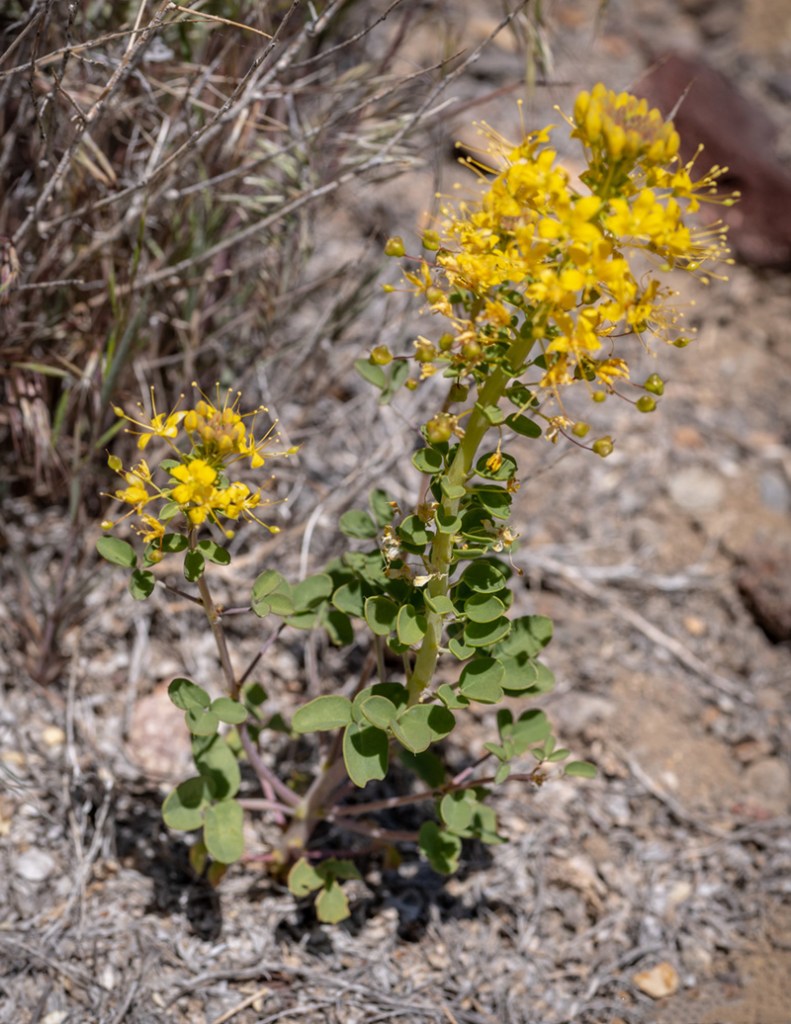
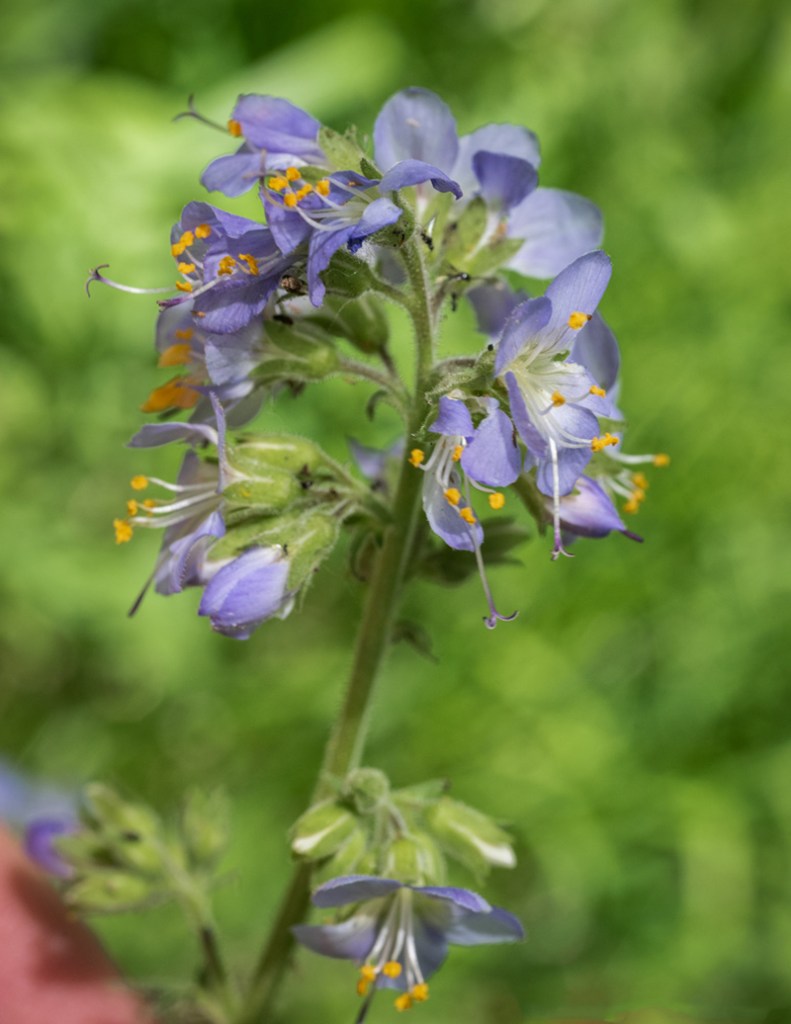
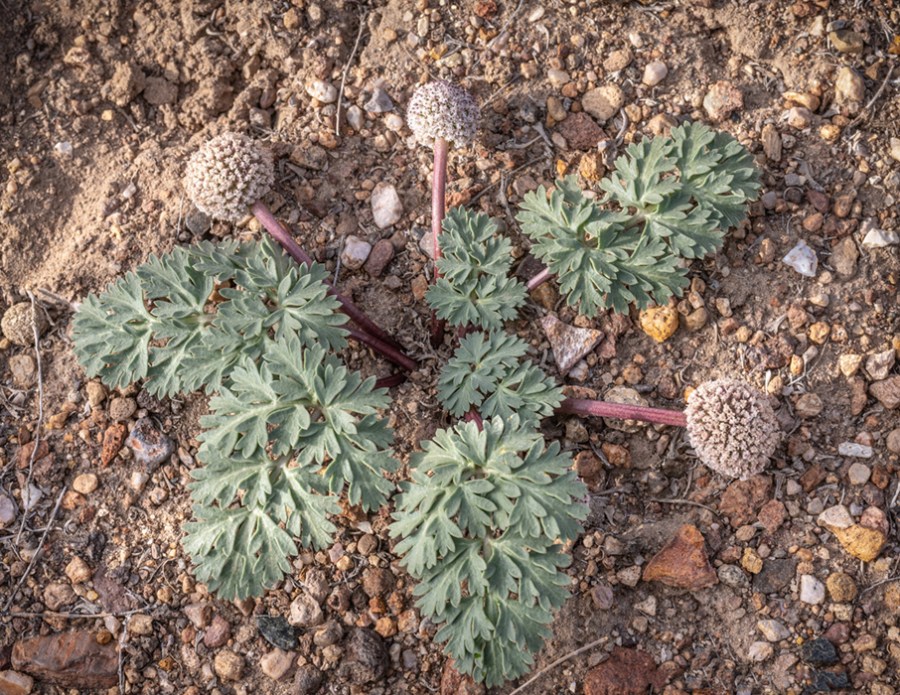
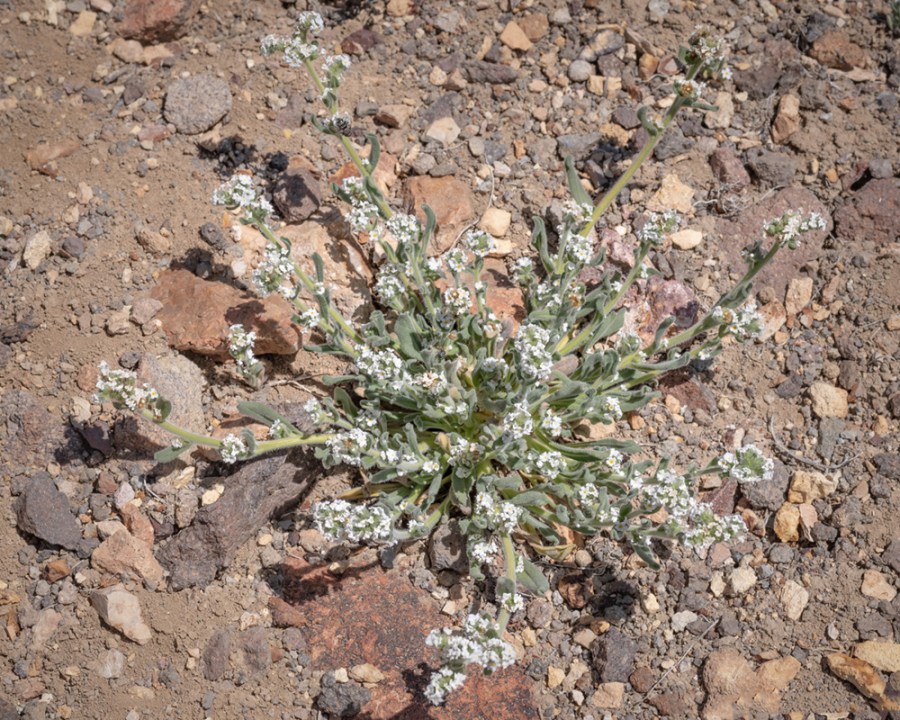
Here are a few plants I was pleased to see last year while roaming the Bodie Hills:

Cleomella hillmanii

Polemonium occidentale

Lomatium foeniculaceum

Stylocline psilocarphoides

Cymopterus globosus

Claytonia perfoliata

Amsinckiopsis kingii


Copyright © Tim Messick 2023. All rights reserved.

Mapping the Varieties of Eriogonum microtheca (Great Basin wild buckwheat)

Two varieties of Great basin wild buckwheat (Eriogonum microtheca) are common in the Bodie Hills (var. laxiflorum and var. ambiguum), and a third (var. alpinum) is likely present in a few areas. Several other varieties occur throughout the deserts and mountains of western North America. The characters that distinguish these are, aside from flower color, fairly subtle differences in stem and leaf vestiture (hairiness), leaf size, and plant height. Most of the varieties are difficult to identify with certainty from photographs alone, but some have narrow geographic distributions, which reduces the number of possibilities in many areas to just two or three.

Eriogonum microtheca var. ambiguum (left) and var. laxiflorum (right).

I’ve been wanting to understand these taxa better. So, I’ve mapped the documented locations of each, and I share those maps with you below, along with some notes on identification and links to photos.

First, a few notes:

  1. Is the epithet microthecA or microthecUM ? The spelling was was originally published in 1848 as Eriogonum microtheca, but since 1858 microthecum has been in general use. Apparently, this was an error—probably introduced and widely accepted, because it “sounds right” and the usual practice is to have the genus and epithet endings agree in gender (-um is neuter, -a is feminine). Recently, as microtheca became accepted once more, there was a proposal to conserve microthecum, which (unfortunately in my opinion) did not prevail. So, microtheca it is, but in references that have not been recently updated, microthecum is still widely used. Confusion on this important issue will persist for decades to come.
  2. Data sources: The maps are based mostly on specimen location data downloaded (as KML files) from the Consortium of California Herbaria (CCH), served by the CCH2 data portal and the Intermountain Regional Herbarium Network (IRHN). Several maps include additional “research grade” observations downloaded (as CSV files) from iNaturalist. The map for variety microtheca is based mostly on data from the Consortium of Pacific Northwest Herbaria (CPNWH). Caveat: Some collections or observations may be misidentified or have mis-mapped coordinates, so some locations shown on these maps may be incorrect. The geographic ranges suggested by these maps should be considered very approximate.
  3. Also: Descriptive details and common names are mostly from the Flora of North America treatment of Eriogonum microthecum.
  4. Mapping software: The maps were compiled using Quantum GIS (QGIS), a free, open source Geographic Information System that I’m gradually learning to use. The base map is a combination of “Stamen Terrain Background” and “ESRI Terrain” web map services. Additional minor cleanup and formatting was done in Adobe Photoshop and Adobe Illustrator.

Map 1, var. laxiflorum, var. simpsonii , and var. microtheca. These are the three most widespread varieties. Var. laxiflorum (Great Basin wild buckwheat) (photos) is common across the central and northern Great Basin, and the eastern Sierra-Cascade ranges, up to eastern Washington. Var. simpsonii (Simpson’s wild buckwheat) (photos) is common across the central and southern Great Basin to the western Rocky Mountains and Colorado Plateau. These two are very similar, but the leaf margins of var. simpsonii are revolute (turned under) or nearly so; those of var. laxiflorum are not.

Variety microtheca (Slender wild buckwheat) (photos, specimen images) occurs mostly from central Washington to central Idaho. Its flowers are yellow (flowers of var. laxiflorum and var. simpsonii are mostly white), but so are the flowers of var. ambiguum, which also extends into eastern Washington and western Idaho (see Map 2). The flowering stems and inflorescence branches of var. microtheca are usually glabrous (hairless); those of var. ambiguum are tomentose (with densely interwoven, generally matted hairs) to floccose (with tufts of soft woolly hairs, the tufts often deciduous).

Map 1.

Map 2, var. ambiguum and var. schoolcraftii. Variety ambiguum (Yellow-flowered wild buckwheat) (photos) occurs in the eastern Sierra Nevada and western Great Basin from Inyo County to southeastern Oregon. It is similar to and sympatric with var. laxiflorum, except for its yellow perianth. Its range also overlaps with var. microtheca in eastern Oregon; but, as noted above, the flowering stems and inflorescence branches of var. microtheca are usually glabrous, while those of var. ambiguum are tomentose to floccose.

Variety schoolcraftii (Schoolcraft’s wild buckwheat) (photos) has a very narrow distribution southeast of Honey Lake, in Lassen, Washoe, and perhaps also Plumas counties. It’s very similar to var. ambiguum (yellow flowers and tomentose/floccose herbage), but has slightly larger leaves, flowers, and fruits.

In var. ambiguum: leaf blades are mostly ≤ 0.6 cm wide; flowers are mostly < 2.5 mm long; involucres are 2–2.5 mm long; achenes are 1.5–2 mm long.
In var schoolcraftii: leaf blades are 0.5–1.2 cm wide; flowers are mostly 2.5–3 mm long; involucres are 2.5–4 mm long; achenes are 2.5–3 mm long.

Map 2.

Map 3, var. alpinum. Variety alpinum (Sonora Pass wild buckwheat—though based on its distribution I think it should be “Mono” wild buckwheat) (photos) is known mostly from the eastern Sierra Nevada (and the Sweetwaters, Bodie Hills, and Glass Mountain) in Mono County, plus a few nearby locations in Alpine and Tuolumne counties. With white to rose or reddish corollas, it resembles var. laxiflorum (common throughout the same area), but its stature is shorter, leaves are shorter and narrower with revolute margins, and hairs are often whiter than in var. laxiflorum. It seems to favor the crests of glacial moraines, arid hilltops, and high ridge habitats.

Map 3.

Map 4, var. lapidicola, and var. panamintense. Variety panamintense (Panamint wild buckwheat) (photos, specimen images) is probably restricted to the desert ranges of central Inyo County (one collection in the southern Sierra Nevada may be misidentified). Variety lapidicola (Pahute Mesa wild buckwheat) (photos, specimen images) is known from the Inyo Mountains of Inyo county, the Pahute Mesa/Rainier Mesa area of Nye County, and other scattered locations in central and eastern Nevada as far north as Elko County.

These both differ from var. simpsonii and var. laxiflorum in having flowering stems and inflorescence branches generally glabrous; hairs, if present, are generally brownish or reddish rather than whitish. Both have leaf blades elliptic, and the margins not revolute.

Variety panamintense is a shrub 3–6 dm tall, with leaf blades broadly elliptic, 6–18 mm long × 3–8 mm wide, brown-tomentose below, floccose to subglabrous above; involucres 2–2.5 mm, subglabrous or glabrous; flowers 1.5–2(–2.5) mm; and achenes 1.8–2 mm long.

Variety lapidicola is a subshrub 0.5–0.5 dm tall, with leaf blades elliptic, 3–7(–8) mm long × 1–4 mm wide, densely reddish-brown-tomentose below, tomentose to floccose above; involucres 2.5–3.5 mm, floccose to subglabrous; flowers (1.5–)2–3.5 mm; and achenes 2.5–3 mm long.

Map 4.

Map 5, var. arceuthinum and var. phoeniceum. Both of these are rare, known only from a very few locations in eastern Nevada and western Utah. Varieties laxiflorum, simpsonii, and to a lesser extent lapidicola are also prevalent in this region. Variety arceuthinum (Juniper Mountain wild buckwheat) (specimen images) is known from a scant 5 specimens in the Mahogany Mountains of Lincoln County, Nevada and Iron County, Utah. Variety phoeniceum (Scarlet wild buckwheat) (specimen images) is apparently known from only a few specimens collected in Millard and Beaver counties, Utah.

Both are short, compact subshrubs, under 10 cm tall. Both have very small, narrowly linear leaf blades, 4–8 mm long and ≤ 1.2 mm wide, densely white-tomentose below and sparsely floccose or glabrous and green above, with revolute margins. The differences are subtle: (1) var. arceuthinum is generally 5–7 cm tall with a spreading caudex, while var. phoeniceum is only 2–4 cm tall, generally without a caudex; (2) var. arceuthinum has glabrous involucres, while var. phoeniceum has floccose to subglabrous involucres. With so few specimens available, and the differences so minor, are these really distinct taxa? More fieldwork needed, I think.

Map 5.

Map 6, var. corymbosoides, var. johnstonii, and var. lacus-ursi. These three varieties occur only in the Transverse ranges of southern California. Of the more widespread varieties, only var. simpsonii may also occur in this area. It differs from these three in having flowering stems and inflorescence branches that are generally tomentose to woolly-hairy (vs. generally glabrous in var. corymbosoides, var. johnstonii, and var. lacus-ursi).

Variety lacus-ursi (Bear lake wild buckwheat) (specimen images) consists of subshrubs about 1.5–2 dm tall, with cream-colored flowers 2.0–2.5 mm long. Its leaves are narrowly elliptic, densely white-tomentose below and glabrous or nearly so above, with the margins usually revolute. It is known only from clayey outcrops in Bear Valley in the San Bernardino Mountains.

Variety johnstonii (Johnston’s or San Gabriel Mountains wild buckwheat) (specimen images) consists of decumbent, spreading subshrubs, less than 1.5 dm tall, with white to reddish flowers mostly 3–3.5 mm long. Its leaves are elliptic to obovate, densely whitish-brown-tomentose below and floccose to subglabrous above, with the margins usually not revolute. It occurs in montane conifer woodlands and was initially known only from high elevations in the San Gabriel Mountains, but has since been found in the San Bernardino Mountains as well.

Variety corymbosoides (San Bernardino wild buckwheat) (specimen images) consists of larger, rounded to spreading shrubs, 3–6 dm tall, with white to reddish flowers 2.0–2.5 mm long. As in var. johnstonii, its leaves are elliptic to obovate, densely whitish-brown-tomentose below and floccose to subglabrous above, with the margins usually not revolute. It occurs in chaparral and in oak and conifer woodlands in both the San Bernardino Mountains and San Gabriel Mountains.

Map 6.

Map 7, All varieties, with (very) approximate range boundaries.

As of this writing, there are no observations in iNaturalist for the five rarest varieties of Eriogonum microtheca: vars. arceuthinum, phoeniceum, lacus-ursi, corymbosoides, and johnstonii. These present great opportunities for Nevada/Utah and SoCal botanists to document these taxa with photographs from the field!

When photographing these plants, try to capture the following details: 1) stem hairs: abundance, texture, and color; 2) perianth color; 3) leaf blades: hairiness above and below, margins revolute or not, length (measure); 4) plant height (measure).

Map 7.

Copyright © Tim Messick 2023. All rights reserved.