Category Archives: Botany

Food of the Gods in the Bodie Hills

How can a scrawny plant, growing in disturbed soils, with painfully sharp spines all over its fruits come to be named  for the mythical “food of the Greek gods”—Ambrosia—a name also related, apparently, to the Greek word for immortality, αθανασία (athanasia)? Carl Linnaeus himself, the “father of modern taxonomy,” bestowed the name in 1754. But why Ambrosia? I haven’t found an explanation. The authoritative Flora North America says “allusion unclear.” One might say it’s a crusty old botanist’s joke on posterity, but I won’t impugn the intentions of the great Linnaeus. The genus isn’t native to Sweden and he may have examined only a few specimens from North America (collected by others). Maybe they smelled nice, but he probably didn’t get to know the genus well enough.

Ambrosia

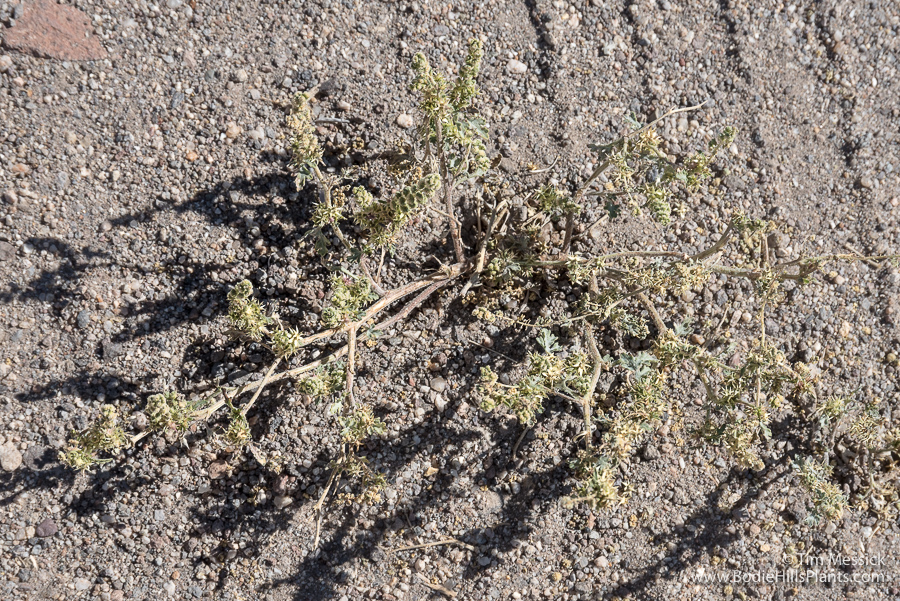
Ambrosia acanthicarpa, annual bur-weed or annual ragweed, grows on disturbed, sandy soils, often along roadsides, throughout much of western—especially southwestern—North America. The plants seen here were on a dirt road near the north edge of the Bodie Hills, in Lyon County, Nevada. I’ve also seen it beside Hwy 270 at Mormon Meadow and I’ve probably overlooked it at other locations. (Though you’re not likely to overlook it if you encounter it while wearing open-toed sandals.)

It’s not immediately obvious, but Ambrosia is a composite—in the sunflower family (Asteraceae). There are more than 40 species of Ambrosia in the New World, mostly in western North America. Ambrosia now includes plants formerly placed in Hymenoclea and Franseria.

Ambrosia

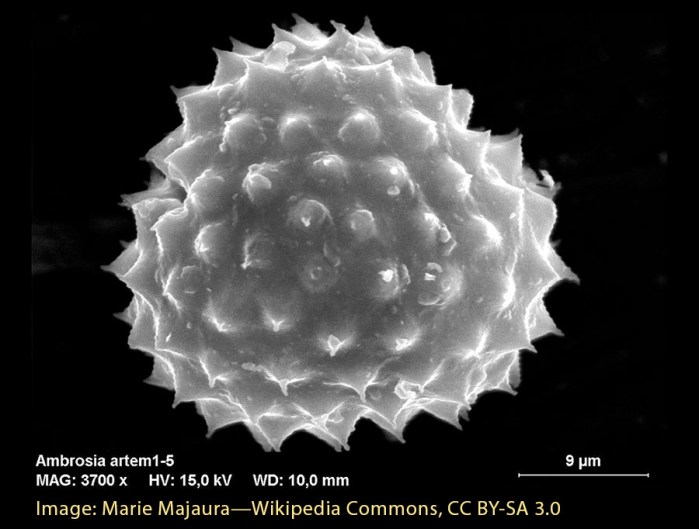
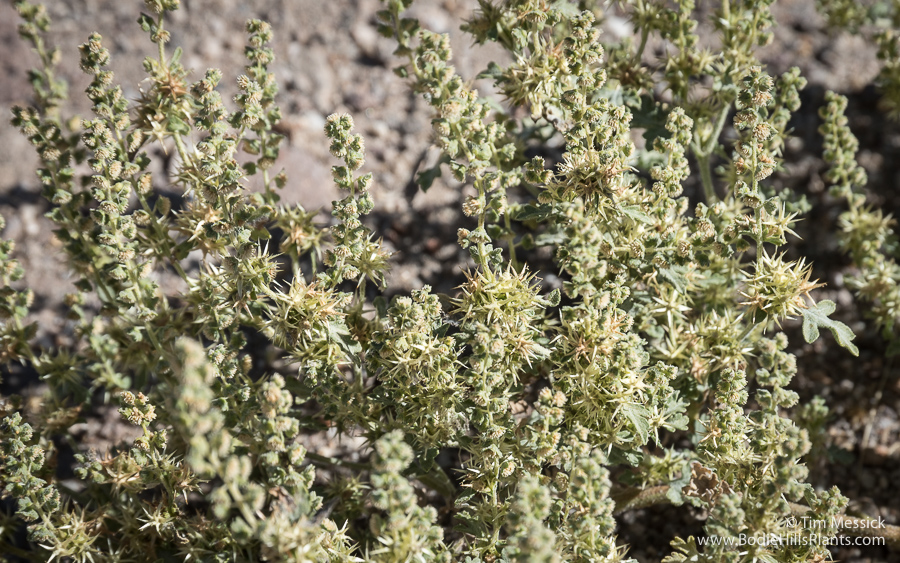
Despite its vicious demeanor, Ambrosia has an intriguing anatomy. The male flowers, bulging with stamens, are tightly clustered into numerous small heads, dangling along the axis of a tall raceme. The pollen shed from those anthers causes agonizing irritation of eyes and sinuses in anyone getting a face-full of the stuff. Magnified, the pollen grains look like lethal medieval weapons.

ambrosia_artem-wikipedia

While the male flowers will insult your eyes and upper respiratory system, it is the female flowers that will draw blood from your toes and fingers. Pistillate flowers are in the axils of leaves below the staminate inflorescence—the better to catch those heavily armed pollen grains. They lack corollas and are encased, usually one at a time, in a long-spined “bur.” (These spines are derived from the paleas—in Asteraceae, the usually very thin, papery, scale-like or bristle-like “chaffy bracts” at the base of each flower.)  As the fruit matures, the bur becomes very hard. The spines stiffen and become very sharp.

Ambrosia

Did you notice the tire tracks in the first photo? Above you see evidence for one of this plant’s long-range dispersal mechanisms. The mature burs attach themselves freely to automobile tires. No doubt this is one reason Ambrosia acanthicarpa is fairly common along disturbed road shoulders and many lesser-used unpaved tracks throughout the American west.


Copyright © Tim Messick 2017. All rights reserved.
DOWNLOAD THE CHECKLIST
The Checklist: New 2017 Edition

I’ve made some corrections and additions to Plants of the Bodie Hills: an Annotated Checklist, based on some fieldwork and other research during 2016. CLICK HERE to visit the Downloads page. The January 2017 edition of the checklist is a 47-page, 5.1 mb PDF file. [UPDATE, January 16: A few more typos corrected. You may want to download again if you downloaded prior to 1-16-2017.]

Checklist Cover 2017

The Bodie Hills encompass about 417 square miles in northern Mono County, California, western Mineral County, Nevada, and southern-most Lyon County, Nevada. The checklist includes 679 taxa of vascular plants, of which 575 are definitely known to occur in the Bodie Hills and 104 others are considered likely to be present. The list includes 52 families of dicots, 15 families of monocots, and 8 families of vascular cryptogams.

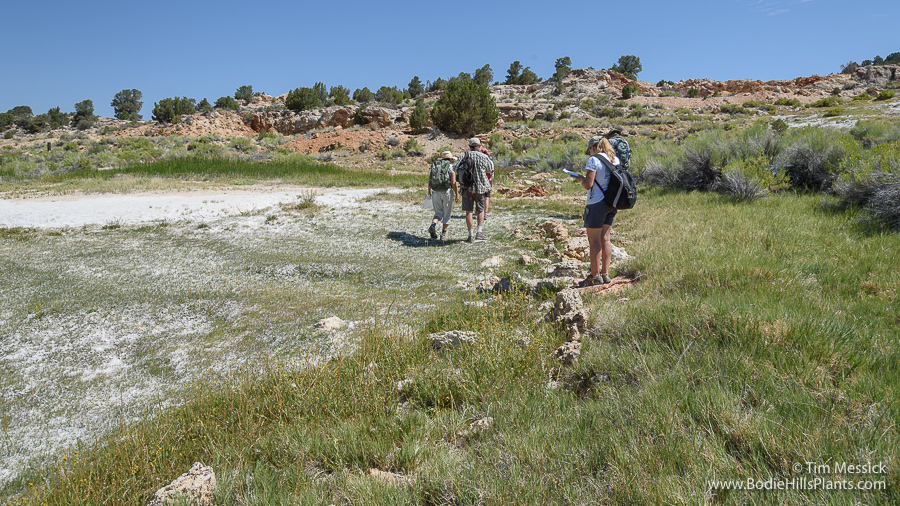
Travertine Hot Springs

Travertine Hot Springs has extensive alkaline wet meadows and dry outcrops.

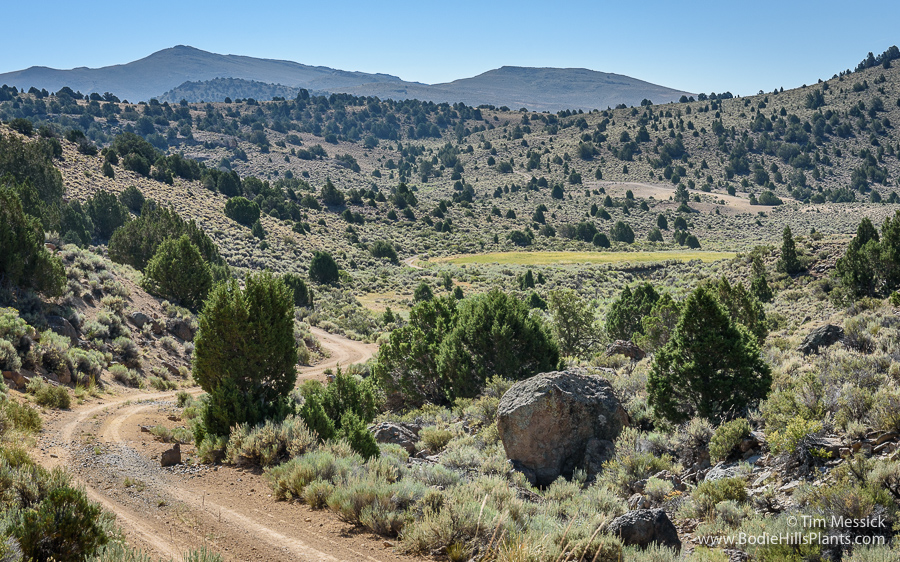
Cinnabar Canyon

Cinnabar Canyon contains pinyon-juniper woodland and an unusual wet meadow.

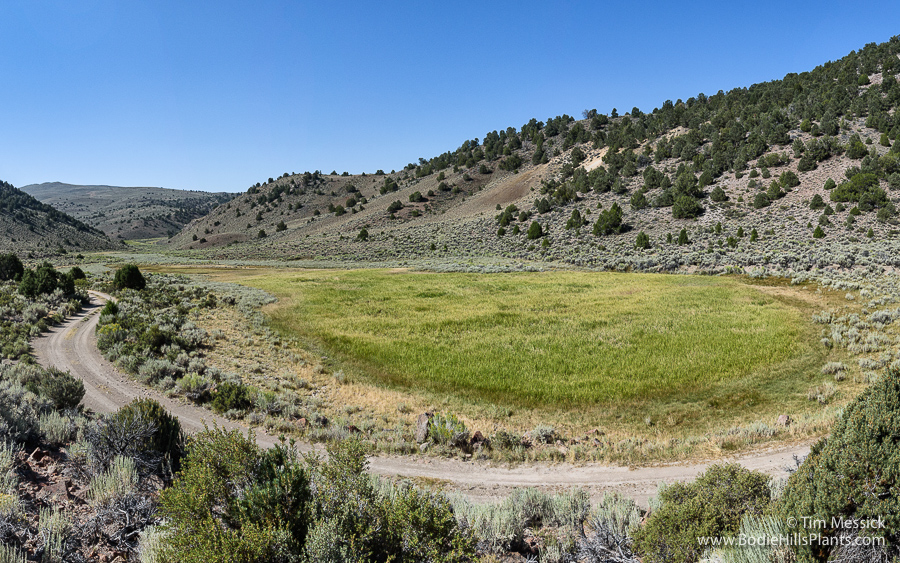
Bodie Mountain

Bodie Mountain supports high-altitude sagebrush scrub with lots of
cushion plants and several alpine species.

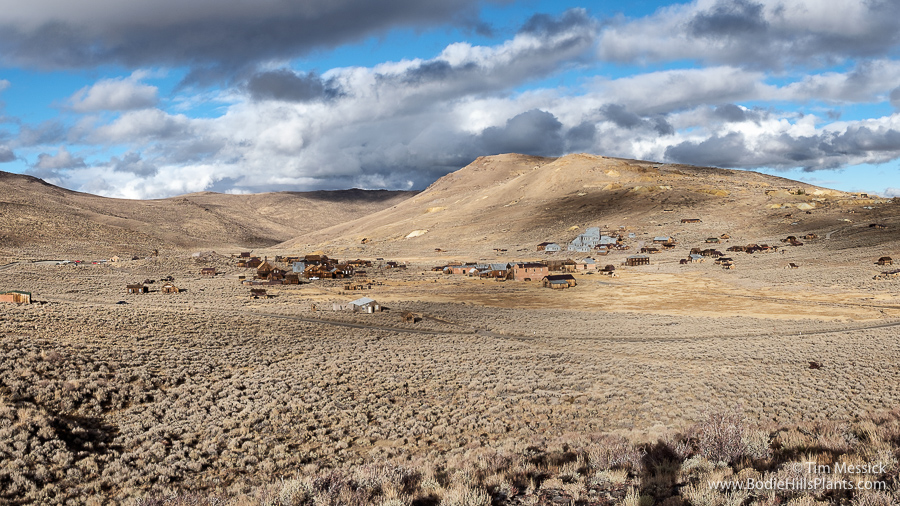
Bodie

Bodie is in the south-central Bodie Hills.


Copyright © Tim Messick 2017. All rights reserved.
DOWNLOAD THE CHECKLIST
Buffalo Berries and Russian Olives: Elaeagnaceae in the Bodie Hills

Elaeagnus

Russian olive (Eleagnus angustifolia) along the road from Fletcher to Aurora.

The Oleaster family, Elaeagnaceae (ee-lee-ag-NAY-see-ee) may be one of the less familiar plant families in eastern California and western Nevada, but the two species we find here are easily recognized and ecologically interesting. Both are large shrubs or small trees with silvery-green leaves and thorny branches. Both are riparian plants — found along streams and rivers. But one is a native plant; the other is an alien.

Shepherdia

Silver buffalo berry (Shepherdia argentea) thicket near
Cottonwood Creek at Dobie Meadows Road.

Silver buffalo berry (Shepherdia argentia) is native to the Bodie Hills and occurs from the western Transverse Ranges (north of Ventura) to the Rocky Mountains and upper midwest, as far as Wisconsin and Manitoba. In the Bodie Hills, Shepherdia argentia is common along the East Walker River and lower Bodie Creek, and is scattered along many other creeks and at some springs. Silver buffalo berry can be recognized by its opposite leaves and branchlets, ovate to oblong leaves less than 2.5 inches long, and in in late summer, by it’s bright red, berry-like fruits. Two other species are native to North America: Shepherdia canadensis (Rocky Mountains to Pacific Northwest, across Canada and northernmost counties of the U.S.) and S. rotundifolia (in Utah and Arizona) .

Shepherdia

Opposite leaves and branching in Shepherdia argentea.

Shepherdia

Foliage of Shepherdia argentea.

Shepherdia

Foliage of Shepherdia argentea.

Elaeagnus

Russian olive along the road from Fletcher to Aurora.

Russian olive (Eleagnus angustifolia) (ee-lee-AG-nus) can be recognized by its alternate, oblong to lanceolate leaves (generally longer and narrower than in buffalo berry), 4-lobed yellow flowers, and greenish-yellow, elliptic, olive-like fruits. Russian olive is native to most of western Asia (including parts of Russia), parts of tropical Asia, and southeastern Europe. It was cultivated in Europe as early as the 1630s. Russian olive was introduced to the central and western United States in the late 1800s as an ornamental tree and a windbreak, after which it spread into the wild.

Animals ate the fruits and dispersed the seeds. The plant tolerates drought and salinity, heat and shade, and a wide variety of soils, though it favors floodplains and riparian areas. Today it is naturalized across the American west and mid-west, several eastern states, and southern Canada. In the Bodie Hills, it’s mostly scattered along the lower part of Bodie Creek, the road from Fletcher to Aurora, and the East Walker River.

Elaeagnus

Besides spreading naturally, Russian olive was formerly also planted for restoration of disturbed lands, wildlife forage, windbreaks, erosion control, roadway landscaping, and ornamental use. It is no longer recommended for any of these uses and it’s considered a noxious weed in many areas. Although many birds and mammals eat the fruits, numerous sources suggest that native vegetation supports a greater diversity of wildlife than vegetation dominated by Russian olive. (Once again, Nature seems to do things better with less intervention from us.)

Elaeagnus

Cattle find a little shade under a Russian olive in July.


Copyright © Tim Messick 2016. All rights reserved.
DOWNLOAD THE CHECKLIST