Category Archives: Plant Identification

Buffalo Berries and Russian Olives: Elaeagnaceae in the Bodie Hills

Elaeagnus

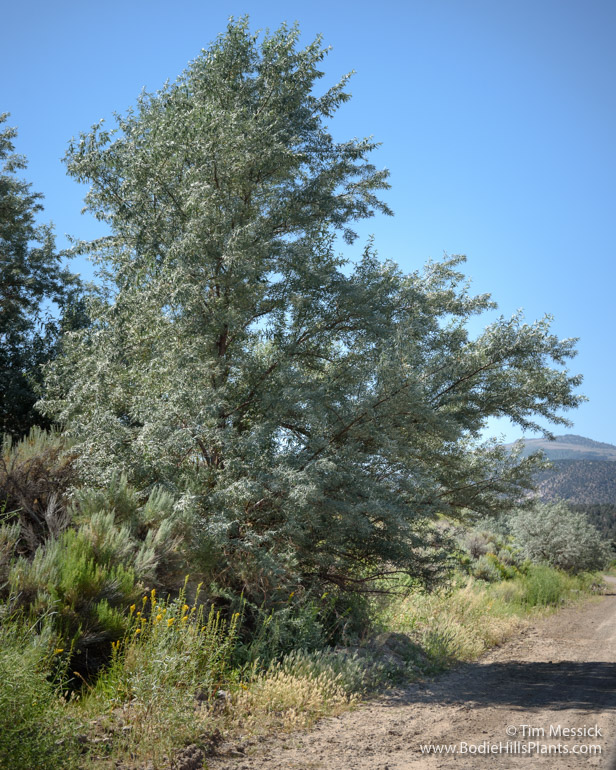
Russian olive (Eleagnus angustifolia) along the road from Fletcher to Aurora.

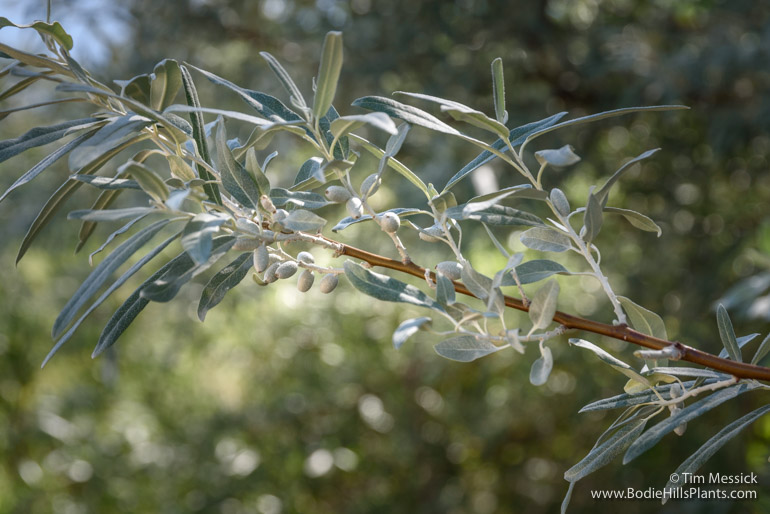
The Oleaster family, Elaeagnaceae (ee-lee-ag-NAY-see-ee) may be one of the less familiar plant families in eastern California and western Nevada, but the two species we find here are easily recognized and ecologically interesting. Both are large shrubs or small trees with silvery-green leaves and thorny branches. Both are riparian plants — found along streams and rivers. But one is a native plant; the other is an alien.
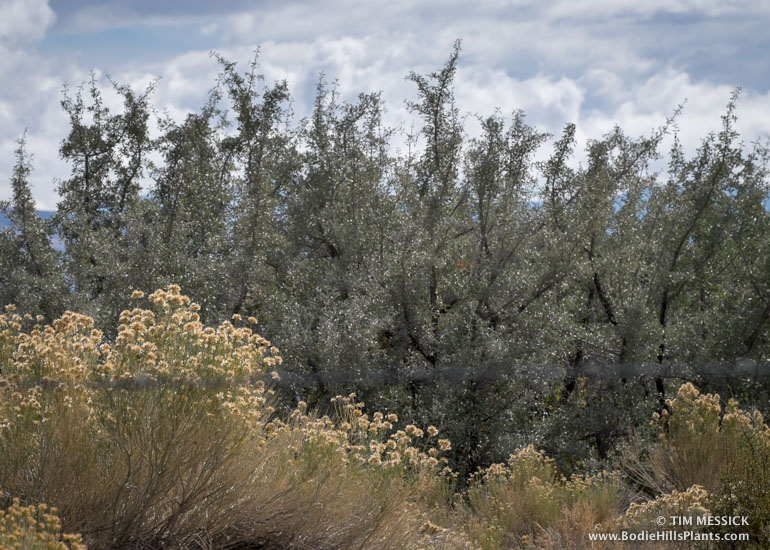
Shepherdia

Silver buffalo berry (Shepherdia argentea) thicket near
Cottonwood Creek at Dobie Meadows Road.

Silver buffalo berry (Shepherdia argentia) is native to the Bodie Hills and occurs from the western Transverse Ranges (north of Ventura) to the Rocky Mountains and upper midwest, as far as Wisconsin and Manitoba. In the Bodie Hills, Shepherdia argentia is common along the East Walker River and lower Bodie Creek, and is scattered along many other creeks and at some springs. Silver buffalo berry can be recognized by its opposite leaves and branchlets, ovate to oblong leaves less than 2.5 inches long, and in in late summer, by it’s bright red, berry-like fruits. Two other species are native to North America: Shepherdia canadensis (Rocky Mountains to Pacific Northwest, across Canada and northernmost counties of the U.S.) and S. rotundifolia (in Utah and Arizona) .
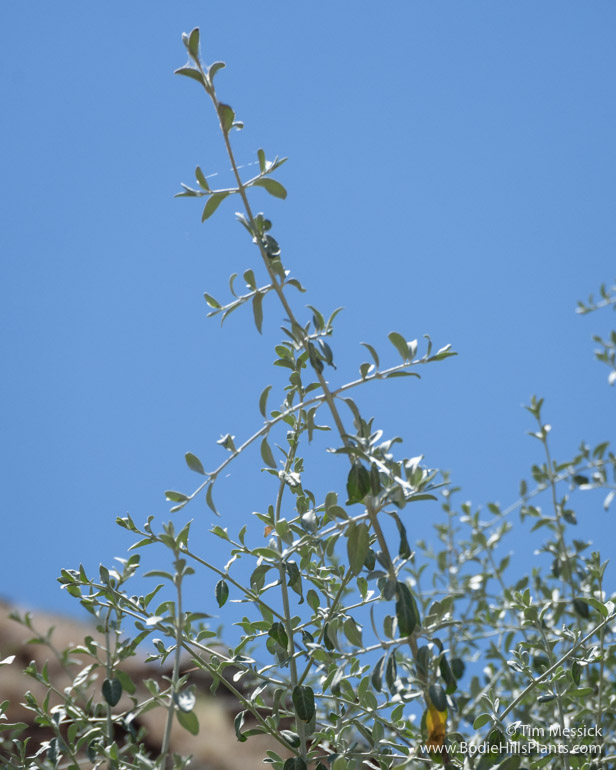
Shepherdia

Opposite leaves and branching in Shepherdia argentea.
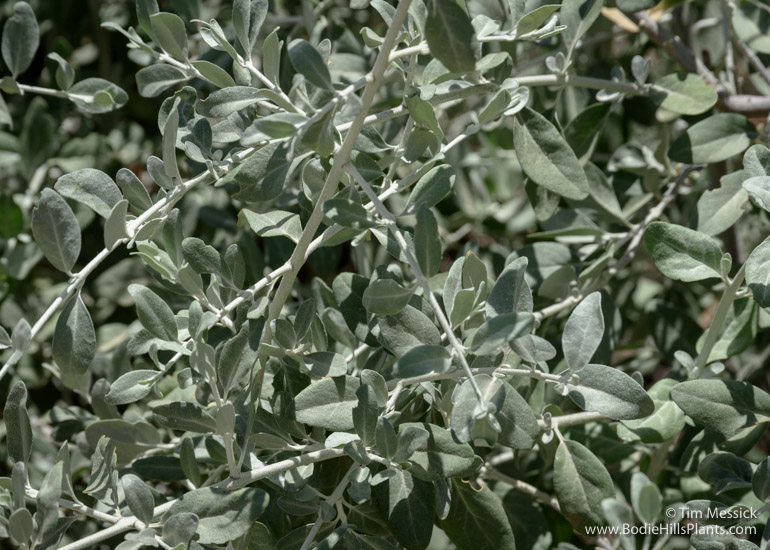
Shepherdia

Foliage of Shepherdia argentea.

Shepherdia

Foliage of Shepherdia argentea.

Elaeagnus

Russian olive along the road from Fletcher to Aurora.

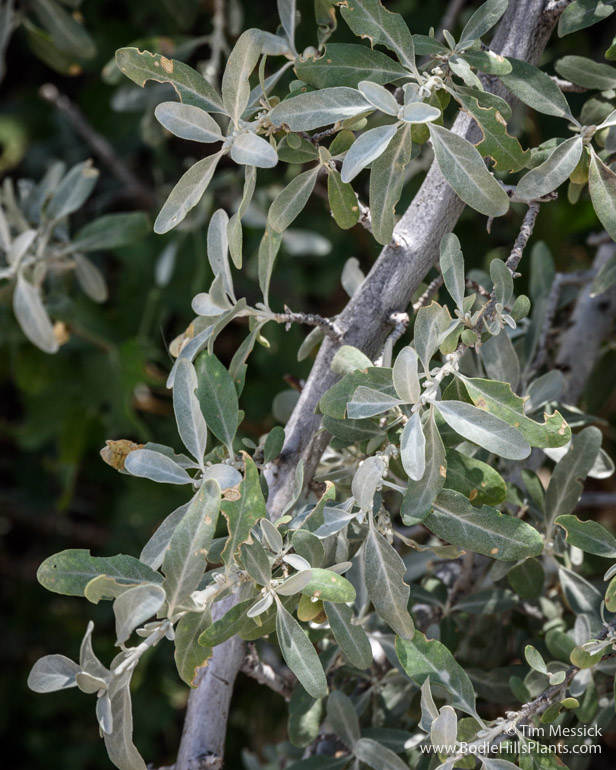
Russian olive (Eleagnus angustifolia) (ee-lee-AG-nus) can be recognized by its alternate, oblong to lanceolate leaves (generally longer and narrower than in buffalo berry), 4-lobed yellow flowers, and greenish-yellow, elliptic, olive-like fruits. Russian olive is native to most of western Asia (including parts of Russia), parts of tropical Asia, and southeastern Europe. It was cultivated in Europe as early as the 1630s. Russian olive was introduced to the central and western United States in the late 1800s as an ornamental tree and a windbreak, after which it spread into the wild.

Animals ate the fruits and dispersed the seeds. The plant tolerates drought and salinity, heat and shade, and a wide variety of soils, though it favors floodplains and riparian areas. Today it is naturalized across the American west and mid-west, several eastern states, and southern Canada. In the Bodie Hills, it’s mostly scattered along the lower part of Bodie Creek, the road from Fletcher to Aurora, and the East Walker River.
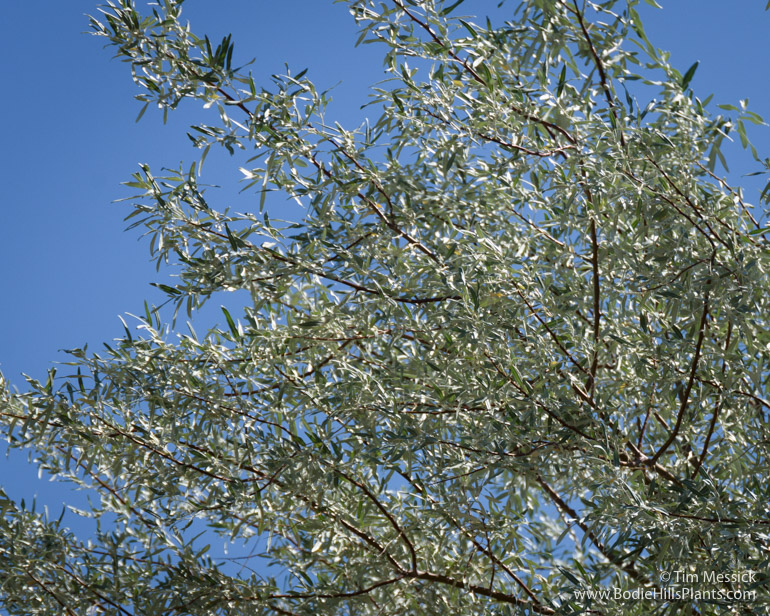
Elaeagnus

Besides spreading naturally, Russian olive was formerly also planted for restoration of disturbed lands, wildlife forage, windbreaks, erosion control, roadway landscaping, and ornamental use. It is no longer recommended for any of these uses and it’s considered a noxious weed in many areas. Although many birds and mammals eat the fruits, numerous sources suggest that native vegetation supports a greater diversity of wildlife than vegetation dominated by Russian olive. (Once again, Nature seems to do things better with less intervention from us.)
Elaeagnus

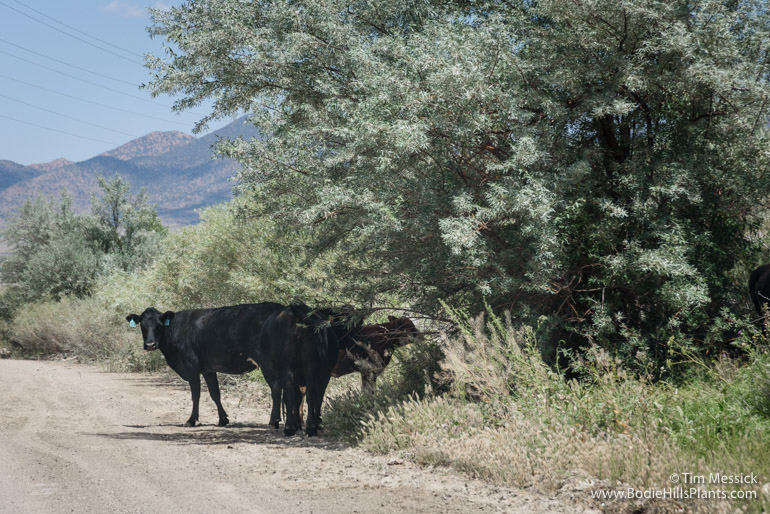
Cattle find a little shade under a Russian olive in July.


Copyright © Tim Messick 2016. All rights reserved.
DOWNLOAD THE CHECKLIST
Sand Rice Grass

Stipa hymenoides

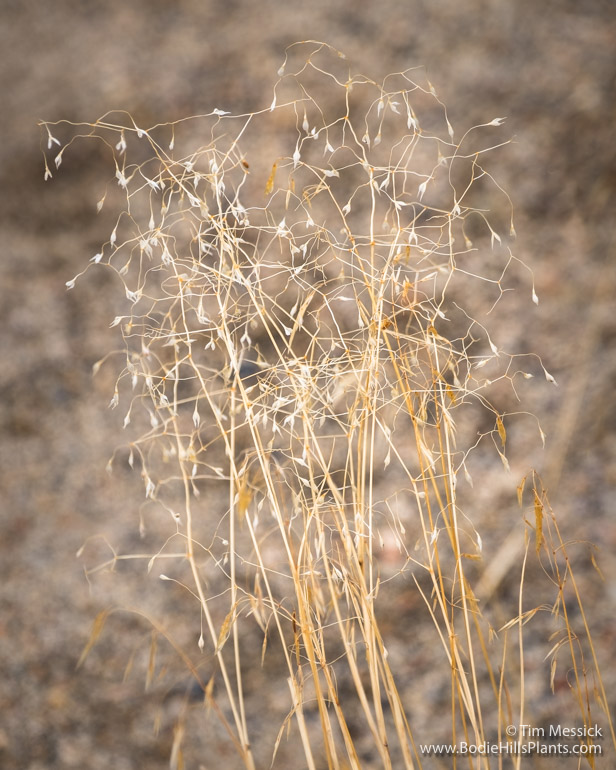
One of my favorite grasses of the Great Basin is the common and widespread sand rice grass (Stipa hymenoides). The rice grasses (or “ricegrasses”) were formerly treated in the genus Oryzopsis, which differed from the closely related needle grasses (Stipa spp.) in part by their short, generally straight and deciduous awns, rather than the mostly much longer, bent, and persistent awns of the needle grasses. Alas, Stipa and Oryzopsis were long known to hybridize promiscuously, and other morphological and developmental studies showed more similarities between the groups, so (to oversimplify the taxonomic story) Oryzopsis was lumped into Stipa. But in common parlance, the shorter-awned taxa are still “rice grasses” and the long-awned taxa are still “needle grasses”.

Stipa hymenoides

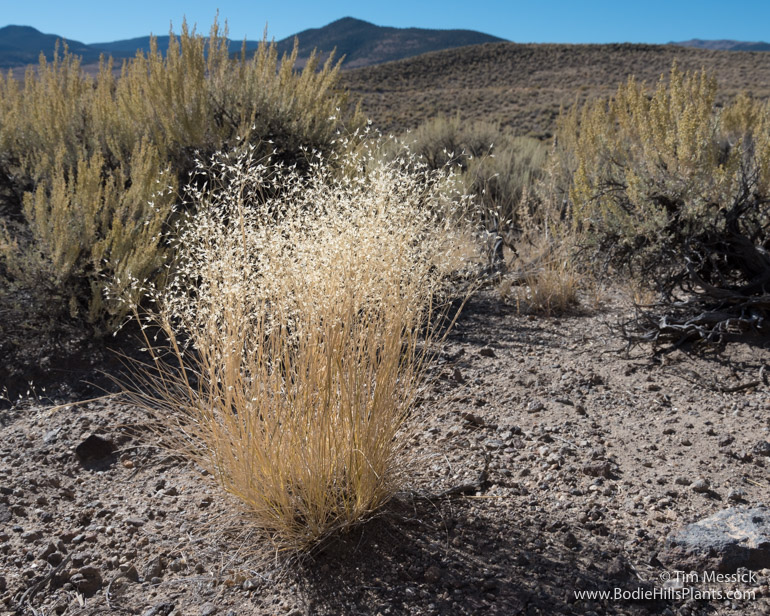
In late summer and fall, the seeds swell and push open the florets, making the plants catch the light especially well, so these bright little bunchgrasses can be seen easily from afar. The plants above, however, were right along the sandy edge of the Sweetwater-Aurora road (NF-028), west of The Elbow in Lyon County, in late September.

Stipa hymenoides

Rice grass seeds, especially those of Stipa hymenoides, are highly edible. Sand rice grass used to be called “Indian rice grass”, which is ethnologically and now also politically incorrect, but the name reflected the fact that the seeds were collected for food by Native Americans. Livestock and wildlife find the plants appealing too.

Stipa hymenoides

Sand rice grass is the official the State Grass of Utah and is planted for land reclamation, habitat improvement, and ornamental purposes. Let there be no confusion, however: “rice grass” is very different from true rice, which is also grass (Oryza spp.), but of tropical wetlands (and widely cultivated).

Stipa hymenoides

Stipa hymenoides, last October, at Lee Vining.


Copyright © Tim Messick 2016. All rights reserved.
DOWNLOAD THE CHECKLIST

The Center of Diversity for Boechera

Did you know that Mono County is home to more species of Boechera (“rock-cress,” in the mustard family) than any other county in the United States?

Boechera retrofracta

Boechera puberula north of Masonic.

Neither did I, until I ran across a web page with 103 maps showing the number of species per county for the “Largest Genera in Continental North America”. This analysis is part of the Biota of North America Program (BONAP) (Kartesz 2015a, 2015b). The overall distribution patterns these maps reveal are interesting, and perusing the maps for familiar genera and favorite places is also enlightening. For example:

Inyo County, CA boasts the greatest diversity of Eriogonum (55 spp.), Phacelia (43 spp.), Lupinus (40 species), Cryptantha (24 spp.), and Ericameria (24 spp.).
San Bernardino County, CA has the greatest variety of Mentselia (24 spp.), Gilia (23 spp.), and Galium (20 spp.).
Garfield County, UT has the greatest numbers of Astragalus (59 spp.), Penstemon (31 spp.), Oreocarya (16 spp.), and Cymopterus (11 spp.).
Juncus is most diverse in Plumas County, CA (33 spp.).
Castilleja is most diverse in Fresno County, CA (21 spp.).
Artemisia is most diverse in Fremont County, WY (18 spp.) and nearly as diverse in Elko  County, NV.
Calochortus is most diverse in Kern County, CA (17 spp.).
And so on. As one might expect, the larger and more physiographically diverse counties are favored to have high numbers of species for large genera in the arid western states (e.g., Inyo, San Bernardino, Nye, and Coconino Counties). Perhaps grouping some adjacent small counties together would shift the locations of some hot spots.

Boechera retrofracta

Boechera puberula up close.

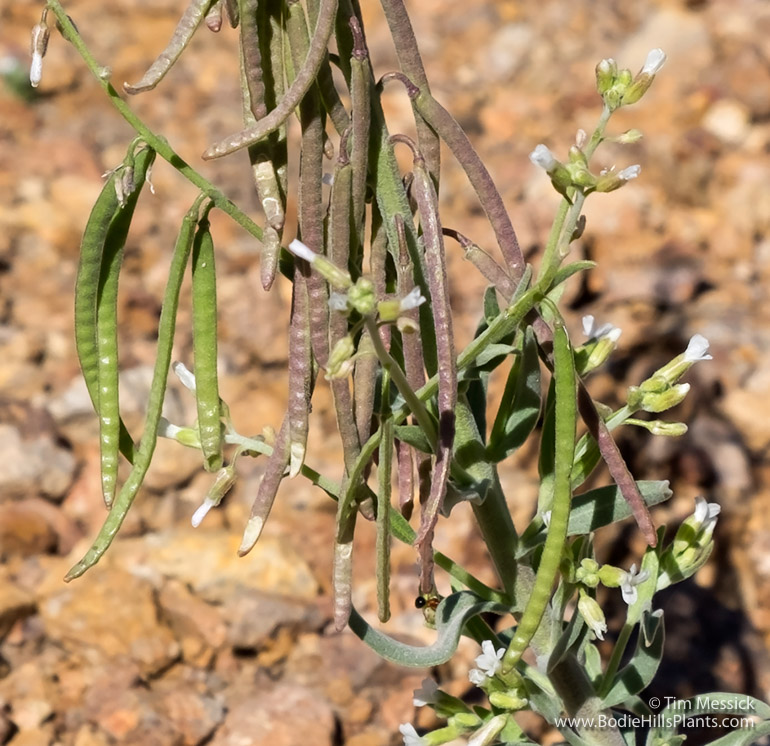
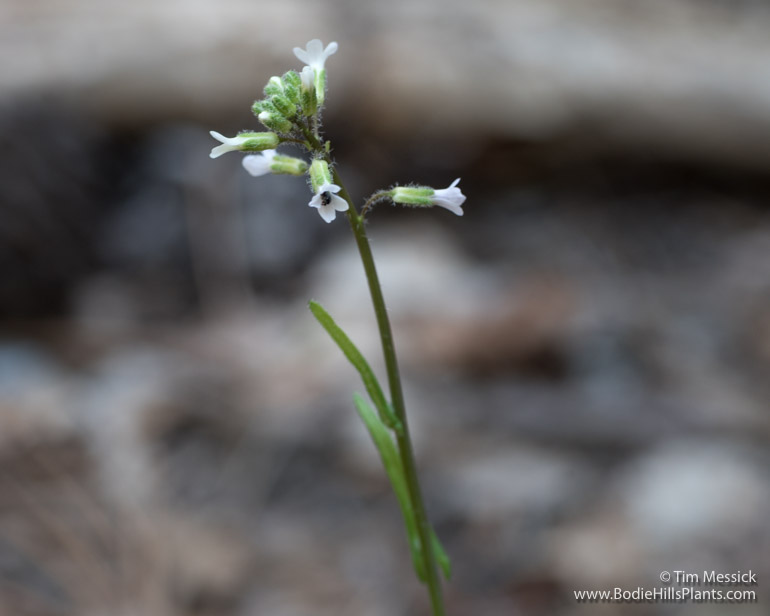
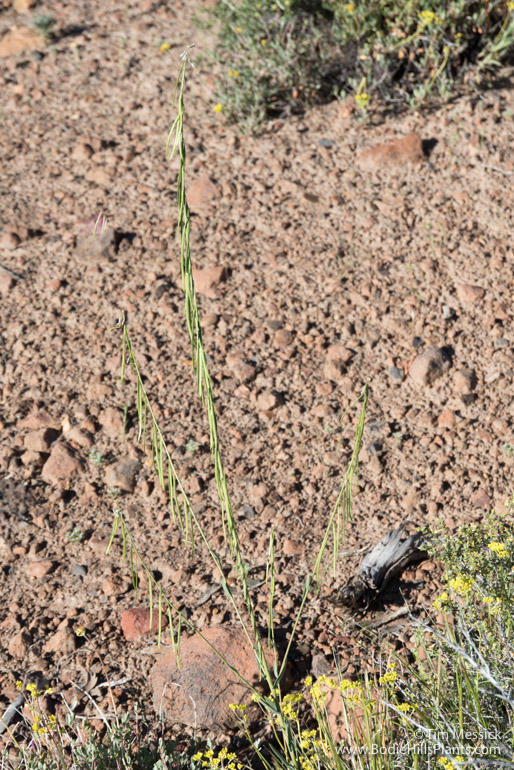
Mono County, then, is the center of diversity for Boechera, with 36 species (listed below). Sixteen of these are known or appear likely to occur in the Bodie Hills. No wonder I didn’t find them all during my field work 30-some years ago, and no wonder I gave up trying to key all my specimens and shipped them off to Reed C. Rollins (1911–1998), a professor of botany at Harvard University, and the renowned expert on many Cruciferae, including what we then called Arabis. He kindly annotated them all and shortly thereafter cited several of my specimens in describing Arabis bodiensis (now Boechera bodiensis) as a new species from material previously identified as Arabis fernaldiana var. stylosa. Rollins (1982) wrote, “Furthermore, an extensive sampling of Arabis populations of the Bodie Hills by Tim Messick has shown that what we name A. bodiensis below is consistent in its characters and is present on many appropriate sites throughout the area. This adds up to the necessity of recognizing the Bodie Hills material as an undescribed species.”

Boechera sp.

Boechera sp.at Grover Hot Springs in Alpine County.

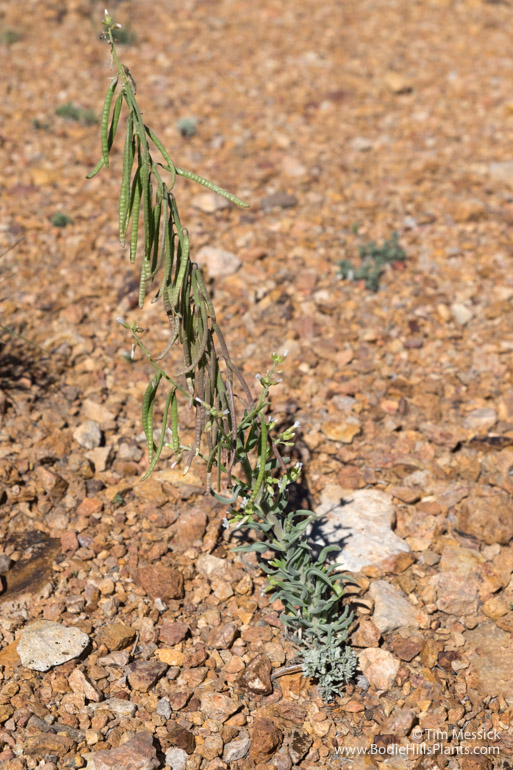
The rock cress species are fairly challenging to identify. One often needs flowers (for their color), leaves (for their shapes and trichomes or hairs), intact fruits, and mature seeds to run a specimen successfully through the keys. Most Boechera plants don’t provide all of these parts in good condition all at the same time. One may need to key the same population in both spring and summer (taking notes and photographs) to do the job well. Familiarity and practice make for easier and more reliable identifications in any large group of plants, so the key to getting good with Boechera may be to live in or near Mono County.  Or Inyo County, which has nearly as many Boechera species.

Boechera sp.

Boechera sp. at Travertine Hot Springs

And finally, the elephant in the room is of course: How does one pronounce the name Boechera?  “BOH-chera” (long O) appears likely or even obvious to most Americans, but “oe” in Latin names is always pronounced “ee” (long E), as it should be in Oenothera or Oenanthe. So is it BEE-chera? Boechera is named for Tyge W. Boecher (1909–1983), a Danish botanist, evolutionary biologist, plant ecologist, and phytogeographer. But the Danish spelling is Böcher (with an o-umlaut), and this would suggest the “oe” (or ö) should be pronounced more like the “oe” in the French words oeil (eye) and oeuvre (an artist’s collected works). This sound can’t be spelled in English, but “BUH-chera,” with a listless enunciation of the first syllable, comes close. Or maybe “BOO-chera.” Take your pick.

Boechera sp.

Boechera sp. in Bridgeport Canyon. These are not especially showy plants.

The 36 species of Boechera in Mono County (according to CalFlora) are listed below. Those known or likely to be in the Bodie Hills are followed by a “(BH)”.

  1. Boechera arcuata (BH)
  2. Boechera bodiensis (BH)
  3. Boechera cobrensis (BH)
  4. Boechera covillei
  5. Boechera davidsonii
  6. Boechera depauperata
  7. Boechera dispar
  8. Boechera divaricarpa
  9. Boechera elkoensis (BH)
  10. Boechera evadens (BH)
  11. Boechera glaucovalvula
  12. Boechera howellii
  13. Boechera inyoensis
  14. Boechera lemmonii (BH)
  15. Boechera lyallii (BH)
  16. Boechera microphylla
  17. Boechera pauciflora (BH)
  18. Boechera paupercula (BH)
  19. Boechera pendulina
  20. Boechera pendulocarpa (BH)
  21. Boechera perennans
  22. Boechera pinetorum
  23. Boechera pinzliae
  24. Boechera platysperma (BH)
  25. Boechera puberula (BH)
  26. Boechera pulchra (BH)
  27. Boechera rectissima
  28. Boechera repanda
  29. Boechera retrofracta (BH)
  30. Boechera shockleyi
  31. Boechera sparsiflora (BH)
  32. Boechera stricta (BH)
  33. Boechera suffrutescens
  34. Boechera tiehmii
  35. Boechera tularensis
  36. Boechera xylopoda

References:

Kartesz, J.T., The Biota of North America Program (BONAP). 2015a. North American Plant Atlas. (http://bonap.net/napa). Chapel Hill, N.C.

Kartesz, J.T. 2015b. Floristic Synthesis of North America, Version 1.0. Biota of North America Program (BONAP) [maps]

Rollins, Reed C. 1982. Studies on Arabis (Cruciferae) of Western North America II. Contributions from the Gray Herbarium. 212: 103-114

Boechera sp. with Puccinia rust

Boechera becomes infected with the yellow, flower-mimicing Puccinia rust. (See the Puccinia post.)


Copyright © Tim Messick 2016. All rights reserved.
DOWNLOAD THE CHECKLIST