Tag Archives: Asteraceae

Psathyrotes, Psathyrotopsis, and Trichoptilium (Oh, My!)

Recently I found myself looking closely at keys, descriptions, and photos of Psathyrotes annua (Annual turtleback) and P. ramosissima (“regular” Turtleback)—both rayless members of the Sunflower family, Asteraceae—to clear up some lingering uncertainty over how to distinguish the two. Then one taxon led to another and it became a larger project.

Psatyrotes annua is familiar to many who have wandered the perimeter of Mono Lake. It thrives in the sparsely vegetated sands and gravelly pumice of Mono’s prehistoric and post-1945 receding shorelines. It’s often misidentified as P. ramosissima, which so far, has probably not been found in the Mono Basin, but is common in the Mojave, Colorado, and western Sonoran Deserts. These two can be distinguished as follows:

  • Leaf blades generally clearly divided by deeply-set, anastomosing (cross-connecting) veins into irregular, ovate to polygonal areas (suggesting the segmented “scutes” of a turtle’s carapace); outer phyllaries ± wide, spatulate to obovate, widely spreading to reflexed; florets 21–26 (16–32) per head; pappus of 120–140 bristles in 3–4 series …… Psathyrotes ramosissima
  • Leaf blades generally weakly or not at all divided by veins into scute-like areas; outer phyllaries ± narrow, mostly lance-linear, ± erect to spreading; florets 13–16 (10–20) per head; pappus of 35–50 bristles in one series …… Psathyrotes annua
Psathyrotes ramosissima
Left: © Chloe & Trevor Van Loon/iNaturalist, Right: © Tom Chester/iNaturalist
Psathyrotes annua
Left: © Tim Messick/iNaturalist, Right: © Jim Morefield/iNaturalist

Exploring this small genus further, one finds there are currently three species in Psathyrotes, another close relative formerly in Psathyrotes now banished to Trichoptilium—a monotypic (one species) genus—and three more close relatives housed in Psathyrotopsis, a newer genus carved out of Psathyrotes.

Apparently no single key has been crafted that includes all 7 species of Psathyrotes, Trichoptilium, and Psathyrotopsis. The Jepson eFlora includes two Psathyrotes and the Trichoptilium. The Flora of North America (FNA) includes all three Psathyrotes, the Trichoptilium and one species of Psathyrotopsis, but not the other two, which appear to be narrow endemics in southern Coahuila, Mexico. Both Jepson and FNA make you work through ponderous keys for the entire sunflower family to distinguish these three genera. A paper on “Taxonomy of Psathyrotes” (Strother and Pilz 1975) includes a key to all of the taxa included in FNA, but not the third Psathyrotopsis, because it was described later (Turner 1993).

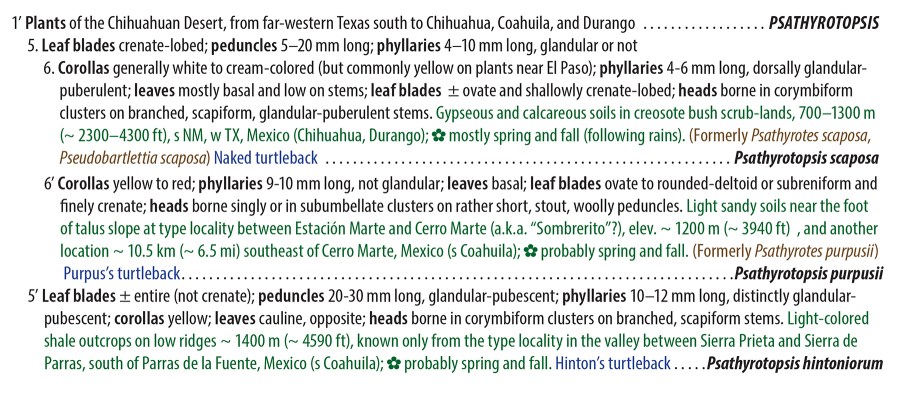
So, why not write a straightforward key that includes all seven taxa? Not so simple, it turns out, because existing keys don’t all use the same set of characters, and that newest species endemic to southern Coahuila (Psathyrotopsis hintoniorum) has never been included in a key with its relatives—and the paper describing it refers the reader to the formal description in Latin to figure out what distinguishes it from Psathyrotopsis purpusii. Thank goodness for Google Translate!

Below is an image of my key. (The very limited text formatting abilities in this WordPress blog don’t lend themselves to an indented key longer than 1 or 2 couplets.) The key is adapted from Baldwin 2012, Strother 2006a, Strother 2006b, Strother and Pilz 1975, and Turner 1973 (citations below). It has been modified from the originals by adding species, changing some terminology, rearranging some couplets, and adding some character states.

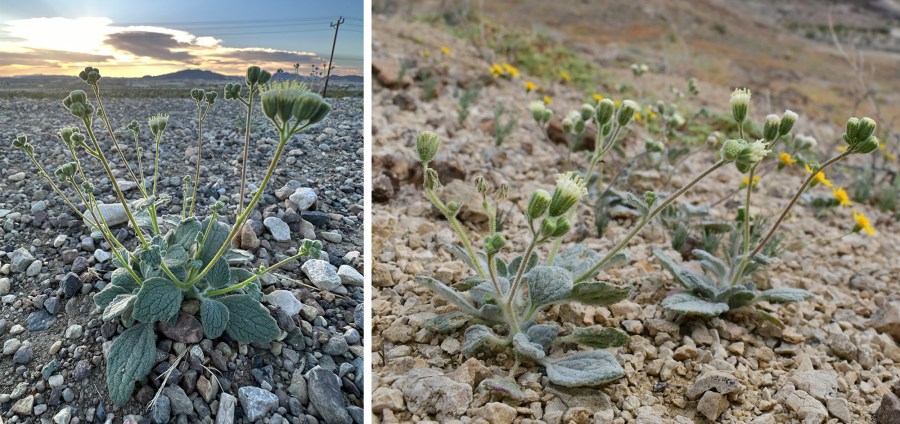
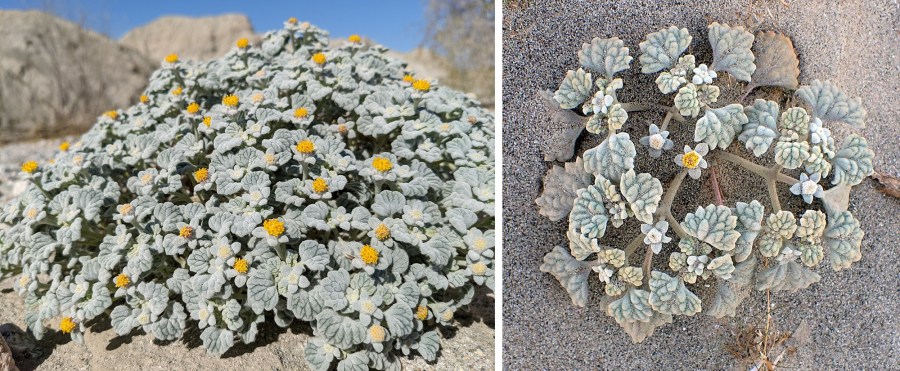
Here are photos of the rest of the species in Psathyrotes, Psathyrotopsis, and Trichoptilium (thank you to the iNaturalist contributors who allow their images to be used non-commercially!)

Psathyrotes pilifera Both: © slothiker/iNaturalist
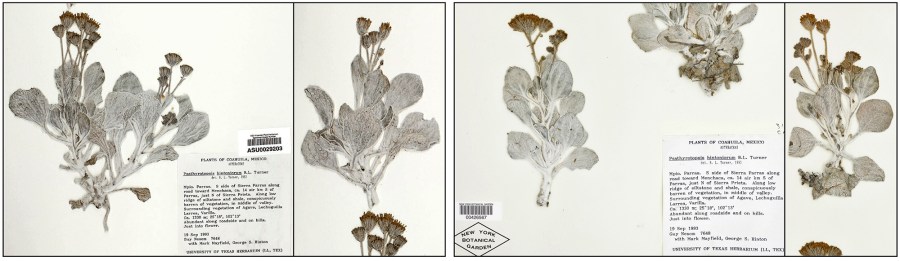
Psathyrotyopsis hintoniorum
Left: © Arizona State University, Right: © New York Botanical Garden
(both are duplicate sheets of Guy Nesom 7648)
Psathyrotopsis purpusii Both: © José G. Flores Ventura/iNaturalist
Psathyrotopsis scaposa
Left: © Matt Reala/iNaturalist, Right: © Joey Santore/iNaturalist
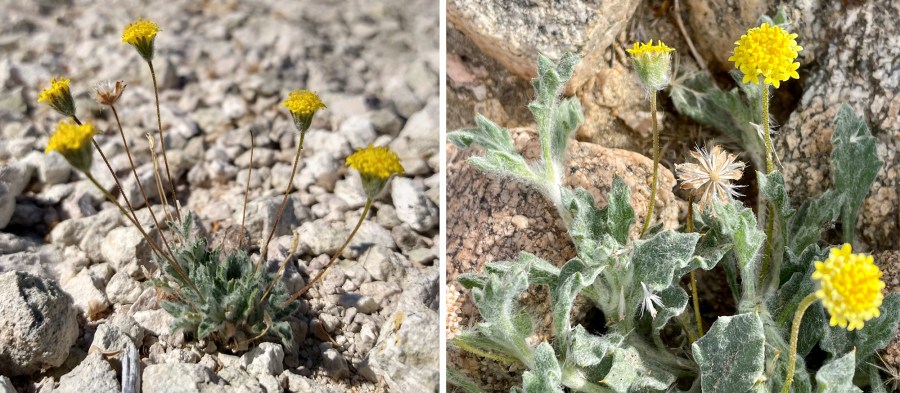
Trichoptilium incisum
Left: © Jessica Irwin/iNaturalist, Right: © Irene/iNaturalist

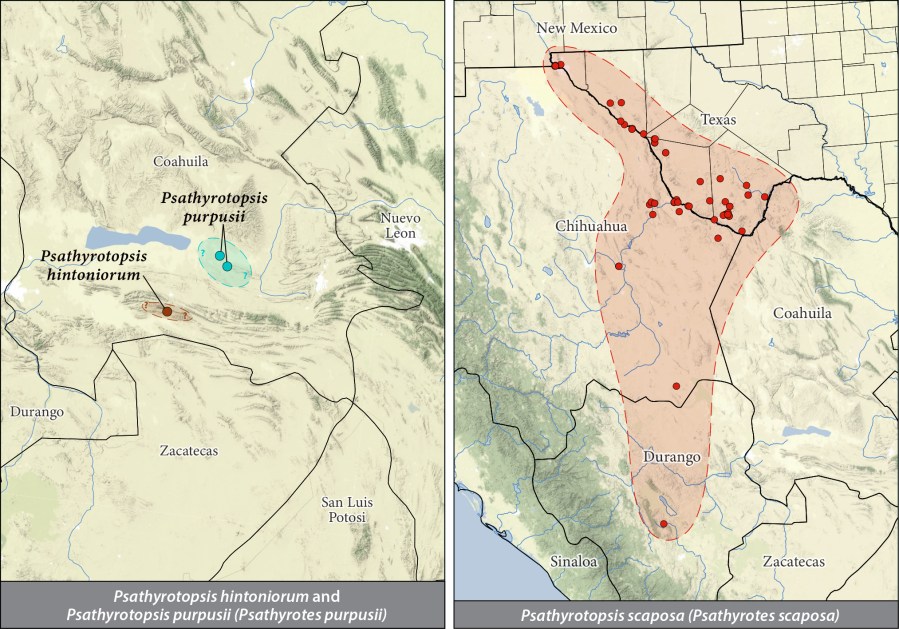
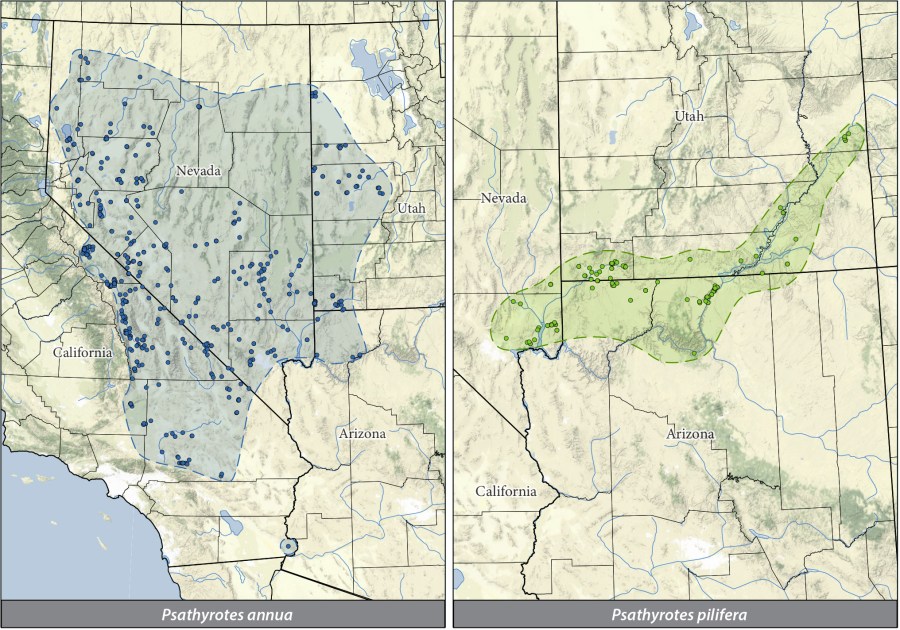
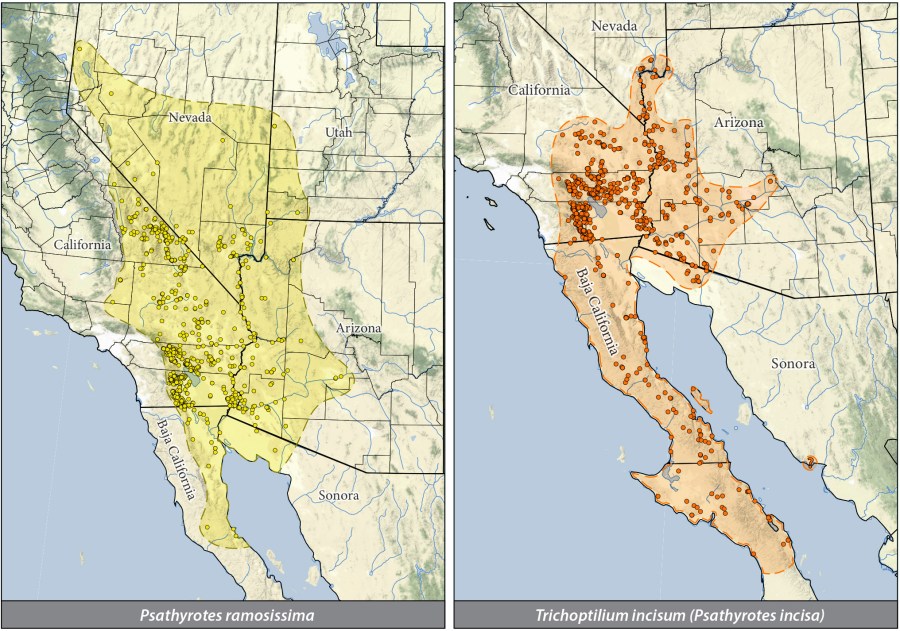
And here are maps showing the known distribution of each species, produced (by me) using QGIS and Adobe Illustrator, based on occurrence data (the dots) from specimen locations served by the SEINet Portal Network and “Research Grade” observations from iNaturalist (note: some dots could be mismapped or misidentifications). Colored shading shows the approximate generalized distribution of each taxon.
References:
Baldwin, Bruce G. 2012. adapted from Strother (2006), Psathyrotes, in Jepson Flora Project (eds.) Jepson eFlora, https://ucjeps.berkeley.edu/eflora/eflora_display.php?tid=571, accessed on November 28, 2022.
Strother, John L., 2006a. Psathyrotes in Flora of North America 21:416–418 (http://www.efloras.org/florataxon.aspx?flora_id=1&taxon_id=126897), accessed on November 28, 2022
Strother, John L., 2006b. Psathyrotopsis in Flora of North America 21:364–365 (http://www.efloras.org/florataxon.aspx?flora_id=1&taxon_id=126898), accessed on November 28, 2022.
Strother, John L and George Pilz. 1975. “TAXONOMY OF PSATHYROTES (COMPOSITAE: SENECIONEAE).” Madroño; a West American journal of botany 23, 24–40. https://www.biodiversitylibrary.org/partpdf/169365
Turner, B. L. 1993. “A new species of Psathyrotopsis (Asteraceae, Helenieae) from Coahuila, México.” Phytologia 75, 143–146. https://doi.org/10.5962/bhl.part.17305.


Copyright © Tim Messick 2024. All rights reserved.

Does Dune Horsebrush Occur in the Bodie Hills?

Tetradymia tetrameres isn’t normally a hill-dwelling plant. As the common name suggests, it’s found most often in deep sands and old, stabilized sand dunes (foreground and center, in the photo above). Deep sand and old dunes usually occur in valleys and basins, not hills, though sometimes deep sandy soils can be found in canyons or ravines that penetrate hilly uplands.

Dune horsebrush near the mouth of a canyon entering Adobe Valley.

In California this plant found in the north and northeastern Mono Basin, in Adobe Valley (southeast of Mono Basin), and perhaps in Deep Springs Valley (south of the White Mountains). The CNPS Inventory of Rare and Endangered Plants ranks it as “fairly endangered in California, common elsewhere” but globally it’s “apparently secure, considering populations outside California”.

Outside of California, the “global” range of dune horsebrush encompasses just a handfull of counties in northwest and central Nevada — again, mostly in “sand dunes,” “sandy desert,” “dunes of compacted sand,” “sand in and around small, rather stable dunes,” etc.

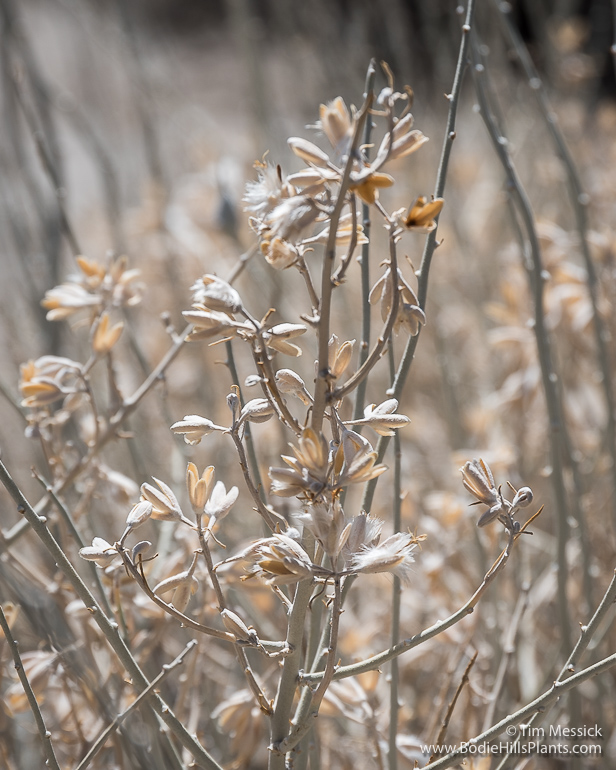
Persistent phyllaries and lingering papus bristles give dune horsebrush
a bright appearance during September and October.

But does it occur in the Bodie Hills? Well, there’s an unnumbered collection by the Mariposa-based lawyer/botanist Joseph Whipple Congdon dated Aug 17, 1898. The location is given as “Bodie. Desert road.” Berkeley Mapper places the collection site near Bodie, which is logical based on the label information, but unlikely because there are no deep sands or dunes near Bodie. Having not seen this ancient specimen (DS1815), I thought it might be misidentified, but the specimen bears no annotation labels changing the determination, and Congdon had previously collected Tetradymia canescens, again without subsequent corrections.

His other collection locations on August 17  (“Mono Lake,” and “Desert Road”) shed no further light on the location of the Tetradymia. But on the 13th he was at Mono Pass and Bloody Canyon. On the 14th he was at Walker Lake. On the 15th and 16th he was at “Walker Lake to Mono Lake,” “Below Walker Lake,” and “Near Mono Lake.” So this was the smaller Walker Lake east of Mono Pass, not the larger Walker Lake near Hawthorne in Nevada. I think he may have spent a night or two at Goat Ranch on the south edge of the Bodie Hills, because he collected there on the 18th, then on the 19th he was on his way to Bridgeport. I doubt he even went to Bodie on this trip.

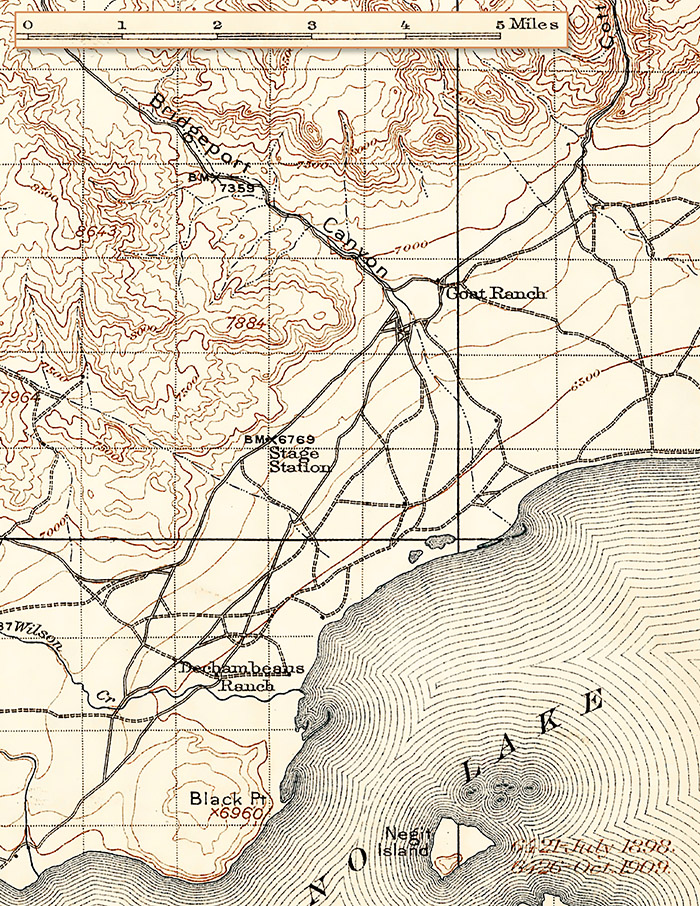
So where did Congdon collect his Tetradymia tetrameres, and was it “in the Bodie Hills”? I think he encountered it in the stabilized dunes he would have passed through if he had traveled the road from the DeChambeau Creek area, past DeChambeau Ranch (on today’s Cemetery Road) to Goat Ranch. Today, these dunes are also crossed by Highway 167, and the practiced eye will easily recognize dune horsebrush there on both sides of the highway north of Black Point. But this is clearly in the Mono Basin, not in the Bodie Hills, and some 9 to 11 air miles from the town of Bodie.

Part of the 1911 USGS 1:125,000 Bridgeport quadrangle, showing
the many roads between Black Point and Goat Ranch.

Dune horsebrush along Highway 167, north of Black Point.

There are, however, at least a few individuals of T. tetrameres actually in the Bodie Hills, just barely, along Cottonwood Canyon Road, near the mouth of Cottonwood Canyon, in sandy soil, but uncharacteristically in pinyon pine woodland. Having also seen dune horsebrush on sandy flats and slopes in a canyon of the southern Adobe Hills, at the northwest end of Adobe Valley, I would not be surprised to see more of it along the southeast edge of the Bodie Hills, where sandy deposits of the northeastern Mono Basin climb into some of the little valleys and canyons west and northeast of Cedar Hill.

Dune horsebrush in marginal habitat at the edge of the Bodie Hills.

Dune horsebrush has a very limited range in California. It has a wider range in Nevada, but is still endemic to the western and central Great Basin. It is easily overlooked and partial to remote, dry, dusty places, so I think a lot more of it could be found with some deliberate searching.

•     •     •

Speaking of “horsebrushes,” what other Tetradymia species occur in the Bodie Hills? Tetradymia canescens, “gray horsebrush,” is common (but rarely if ever abundant) on dry slopes among sagebrush through much of the range. Tetradymia glabrata, “little leaf horsebrush,” was collected somewhere on Rough Creek by Clare Hardham in 1969, and near lower Cottonwood Canyon by Frank Vasek in 1975. I’ve seen it on a low ridge at the west end of Fletcher Valley. Tetradymia spinosa, the (visiously) “spiny horsebrush,” is found in the northern and eastern foothills of the Bodie Hills. Tetradymia axillaris, the longer-spined “cotton-thorn” or “longspine horsebrush” has been collected in northern Owens Valley (Mono Co.), north of Yerington (Lyon Co.), and north of Luning (Mineral Co.), but probably isn’t in the Bodie Hills.

Tetradymia canescens

Tetradymia spinosa


Copyright © Tim Messick 2017. All rights reserved.
DOWNLOAD THE CHECKLIST

Food of the Gods in the Bodie Hills

How can a scrawny plant, growing in disturbed soils, with painfully sharp spines all over its fruits come to be named  for the mythical “food of the Greek gods”—Ambrosia—a name also related, apparently, to the Greek word for immortality, αθανασία (athanasia)? Carl Linnaeus himself, the “father of modern taxonomy,” bestowed the name in 1754. But why Ambrosia? I haven’t found an explanation. The authoritative Flora North America says “allusion unclear.” One might say it’s a crusty old botanist’s joke on posterity, but I won’t impugn the intentions of the great Linnaeus. The genus isn’t native to Sweden and he may have examined only a few specimens from North America (collected by others). Maybe they smelled nice, but he probably didn’t get to know the genus well enough.

Ambrosia

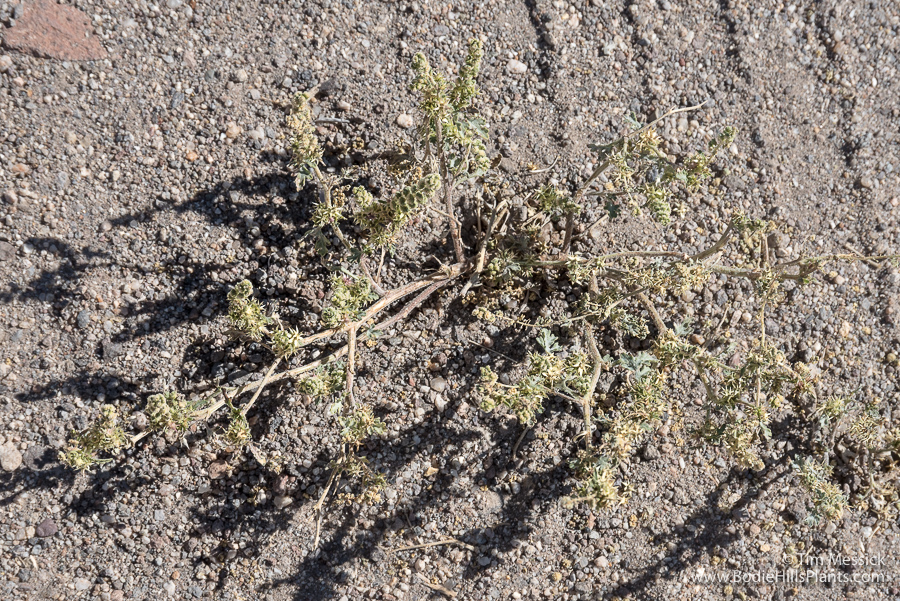
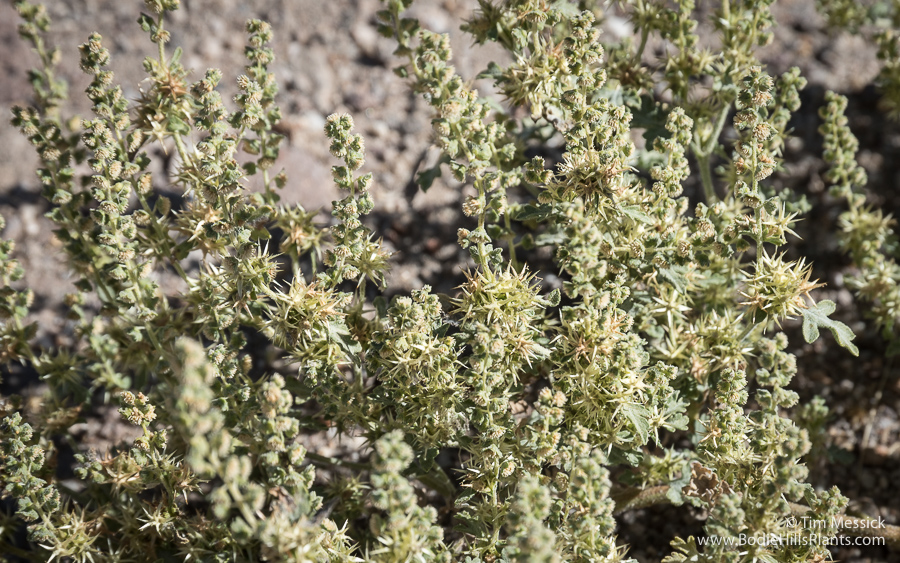
Ambrosia acanthicarpa, annual bur-weed or annual ragweed, grows on disturbed, sandy soils, often along roadsides, throughout much of western—especially southwestern—North America. The plants seen here were on a dirt road near the north edge of the Bodie Hills, in Lyon County, Nevada. I’ve also seen it beside Hwy 270 at Mormon Meadow and I’ve probably overlooked it at other locations. (Though you’re not likely to overlook it if you encounter it while wearing open-toed sandals.)

It’s not immediately obvious, but Ambrosia is a composite—in the sunflower family (Asteraceae). There are more than 40 species of Ambrosia in the New World, mostly in western North America. Ambrosia now includes plants formerly placed in Hymenoclea and Franseria.

Ambrosia

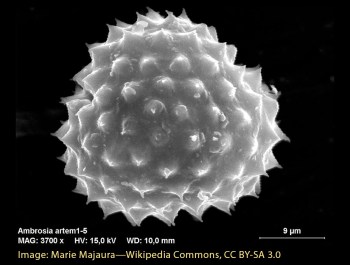
Despite its vicious demeanor, Ambrosia has an intriguing anatomy. The male flowers, bulging with stamens, are tightly clustered into numerous small heads, dangling along the axis of a tall raceme. The pollen shed from those anthers causes agonizing irritation of eyes and sinuses in anyone getting a face-full of the stuff. Magnified, the pollen grains look like lethal medieval weapons.

ambrosia_artem-wikipedia

While the male flowers will insult your eyes and upper respiratory system, it is the female flowers that will draw blood from your toes and fingers. Pistillate flowers are in the axils of leaves below the staminate inflorescence—the better to catch those heavily armed pollen grains. They lack corollas and are encased, usually one at a time, in a long-spined “bur.” (These spines are derived from the paleas—in Asteraceae, the usually very thin, papery, scale-like or bristle-like “chaffy bracts” at the base of each flower.)  As the fruit matures, the bur becomes very hard. The spines stiffen and become very sharp.

Ambrosia

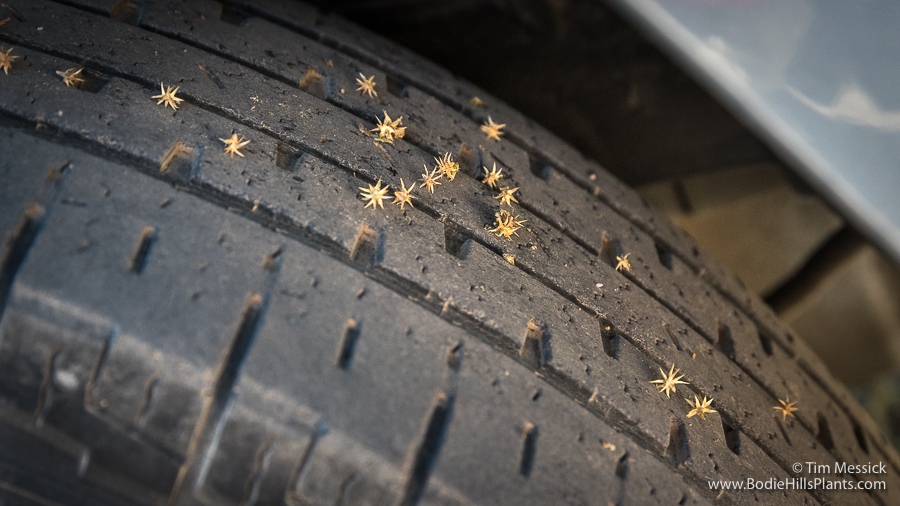
Did you notice the tire tracks in the first photo? Above you see evidence for one of this plant’s long-range dispersal mechanisms. The mature burs attach themselves freely to automobile tires. No doubt this is one reason Ambrosia acanthicarpa is fairly common along disturbed road shoulders and many lesser-used unpaved tracks throughout the American west.


Copyright © Tim Messick 2017. All rights reserved.
DOWNLOAD THE CHECKLIST